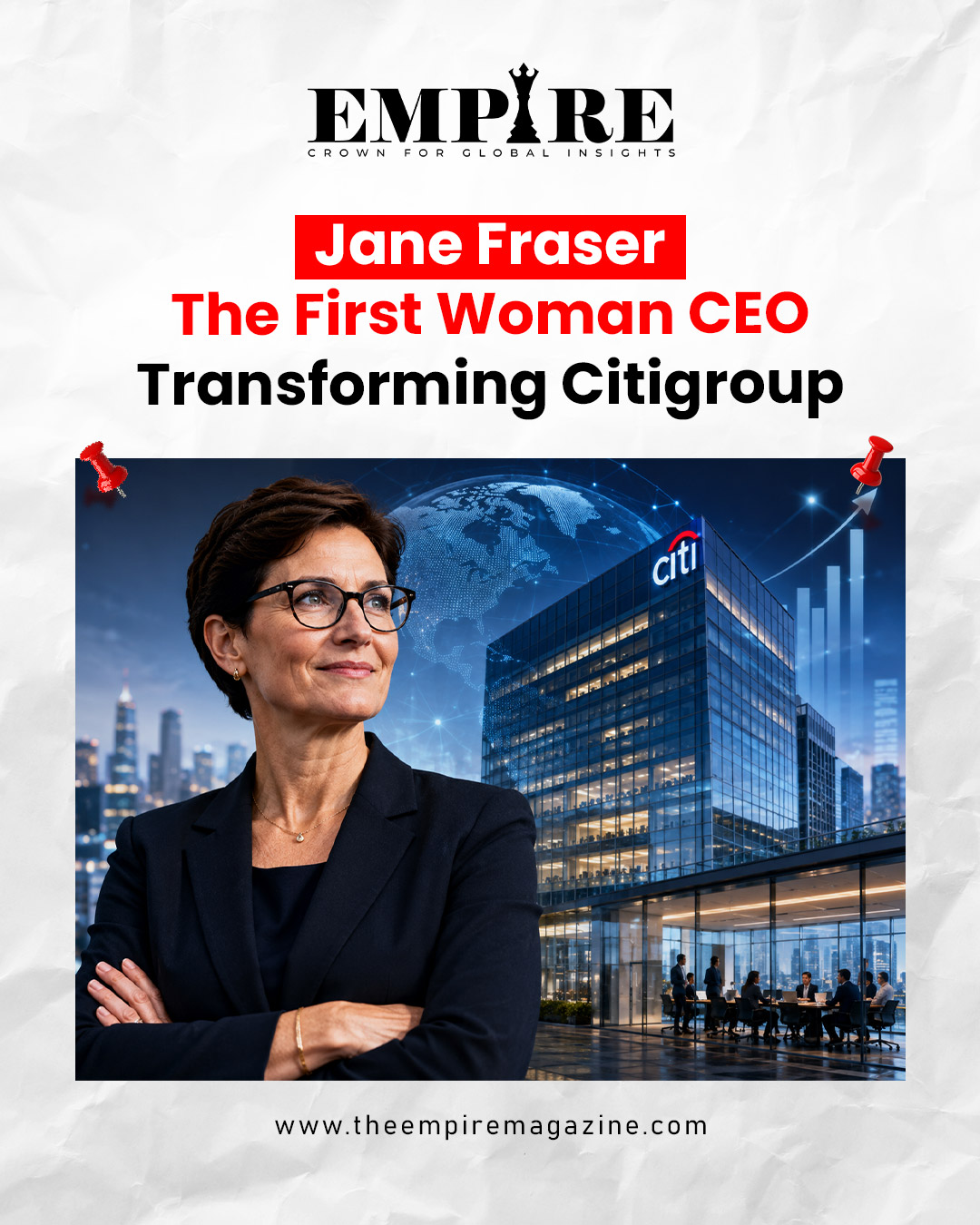
When Jane Fraser became Chief Executive Officer of Citigroup in March 2021, she achieved something no woman had before—leading a major Wall Street bank. But her appointment represented far more than a historic milestone. She inherited one of the world’s largest financial institutions at a time when it faced regulatory scrutiny, outdated technology, operational inefficiencies, and declining investor confidence.
Five years later, Fraser’s leadership is increasingly being viewed as one of the banking industry’s most ambitious transformation stories. Rather than pursuing headline-making acquisitions, she has focused on simplifying Citi’s sprawling operations, modernizing technology, strengthening risk management, and preparing the bank for an AI-driven financial future. Those efforts have started translating into stronger financial performance and renewed investor confidence.
Her journey illustrates how strategic discipline, long-term thinking, and cultural change can reshape even the most complex global organizations.
Breaking Wall Street’s Glass Ceiling
For decades, leadership at America’s largest investment banks remained overwhelmingly male. Jane Fraser’s appointment changed that narrative.
Born in Scotland, Fraser studied economics at the University of Cambridge before earning an MBA from Harvard Business School. Prior to joining Citigroup in 2004, she spent years at McKinsey & Company, advising global corporations on strategy and organizational transformation.
Within Citi, Fraser steadily built a reputation as a problem solver. She held leadership roles across Latin America, the private bank, consumer banking, mergers and acquisitions, and eventually served as President of Citi before assuming the CEO role.
Her broad operational experience made her one of the few executives capable of understanding Citi’s immense global footprint spanning more than 180 countries and jurisdictions.
However, becoming the first woman CEO was only the beginning. The bigger challenge was repairing a bank that had struggled for years to keep pace with competitors.
The Challenges Jane Fraser Inherited at Citigroup
When Fraser took charge, Citigroup faced several structural problems that had accumulated over decades.
The bank operated through a highly complex organizational structure with multiple management layers, fragmented technology systems, inconsistent risk controls, and costly legacy businesses spread across the globe.
Adding to the pressure, U.S. regulators had raised concerns about Citi’s internal controls and risk management following operational failures, including the widely publicized accidental transfer of nearly $900 million in 2020.
Meanwhile, investors questioned whether Citi could ever match the profitability of rivals like JPMorgan Chase or Bank of America.
Rather than seeking quick fixes, Fraser acknowledged that Citi required a complete transformation.
Her message to investors was clear: simplify first, grow later.
Simplifying a Banking Giant
One of Fraser’s earliest strategic decisions was reducing Citi’s complexity.
The bank exited consumer banking operations across several international markets where returns remained modest. These divestments allowed management to focus resources on businesses where Citi possessed genuine competitive advantages, including institutional banking, treasury services, wealth management, investment banking, and U.S. personal banking.
Internally, Fraser flattened management structures, reduced bureaucracy, and streamlined decision-making.
Thousands of positions were eliminated as overlapping functions disappeared, while investments increased in technology, compliance, cybersecurity, and client-facing businesses.
Although workforce reductions attracted criticism, Citi positioned them as part of a broader modernization strategy rather than short-term cost cutting.
Digital Transformation and Artificial Intelligence
Technology has become one of Fraser’s defining priorities.
Rather than viewing artificial intelligence simply as a cost-saving tool, she has repeatedly described AI as technology that fundamentally changes how financial professionals work.
Citi continues investing heavily in automation, cloud infrastructure, digital platforms, fraud detection, compliance systems, and AI-powered client services.
Fraser believes repetitive analytical tasks can increasingly be handled by AI, allowing employees to spend more time advising clients, managing complex financial transactions, and making strategic decisions.
However, she has also acknowledged that technological transformation inevitably changes workforce requirements. Recent restructuring, including technology-related job reductions in some regions, reflects Citi’s shift toward automation while continuing to hire talent in growth areas such as wealth management and investment banking.
Financial Results Show Signs of Progress
Transforming a global bank requires patience, and meaningful results rarely appear overnight.
Over the past several years, Citi has begun delivering stronger financial performance.
The bank has reported its highest quarterly revenues in roughly a decade, while returns on tangible common equity have improved significantly. Citi has also announced ambitious profitability targets for the coming years, supported by continued operational improvements and disciplined capital allocation.
Investor confidence has gradually strengthened as the bank demonstrates measurable progress in simplifying operations and improving execution.
Fraser has emphasized that transformation is not complete but argues the foundation for sustainable long-term growth has now been established.
A Different Style of Leadership
One reason Jane Fraser stands out among global banking leaders is her management philosophy.
Rather than projecting traditional Wall Street toughness, Fraser frequently speaks about empathy, collaboration, accountability, and creating a workplace where employees can perform at their best.
That does not mean avoiding difficult decisions.
She has overseen significant restructuring, workforce reductions, and major organizational change while simultaneously emphasizing transparency and direct communication.
Fraser often argues that effective leadership combines compassion with clear performance expectations.
Industry observers note that her approach reflects a broader shift in corporate leadership, where long-term organizational health increasingly depends on both operational excellence and employee engagement.
Preparing Citi for the Next Decade
The global banking landscape is evolving rapidly.
Artificial intelligence, digital payments, geopolitical uncertainty, cybersecurity threats, stricter regulation, and rising customer expectations continue reshaping financial services.
Fraser believes Citi’s competitive advantage lies in serving multinational corporations operating across borders.
Rather than competing solely through domestic consumer banking, Citi continues strengthening its global institutional business, treasury and trade solutions, securities services, investment banking, and wealth management.
The bank is also expanding AI-enabled tools designed to improve customer engagement, operational efficiency, and personalized financial services.
This strategy positions Citi to capitalize on increasing cross-border trade and global corporate activity while maintaining disciplined risk management.
Why Jane Fraser’s Success Matters Beyond Citigroup
Fraser’s impact extends beyond one financial institution.
Her success has challenged long-held assumptions about leadership in investment banking, an industry historically associated with aggressive dealmaking and traditional management cultures.
Her appointment encouraged broader conversations about diversity in executive leadership, particularly within financial services.
However, Fraser herself has consistently focused less on symbolism and more on performance.
She has repeatedly argued that leadership credibility ultimately comes from delivering results, improving organizations, and creating long-term value for clients, employees, and shareholders.
As Citi continues progressing through its multi-year transformation, many industry analysts increasingly view Fraser’s tenure as evidence that disciplined execution often matters more than dramatic strategic overhauls.
Challenges Still Lie Ahead
Despite encouraging progress, Fraser’s work is far from finished.
Citigroup must continue improving profitability relative to competitors while completing regulatory remediation programs, advancing digital modernization, integrating artificial intelligence responsibly, and maintaining employee morale through ongoing organizational change.
Economic uncertainty, fluctuating interest rates, geopolitical tensions, and cybersecurity risks also present ongoing challenges for every global financial institution.
Success will ultimately depend on whether Citi can consistently convert operational improvements into sustained shareholder returns while preserving its reputation as one of the world’s leading international banks.
Recent performance suggests the strategy is gaining momentum, but maintaining that momentum will require continued discipline over the coming years.
Jane Fraser’s story: about taking charge of one of the world’s most complex financial institutions
Jane Fraser’s story is not merely about becoming the first woman to lead a major Wall Street bank it is about taking charge of one of the world’s most complex financial institutions during a period of immense pressure and executing one of banking’s most comprehensive transformation programs.
Her leadership has focused on simplifying operations, strengthening governance, embracing digital innovation, investing in artificial intelligence, and rebuilding investor confidence. While challenges remain, Citi today is markedly different from the organization she inherited in 2021.
For business leaders, investors, and aspiring executives alike, Jane Fraser demonstrates that sustainable transformation is rarely driven by dramatic headlines. Instead, it is built through consistent execution, strategic clarity, technological modernization, and the willingness to make difficult decisions in pursuit of long-term success.
For more insights, navigate on The Empire Magazine
Previous article: Ebola Outbreak in Africa
Magazine Feautures | Podcasts: Empire Global Talks
Follow The Empire Magazine on Facebook | Instagram | LinkedInThe Empire Magazine | Crown for Global Insights