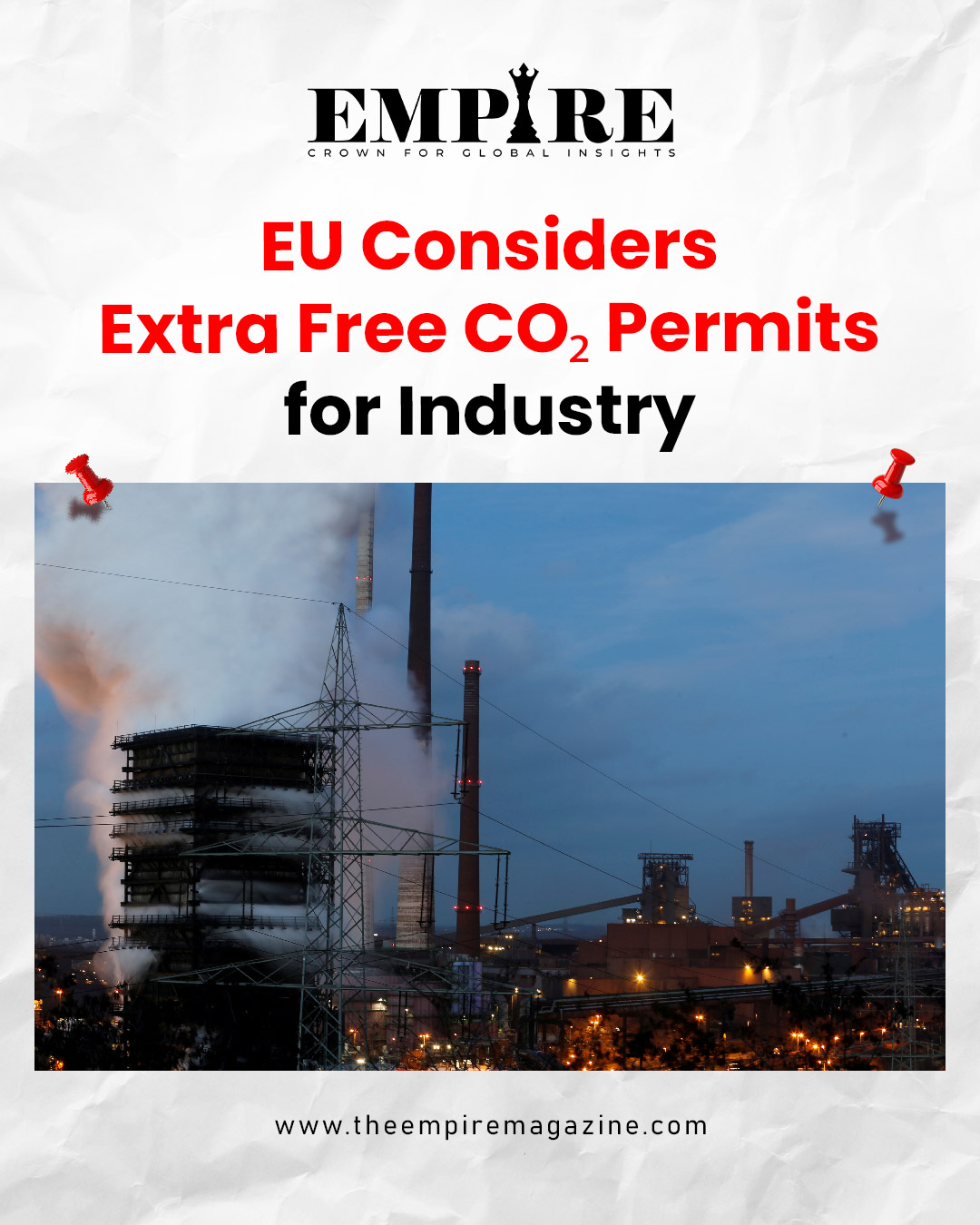
For years, the European Union has positioned itself as the world’s most ambitious climate leader. Through strict emissions regulations, renewable energy investments, and its landmark carbon pricing mechanism, Europe has sought to prove that economic growth and environmental responsibility can coexist. But in 2026, the bloc finds itself facing a difficult reality. Industries across Europe are struggling with rising production costs, expensive energy, growing international competition, and slowing manufacturing output. Against this backdrop, the European Commission is considering granting additional free CO₂ emission permits to heavy industries under its Emissions Trading System (ETS), a move that has sparked intense debate across political, environmental, and business circles. The proposal is designed to provide immediate financial relief to sectors such as steel, chemicals, cement, refineries, and manufacturing, many of which argue that current carbon costs are making European products less competitive against imports from countries with less stringent environmental regulations. Supporters believe the temporary relief is necessary to prevent factory closures, protect jobs, and preserve Europe’s industrial base during a period of economic uncertainty. Critics, however, warn that offering additional free permits weakens the very climate policies that made Europe a global leader in emissions reduction. They argue that easing carbon costs could reduce incentives for companies to invest in cleaner technologies and delay the transition toward a low-carbon economy. The proposal reflects a broader dilemma confronting governments worldwide, how to remain committed to climate ambitions while ensuring industries remain globally competitive. As Europe searches for the right balance, the outcome of this debate could reshape not only its industrial future but also global climate policy itself
Why the EU Is Rethinking Carbon Rules
The European Union’s Emissions Trading System has long been regarded as one of the world’s most successful carbon markets. Introduced in 2005, the ETS operates on a straightforward principle: companies that emit greenhouse gases must purchase carbon allowances, creating a financial incentive to reduce pollution. Over the years, the system has helped lower emissions while encouraging industries to invest in cleaner technologies. However, today’s economic conditions have changed dramatically. European manufacturers are facing slower economic growth, persistent inflationary pressures, higher borrowing costs, and fierce competition from countries where environmental regulations remain less demanding. Business leaders argue that while Europe continues to tighten environmental standards, competitors in Asia and other regions often operate with significantly lower compliance costs. This disparity, they say, creates an uneven playing field that risks driving production and emissions outside Europe instead of reducing them globally, a phenomenon widely known as “carbon leakage.” In response, several member states, including Italy, Poland, and the Czech Republic, have urged Brussels to revise the allocation of free emissions allowances. The Commission is now considering adjustments to the benchmark calculations used to distribute free permits, enabling eligible industries to receive additional allowances beginning in 2026 while a broader reform of the ETS is prepared. Policymakers insist that these changes are intended as a temporary measure rather than a reversal of Europe’s climate ambitions. Nevertheless, the proposal signals a growing willingness among European leaders to adapt environmental policies in response to economic pressures, highlighting the increasingly delicate balance between maintaining industrial competitiveness and preserving long-term climate commitments.
Understanding the EU’s Carbon Permit System
To understand why the latest proposal has generated such attention, it is important to understand how the EU carbon market functions. Under the Emissions Trading System, the European Union sets an overall cap on greenhouse gas emissions. Companies receive or purchase emissions allowances, with each permit allowing the release of one tonne of carbon dioxide. Businesses that reduce emissions below their allowance levels can sell unused permits, while those exceeding their limits must purchase additional credits from the market. This market-based approach rewards efficiency while placing a financial cost on pollution. Historically, the EU has also allocated a portion of these allowances free of charge to industries considered vulnerable to international competition. The objective has always been to prevent companies from relocating production to countries with weaker environmental standards. The current proposal seeks to expand these free allocations by revising technical benchmarks that determine eligibility, particularly for industries with high energy consumption. Supporters argue that these revisions merely correct flaws in the existing system rather than weakening it, ensuring companies receive allowances that better reflect real production processes. Environmental organizations remain skeptical, pointing out that increasing free allocations could reduce carbon prices, weaken incentives for technological innovation, and make it more difficult for Europe to meet its legally binding climate targets for 2030 and beyond. As policymakers debate these technical adjustments, the broader question remains whether carbon markets can continue driving emissions reductions while simultaneously protecting industrial competitiveness during periods of economic stress.
Why European Industries Want More Free CO₂ Permits
From the perspective of Europe’s manufacturing sector, the request for additional free permits is driven less by environmental policy than by economic survival. Industries such as steelmaking, chemicals, aluminium, cement, fertilizers, and refining require enormous amounts of energy and produce unavoidable emissions during manufacturing. Rising electricity prices following recent energy market disruptions, combined with increasing carbon costs under the ETS, have significantly raised production expenses. Many executives argue that European manufacturers are now competing against imports produced under far less demanding environmental regulations, placing domestic factories at a structural disadvantage. Industry associations warn that unless operating costs decline, investment could shift outside Europe, resulting in factory closures, job losses, and weakened supply chains. Ironically, they argue that global emissions may even rise if production moves to countries relying more heavily on coal-powered manufacturing. Additional free permits, therefore, are viewed as a bridge that allows businesses to remain competitive while gradually investing in cleaner technologies such as hydrogen-based steel production, carbon capture systems, and electrified manufacturing. Supporters also emphasize that the proposal complements other EU initiatives, including the Carbon Border Adjustment Mechanism (CBAM), which is designed to impose carbon costs on imported goods. Together, they argue, these policies can protect European industry without abandoning climate goals. Whether this balance can be achieved remains one of the defining policy questions confronting the European economy today.
The Climate Debate Around the Proposal
Environmental groups see the proposal through an entirely different lens. For climate advocates, expanding free emissions permits risks sending the wrong message at a time when scientific warnings about climate change continue to intensify. They argue that the Emissions Trading System has been effective precisely because emitting carbon carries a financial cost. Reducing that cost, even temporarily, may discourage companies from accelerating investments in cleaner production methods and renewable energy adoption. Critics also worry that repeated concessions to industry could undermine confidence in Europe’s broader climate strategy and create expectations of future regulatory relaxations whenever economic challenges emerge. At the same time, policymakers acknowledge that climate policies cannot succeed without maintaining public and political support. If businesses close, unemployment rises, and industrial investment leaves Europe, resistance to environmental regulation could grow substantially. This explains why Brussels is attempting to frame the proposal as a targeted adjustment rather than a retreat from climate leadership. Officials continue to stress that Europe’s long-term objective of achieving climate neutrality by 2050 remains unchanged, with the temporary expansion of free permits intended only to support industries through an exceptionally challenging economic period. The debate therefore reflects a much broader policy challenge confronting governments across the world, how to accelerate decarbonisation without sacrificing economic resilience or industrial competitiveness in an increasingly fragmented global economy.
What This Means for Europe’s Future and Global Markets
The European Union’s consideration of additional free CO₂ permits represents far more than a technical adjustment to carbon market rules. It illustrates the growing complexity of governing an economy undergoing simultaneous energy, industrial, technological, and environmental transformations. Whatever decision Brussels ultimately reaches will likely influence climate policy discussions far beyond Europe, as governments worldwide confront similar tensions between ambitious emissions targets and economic competitiveness. If the proposal succeeds in protecting jobs while preserving incentives for decarbonisation, it may become a model for balancing industrial policy with environmental responsibility. If, however, it slows emissions reductions or weakens confidence in carbon pricing, critics will argue that Europe has compromised its own climate leadership. For businesses, investors, and policymakers, the coming months will be closely watched as broader reforms to the Emissions Trading System take shape. The outcome will determine not only how European industries compete in global markets but also how effectively one of the world’s most influential climate policies evolves in an era defined by economic uncertainty. As the world races toward a cleaner future, Europe once again finds itself attempting one of the most difficult balancing acts in modern policymaking, proving that sustainability and competitiveness do not have to be opposing forces, but complementary pillars of long-term prosperity.
For more business and retail insights, read more on The Empire Magazine
Previous article: Genspark.ai reached 2.6 b
Magazine Feautures | Podcasts: Empire Global Talks
Follow The Empire Magazine on Facebook | Instagram | LinkedIn
The Empire Magazine | Crown for Global Insights