How the Strait of Hormuz Reopens and Why It Matters for the Global Economy
One of the world’s most important energy chokepoints Strait of Hormuz is showing signs of life again.
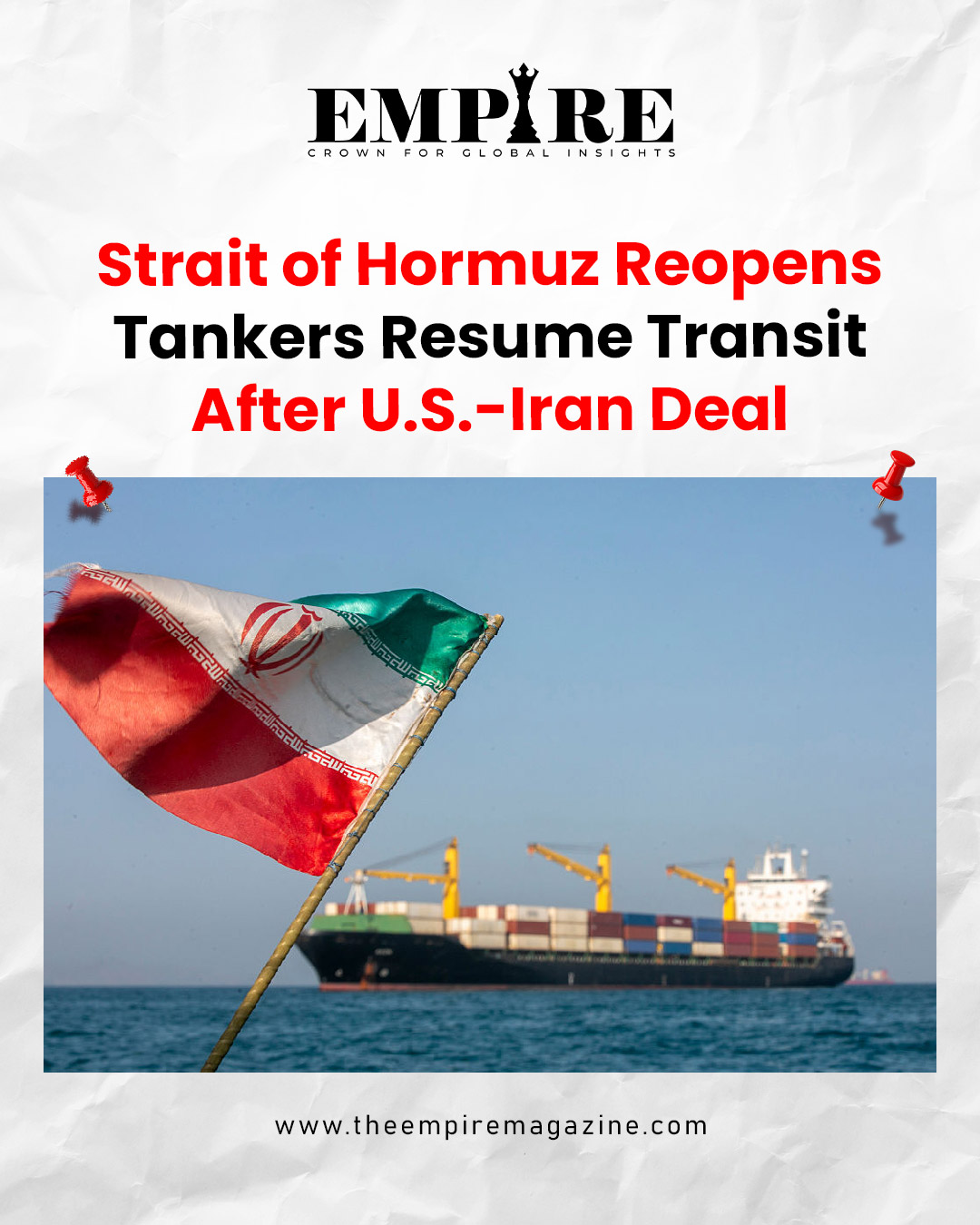
After months of conflict that disrupted global shipping and rattled energy markets, commercial tankers are cautiously returning to the Strait of Hormuz following a preliminary agreement between the United States and Iran. The reopening of the strategic waterway marks a significant step toward restoring global oil supplies, although industry experts warn that normal operations are still some distance away.
The Strait of Hormuz carries around one-fifth of the world’s seaborne oil trade and a significant share of global liquefied natural gas (LNG). Any disruption to this narrow passage between the Persian Gulf and the Gulf of Oman has immediate consequences for fuel prices, inflation and international trade.
While the recent U.S.-Iran understanding has eased immediate fears of a prolonged blockade, shipping companies remain cautious. War-risk insurance costs remain elevated, security concerns persist and vessel traffic has yet to return to pre-conflict levels.
Strait of Hormuz Reopens After U.S.-Iran Agreement
The gradual reopening follows an interim agreement between Washington and Tehran aimed at de-escalating tensions that had effectively restricted commercial navigation through the waterway.
As part of the understanding, Iran committed to restoring maritime traffic while the United States moved toward easing restrictions on Iranian oil exports and port access. Within days of the agreement, multiple crude oil and LNG tankers began transiting the Strait, including Saudi supertankers and Qatari gas carriers that had remained stranded during the crisis.
Shipping data indicates that tanker movements are steadily increasing, providing early signs that confidence is gradually returning to one of the world’s busiest maritime routes.
However, analysts stress that reopening the Strait is not the same as restoring full trade. Many shipowners continue to assess security conditions before committing additional vessels to Gulf routes.
Why the Strait of Hormuz Is Critical to Global Energy
The Strait of Hormuz is only about 33 kilometres wide at its narrowest point, yet it serves as the primary export route for crude oil and natural gas produced by Saudi Arabia, Iraq, Kuwait, the United Arab Emirates, Qatar and Iran.
Before the disruption, roughly 20 million barrels of oil per day passed through the Strait, making it the single most important energy corridor in the world.
When shipping slowed dramatically during the conflict, energy markets reacted immediately. Oil prices surged, insurance premiums climbed and shipping companies diverted vessels along longer routes where possible, increasing transportation costs and delivery times.
Because so many major energy exporters depend on this passage, even limited disruptions have global consequences from rising petrol prices to increased manufacturing costs and broader inflationary pressures.
Strait of Hormuz Reopens as Tanker Traffic Slowly Recovers
Although commercial shipping has resumed, the recovery remains gradual rather than immediate.
Recent vessel-tracking data shows crude carriers, LNG tankers and product tankers once again moving through the Strait. More than a dozen large vessels have successfully completed transits since the agreement took effect, while several producers have restarted export operations.
Still, actual cargo volumes remain below pre-conflict levels. Many shipping companies are waiting for greater political stability before restoring normal schedules. Marine insurers are also closely monitoring developments before reducing war-risk premiums that significantly increased operating costs during the crisis. For now, optimism is returning but cautiously.
Strait of Hormuz Reopens and Oil Prices Respond
Energy markets reacted almost immediately to signs that tanker traffic was resuming. Brent crude prices, which had surged during the height of the disruption, declined as traders anticipated improved oil supplies from the Gulf. The return of stranded cargoes and expectations of higher exports helped ease fears of a prolonged supply shock.
However, analysts caution that price volatility has not disappeared. Oil markets remain highly sensitive to geopolitical developments, and any renewed tensions in the Gulf could quickly reverse recent gains. Market participants are therefore watching shipping volumes through the Strait as closely as diplomatic negotiations themselves.
Why Shipping Companies Remain Cautious
Despite the reopening, confidence has not fully returned. Shipping executives continue to evaluate mine-clearance operations, naval security, insurance costs and the broader political environment before committing fleets to regular Gulf operations.
Industry organisations have also warned that restoring supply chains disrupted over several months will take time. Ships remain unevenly distributed across global trade routes, and some cargoes continue to face delays caused by congestion and rerouting. The reopening therefore represents the beginning of recovery not its completion.
Strait of Hormuz Reopens: What It Means for India and Global Trade
The reopening of the Strait of Hormuz is particularly significant for India, which imports more than 80% of its crude oil requirements. A substantial portion of those imports comes from Gulf nations whose exports pass through this narrow waterway.
When transit slowed during the crisis, Indian refiners closely monitored supply chains and explored alternative sourcing options to avoid potential shortages. Although India maintained adequate strategic reserves, prolonged disruption would have increased import costs and placed additional pressure on fuel prices.
The gradual return of tanker traffic is therefore expected to improve supply stability for India and other major Asian importers such as China, Japan and South Korea. Lower freight costs and improved shipping schedules could also ease pressure on industries that rely heavily on imported energy.
Beyond oil, smoother maritime traffic benefits global trade by reducing delivery delays, stabilising shipping rates and restoring confidence across international supply chains.
Strait of Hormuz Reopens but Challenges Still Remain
While commercial vessels have resumed transit, industry experts believe the shipping corridor has not yet returned to normal. War-risk insurance premiums remain significantly higher than before the conflict, adding to transportation costs for shipowners. Some companies continue to route vessels cautiously or wait for additional security assurances before fully restoring operations.
Regional tensions also remain a concern. The Gulf continues to be one of the world’s most strategically sensitive regions, and any deterioration in diplomatic relations could once again disrupt maritime traffic. Naval patrols by international forces are expected to remain active to ensure the safety of commercial vessels passing through the Strait.
As a result, shipping companies are likely to adopt a cautious approach until confidence in long-term regional stability improves.
Strait of Hormuz Reopens: Winners and Losers
The reopening creates clear advantages for several sectors. Oil-exporting nations in the Gulf can resume smoother exports, helping stabilise government revenues and maintain production targets. Energy-importing countries benefit from improved supply security, while shipping companies gain the opportunity to restore normal trade routes.
Consumers could also benefit if stable oil supplies eventually translate into lower fuel prices and reduced transportation costs. However, not everyone emerges unaffected.
Shipping companies still face elevated insurance expenses, while energy markets remain vulnerable to geopolitical developments. Businesses that shifted to alternative suppliers or longer shipping routes during the disruption may also need time to readjust their operations.
Can the Strait of Hormuz Stay Open?
That remains the key question.
The recent U.S.-Iran understanding has reduced immediate tensions and allowed commercial shipping to resume, but lasting stability will depend on continued diplomatic engagement and regional cooperation.
Energy analysts note that the Strait of Hormuz has experienced periods of tension before, and markets are likely to remain sensitive to any signs of renewed confrontation.
For now, the return of tanker traffic is being viewed as a positive signal rather than a guarantee of permanent normalcy.
Governments, shipping companies and energy traders will continue to closely monitor developments in the Gulf over the coming months.
Strait of Hormuz marks an important turning point for global energy markets.
The reopening of the Strait of Hormuz marks an important turning point for global energy markets after weeks of uncertainty.
The return of commercial tankers following the U.S.-Iran agreement has eased concerns over oil supplies, reduced pressure on shipping routes and improved confidence across international markets. While vessel traffic is steadily increasing, the recovery remains gradual as insurers, shipowners and exporters continue to assess the security environment.
For countries such as India that depend heavily on Gulf energy imports, the reopening offers greater supply stability and the possibility of more predictable fuel prices. For the global economy, it highlights how a single maritime corridor can influence everything from inflation and shipping costs to energy security and international trade.
Although challenges remain, the resumption of tanker transit is a reminder that diplomacy can play a crucial role in restoring confidence to global markets. Whether the Strait remains fully operational in the long term will depend on sustained regional stability, but for now, one of the world’s most vital shipping lanes is moving once again.
For more business and retail insights, read more on The Empire Magazine
Previous article: Reliance Jio Satellites
Magazine Feautures | Podcasts: Empire Global Talks
Follow The Empire Magazine on Facebook | Instagram | LinkedIn
The Empire Magazine | Crown for Global Insights