Cartier is one of the most important luxury jewellery brands in the world and a major growth engine for Richemont, the Swiss luxury group that also owns Van Cleef & Arpels, Buccellati, Vhernier, Piaget, IWC, Jaeger-LeCoultre, Vacheron Constantin, Montblanc, and other luxury maisons.
Founded in Paris in 1847 by Louis-François Cartier, the brand built its reputation through royal clients, high jewellery craftsmanship, watches, diamonds, iconic designs, and global prestige. Today, Cartier remains one of Richemont’s strongest maisons and a central reason why the group has performed better than many luxury competitors during periods of slower demand.
High jewellery has become one of the most resilient categories in luxury because it combines heritage, emotional value, craftsmanship, rarity, and long-term desirability. Cartier’s success shows how jewellery has moved beyond traditional luxury gifting and become a powerful business category for global luxury groups.
Why Cartier Matters to Richemont
Richemont’s business is divided across jewellery maisons, specialist watchmakers, and other luxury businesses. Jewellery has become the strongest division because it continues to attract wealthy clients even when fashion, watches, or discretionary luxury spending face pressure.
Cartier is the largest and most globally recognized jewellery maison inside Richemont. Along with Van Cleef & Arpels, it gives Richemont a strong position in branded jewellery, high jewellery, wedding jewellery, watches, and luxury accessories.
Jewellery as a Stable Luxury Category
Jewellery often performs differently from fashion because it carries emotional and financial value. Customers buy jewellery for weddings, anniversaries, inheritance, celebrations, status, and investment-style collecting. High jewellery pieces are also rare and often connected to craftsmanship, gemstones, and maison heritage.
This gives Richemont a strong advantage. While some luxury categories depend heavily on seasonal trends, jewellery can remain relevant for generations.
Cartier’s History and Luxury Authority
Cartier’s reputation was built over more than 175 years. The brand became known as a jeweller to royalty and high society. It created tiaras, necklaces, bracelets, brooches, rings, and watches for aristocrats, collectors, celebrities, and luxury clients around the world.
The “Jeweller of Kings”
Cartier became famous as the “Jeweller of Kings and King of Jewellers.” This reputation helped the maison build authority in high jewellery. Royal commissions and historic pieces gave Cartier a level of prestige that newer brands cannot easily copy.
This heritage remains important today. Modern luxury consumers still respond to brands with history, authenticity, and recognizable design codes.
Cartier’s Iconic Collections
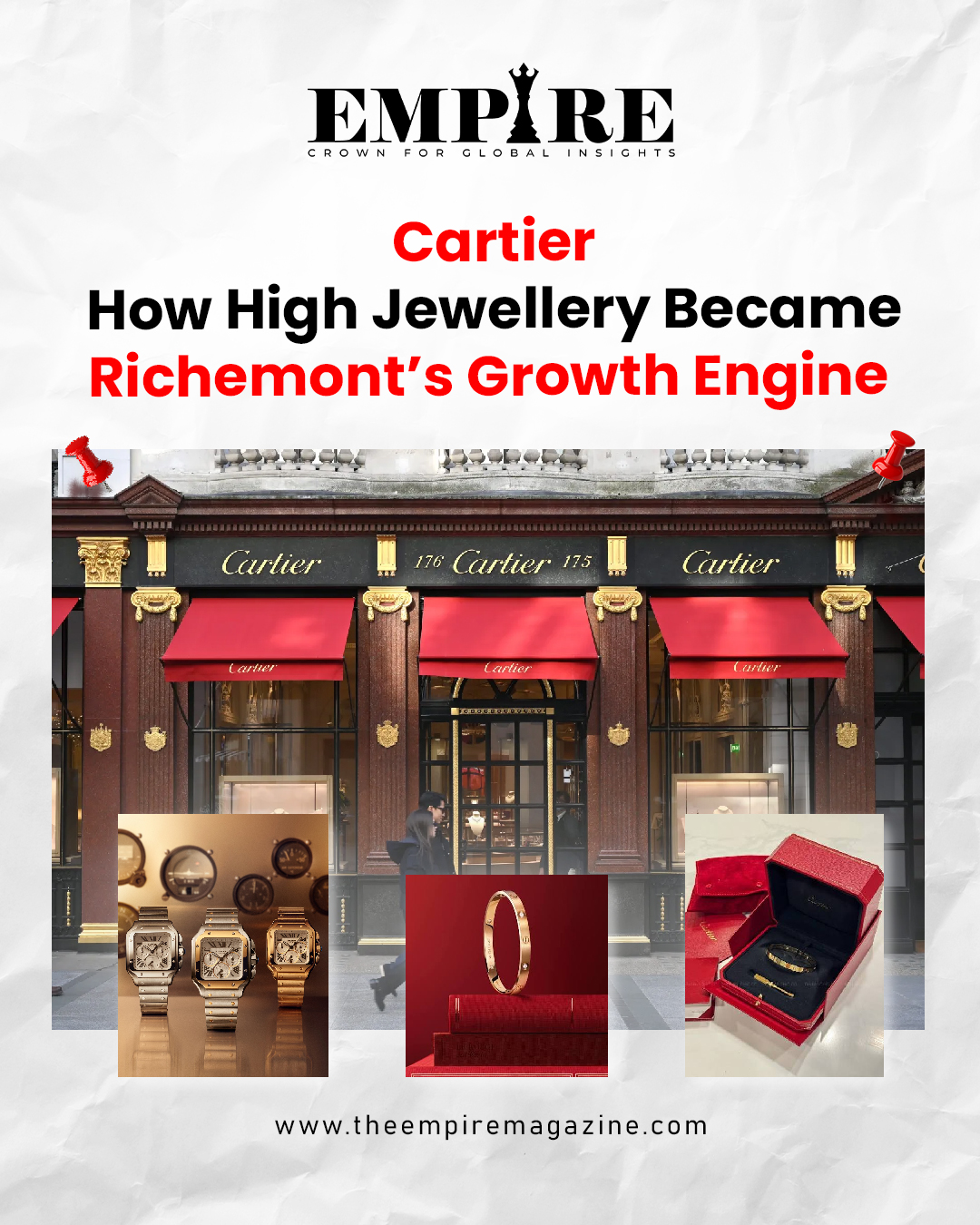
Cartier’s growth is supported by iconic collections that continue to attract customers across generations. These include Love, Juste un Clou, Panthère de Cartier, Trinity, Clash de Cartier, Tank, Santos, and Ballon Bleu.
Love and Juste un Clou
The Cartier Love bracelet became one of the most recognizable jewellery designs in modern luxury. Its screw motif and emotional connection to commitment made it a strong global product. Juste un Clou, inspired by the shape of a nail, also became a major design statement because of its bold simplicity.
These collections are important because they create repeatable demand. Customers can enter the Cartier world through bracelets, rings, necklaces, or earrings while still connecting with a historic maison.
Panthère de Cartier
Panthère de Cartier is another major symbol of the brand. The panther motif has appeared in Cartier jewellery and watches for decades. It represents elegance, power, and bold design.
The panther gives Cartier a distinctive visual identity. In luxury, strong symbols matter because they make products immediately recognizable.
High Jewellery and Wealth Clients
High jewellery is different from regular jewellery collections. It involves rare gemstones, exceptional craftsmanship, unique designs, and very high price points. Pieces may include important diamonds, emeralds, rubies, sapphires, and complex settings created by master artisans.
Why High Jewellery Is Important
High jewellery strengthens Cartier’s brand image and attracts ultra-high-net-worth clients. These clients often buy through private appointments, exclusive events, and maison relationships. High jewellery also supports brand storytelling because each collection can be connected to history, travel, nature, architecture, and craftsmanship.
For Richemont, this category is important because high jewellery can produce strong margins and deepen long-term client loyalty.
Richemont’s Jewellery Maisons Performance
Richemont’s jewellery maisons have become the strongest part of the group’s business. The group’s jewellery division includes Cartier, Van Cleef & Arpels, Buccellati, and Vhernier. In its latest annual results for the year ended March 31, 2026, Richemont reported that Jewellery Maisons sales increased to €16.5 billion, up 8% from the previous year.
The division also delivered an operating result of more than €5 billion. This shows that jewellery is not only a heritage category; it is a major financial engine for the group.
Jewellery Outperforming Watches
Richemont is also known for specialist watch brands such as IWC, Piaget, Vacheron Constantin, Jaeger-LeCoultre, Panerai, and A. Lange & Söhne. However, the watch market has faced pressure in some regions, especially when demand in China weakened.
Jewellery has helped balance this pressure. Cartier and Van Cleef & Arpels have given Richemont stronger resilience during luxury market slowdowns.
Why Branded Jewellery Is Growing
The global jewellery market has historically included many local jewellers and unbranded pieces. However, branded jewellery has become more important as consumers look for authenticity, resale value, design recognition, and trust.
Trust and Brand Power
A Cartier piece carries more than material value. It carries brand history, design identity, craftsmanship, authentication, and global recognition. This matters because luxury consumers want confidence when buying high-value jewellery.
Branded jewellery also supports gifting and status. A Cartier box, design, or signature piece is instantly recognized in many markets.
Cartier’s Retail and Client Experience
Cartier’s growth is supported by a strong global retail network. Luxury jewellery customers often expect private service, elegant boutiques, expert advice, and a refined buying experience.
Boutiques as Brand Temples
Cartier boutiques are not only retail stores. They are brand spaces where customers experience heritage, service, craftsmanship, and exclusivity. Flagship boutiques in cities such as Paris, London, New York, Dubai, Hong Kong, Singapore, and Tokyo support Cartier’s global luxury image.
For high jewellery clients, private events and personalized service are especially important. These experiences strengthen loyalty and help Cartier maintain long-term relationships with wealthy customers.
Cartier and the Rise of Female Luxury Consumers
Jewellery growth is also connected to changing consumer behavior. More women are buying luxury jewellery for themselves, not only receiving it as a gift. This shift supports categories such as bracelets, rings, watches, necklaces, and everyday fine jewellery.
Self-Purchase and Modern Luxury
Self-purchase has become important because it changes how jewellery is marketed. Brands are no longer speaking only to gift buyers. They are also speaking directly to women who buy jewellery as a symbol of achievement, identity, style, and independence.
Cartier benefits from this trend because its collections are recognizable, wearable, and strongly connected to modern luxury lifestyles.
Celebrity Culture and Global Visibility
Cartier remains highly visible through celebrities, red carpet events, cinema, fashion, sports, and cultural partnerships. High-profile appearances help introduce Cartier pieces to younger and global audiences.
From Heritage to Pop Culture
Luxury brands must balance heritage with cultural relevance. Cartier does this by maintaining classic collections while also appearing in modern entertainment, fashion editorials, and celebrity styling.
This keeps the maison visible to new generations without losing its historic identity.
Competition in High Jewellery
Cartier competes with other major jewellery maisons, including Tiffany & Co., Bulgari, Van Cleef & Arpels, Chopard, Harry Winston, Graff, Boucheron, and Chaumet. The competition is strong because high jewellery customers expect excellence in design, gemstones, craftsmanship, and service.
Richemont’s Advantage
Richemont has a strong advantage because it owns multiple jewellery maisons with different identities. Cartier is known for royal heritage, iconic collections, watches, and timeless design. Van Cleef & Arpels is known for poetic jewellery, Alhambra, and high jewellery craftsmanship. Buccellati brings Italian goldsmithing heritage. Vhernier adds a modern Italian jewellery voice.
This portfolio gives Richemont depth across the jewellery market.
Why Cartier Became Richemont’s Growth Engine
Cartier became Richemont’s growth engine because it combines heritage, design icons, high jewellery, global retail power, and strong customer trust. The brand can serve different levels of luxury demand, from entry-level fine jewellery to one-of-a-kind high jewellery pieces.
Its strength also comes from consistency. Cartier has maintained recognizable design codes while adapting to modern luxury consumers. That balance makes it one of the most valuable jewellery maisons in the world.
For more luxury and business insights, read this feature on The Empire Magazine.
Follow The Empire Magazine on Instagram and Facebook.
– The Empire Magazine
Crown For Global Insights