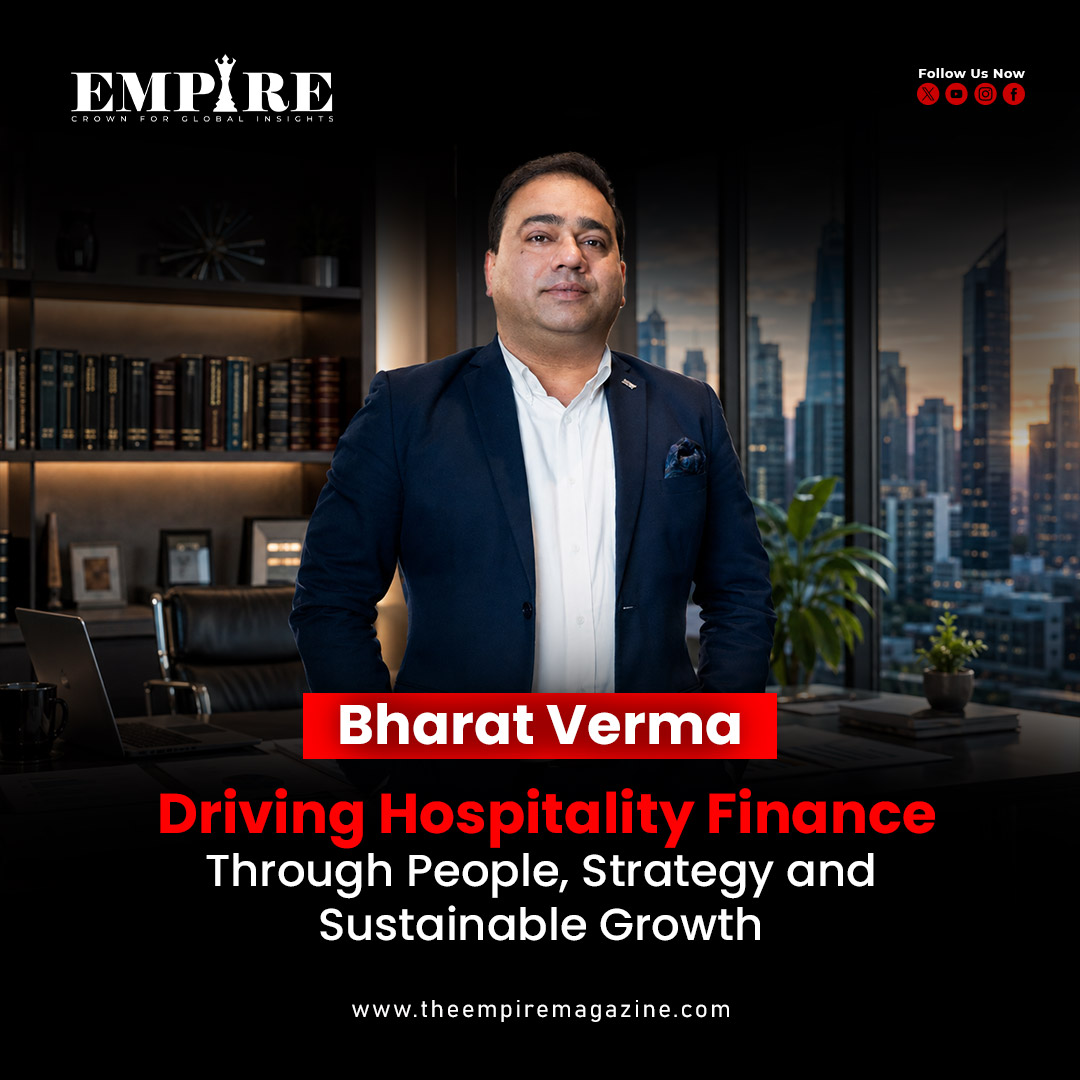
Bharat Verma is driving hospitality finance excellence through strategic leadership, technology, operational efficiency, teamwork and sustainable growth.
Bharat Verma: Driving Hospitality Finance Through People, Strategy and Sustainable Growth
Behind every successful hotel is a financial and operational structure that guests may never see. Budgets, forecasting, internal controls, technology, working capital and performance monitoring work quietly in the background to ensure that the guest experience remains seamless. For Bharat Verma, this invisible side of hospitality is where financial leadership creates tangible business impact. As Cluster Director of Finance and Business Support at IHG Hotels & Resorts, Bharat Verma works closely with hotel leadership and operational teams to strengthen financial performance, improve processes and support sustainable growth across properties. With more than two decades of experience in hospitality finance and exposure to leading global hotel brands, his career demonstrates how finance has evolved from a reporting function into a strategic business partner. From hotel openings and financial turnarounds to GST implementation, technology adoption and team development, Bharat has consistently connected financial discipline with the realities of hotel operations. His philosophy is rooted in a simple belief: when people have the right support, systems work effectively and financial decisions are connected to operational realities, hospitality businesses become stronger, more resilient and better prepared for the future.
Bharat Verma’s Journey Through Global Hospitality Finance
The professional journey of Bharat Verma began with an interest in numbers and the stories they tell about a business. Early in his career, he worked part-time in accounting roles across different industries before discovering hospitality as a field where financial decisions could be seen almost immediately in day-to-day operations. He began his hospitality career with The Oberoi Group of Hotels in 2002 as a Finance Assistant at Wildflower Hall in Shimla, where his responsibilities included stores and receiving. Over time, his career progressed from operational finance into leadership positions, eventually leading to his appointment as Director of Finance at Courtyard by Marriott, Ahmedabad, in 2010. One of the most significant chapters of Bharat Verma’s career has been his contribution to the opening of 17 hotels across IHG, Marriott and Radisson portfolios, covering both new-build properties and conversions. His international assignments also included two periods at InterContinental Lagos in Nigeria, where he worked to address financial and internal-control challenges. These experiences helped shape his understanding that effective hospitality finance requires much more than accounting knowledge. It requires operational awareness, adaptability and the ability to work with people across different functions and markets.
Bharat Verma Combines Financial Strategy With Hotel Operations
What distinguishes Bharat Verma’s hospitality finance leadership is his close connection with hotel operations. Throughout his career, he has worked at both hotel and regional levels, leading finance operations, supporting country and area financial strategies and monitoring performance across multiple properties. This exposure has helped him understand that financial results are rarely created by the finance department alone. Revenue, payroll, procurement, guest satisfaction, operational efficiency and commercial strategy all influence the overall performance of a hotel. Bharat’s cross-functional experience has therefore become an important part of his leadership approach. By spending time with operational and commercial teams, he has developed a broader understanding of how finance supports the entire hotel ecosystem. He believes finance should provide teams with the information, systems and guidance they need to perform effectively rather than simply reporting what has already happened. This practical perspective also explains why Bharat values operational exposure so highly. Financial professionals who understand what happens on the ground can interpret numbers more effectively because they understand the business circumstances behind them. For Bharat Verma, strong hospitality finance begins with understanding the operation itself.
Bharat Verma’s Role in Driving Hotel Financial Performance
As Cluster Director of Finance and Business Support, Bharat Verma plays a central role in financial planning, performance monitoring and strategic support for hotel teams and the Cluster General Manager. His responsibilities involve reviewing performance reports, understanding financial variances, participating in forecasting discussions and monitoring hotel performance through benchmarking and key performance indicators. These activities help leadership identify opportunities to improve returns, manage payroll efficiency and maintain overall financial health. Yet Bharat’s work does not remain confined to reports and spreadsheets. Depending on business requirements, his day may involve operational walkthroughs, leadership discussions and direct engagement with teams. This combination of financial analysis and operational involvement allows him to understand what the numbers are actually saying about the business. For Bharat, the most engaging part of his role is solving real business problems. Identifying trends, improving processes and helping teams deliver stronger results keep the work dynamic. Hospitality is an industry where circumstances can change quickly, and that constant movement requires finance leaders to remain responsive. His approach demonstrates why modern hotel finance increasingly requires leaders who can connect financial information with operational action.
Bharat Verma’s Experience With Major Hotel Openings
Few experiences demonstrate Bharat Verma’s hospitality finance expertise better than his involvement in major hotel openings. He has contributed to the opening of 17 hotels across IHG, Marriott and Radisson portfolios, giving him extensive experience in the financial and operational complexity involved in bringing new properties to life. Hotel openings require coordination across multiple areas, including budgets, hiring, banking, working capital, licensing, insurance, fixed assets, operating equipment, finance policies, internal controls and technology systems. Bharat’s most recent project was the successful opening of the 273-key Holiday Inn & Suites Vientiane in Laos on 18 November 2024. His responsibilities covered hiring, pre-opening and post-opening budgets, banking setup, working capital management, licenses, insurance, fixed assets and operating equipment handover and tracking. He also oversaw the implementation of finance policies and procedures, internal controls and IT systems. Such projects demonstrate that hospitality finance is closely connected with the entire lifecycle of a property. Financial readiness is not something that begins after a hotel opens. It must be built into the property from the earliest stages of planning and preparation.
Bharat Verma Helped Lead GST Implementation Across IHG Hotels
Another significant achievement in Bharat Verma’s finance leadership career was his involvement in the rollout of GST across IHG hotels in India. Tax and regulatory changes can create considerable operational challenges for large hospitality organizations because implementation affects financial processes, compliance requirements and coordination between multiple teams. Bharat worked closely with teams during the transition, helping manage the implementation and maintain compliance across the hotel portfolio. This experience reflects another important dimension of his approach to finance: the ability to translate regulatory requirements into workable operational processes. For hospitality businesses, compliance cannot exist separately from daily operations. It must be integrated into systems, controls and team responsibilities. Bharat’s interest in taxation and law also connects naturally with this aspect of his career. He has long been attracted to professional fields requiring analytical thinking, attention to detail and an understanding of regulations. Although hospitality became his long-term career path, his work continues to involve interpreting policies, advising stakeholders, managing risk and protecting financial integrity. This combination of finance, regulation and operations has strengthened his ability to guide hotel teams through periods of significant change.
Bharat Verma Believes Leadership Must Remain Calm During Change
The hospitality industry is particularly sensitive to market changes, organizational restructuring and regulatory developments. Throughout his career, Bharat Verma has experienced periods where businesses needed to adjust quickly while maintaining operational stability. These situations taught him that effective leadership is not about eliminating uncertainty. It is about helping teams navigate uncertainty without losing direction. Bharat emphasizes flexibility, transparent communication, clear priorities and calm decision-making when circumstances change. When teams understand what matters most and why decisions are being taken, they are better positioned to respond to unexpected developments. This leadership philosophy also influences how he builds teams. Instead of attempting to control every action, Bharat focuses on creating clear expectations, providing the right tools and giving people the guidance they need. Once that foundation is established, he allows team members to take ownership of their responsibilities. This approach combines accountability with trust. For Bharat Verma, strong leadership does not mean standing at the center of every decision. It means creating an environment where people have the confidence and resources to make good decisions themselves.
Bharat Verma Uses Technology to Make Hospitality Finance Smarter
Technology has become an increasingly important part of Bharat Verma’s approach to hospitality finance. His day-to-day work involves financial accounting and reporting systems, automated reconciliation tools and integrated property management and point-of-sale platforms. He also works with IHG’s budgeting and forecasting tools, including Fairplanner, as well as DocMx, an automated internal-control system integrated into the financial process. These technologies reduce manual work, improve accuracy and provide clearer visibility into business performance through dashboards and real-time information. For finance leaders, reliable data can significantly improve decision-making because it reduces the delay between identifying a business development and responding to it. Bharat’s technology-focused approach reflects the broader transformation taking place across hospitality finance. Traditional financial reporting is increasingly being supported by automation, predictive analysis and integrated business systems. The objective is not technology for its own sake. It is about creating better information, reducing repetitive tasks and giving leaders more time to focus on analysis and strategic decisions. Bharat Verma’s experience demonstrates how technology can allow finance teams to become more responsive partners to hotel operations.
Bharat Verma Puts People at the Center of Financial Leadership
Despite working in a function driven by numbers and systems, Bharat Verma’s leadership philosophy is fundamentally people-first. Years of working with diverse hotel teams and regional operations have shaped a collaborative leadership style focused on enabling people rather than directing every detail of their work. Bharat believes teams perform better when expectations are clear and the right tools and guidance are available. Once those conditions are created, employees should have the space to take ownership. Trust and open communication are central to his approach. He values honest conversations, remains accessible to his colleagues and actively supports team development. This philosophy reflects his broader understanding of hospitality as a people-driven industry. Financial performance ultimately depends on people delivering the guest experience, managing operations and responding to challenges every day. When employees feel supported and understand their responsibilities, the organization is more likely to perform consistently. Bharat Verma therefore sees team development not as a separate human-resources activity but as an important component of sustainable business performance. His leadership approach connects financial discipline with employee empowerment, demonstrating that strong systems and strong people are mutually reinforcing.
Bharat Verma Sees Finance as More Than Numbers
For Bharat Verma, the purpose of hospitality finance extends beyond profitability. Financial decisions can influence employees, guests, communities and the long-term stability of a hotel. This broader perspective has shaped the way he measures professional impact. While financial results remain important, he is equally motivated by seeing teams succeed, processes improve and operations become stronger. Bharat describes finance as a quiet but powerful influence on organizational culture, sustainability and long-term stability. This philosophy is particularly relevant as hospitality businesses increasingly consider environmental and social factors alongside traditional financial measures. Hotels consume significant resources and operate through large teams, making responsible business practices increasingly important. Bharat believes sustainability will become more deeply integrated into financial thinking as organizations recognize that environmental and social considerations can affect long-term performance. This means finance teams will increasingly need to evaluate not only immediate returns but also the durability and wider impact of business decisions. Bharat Verma’s perspective positions the finance function as an important contributor to sustainable hospitality growth, where financial discipline, responsible operations and people development work together rather than existing as separate priorities.
Bharat Verma’s Leadership Has Been Recognized for Financial Excellence
Recognition has been an important part of Bharat Verma’s professional journey, but he places greater value on achievements that reflect collective effort. In 2011, he was recognized by Marriott as the “Best Director of Finance” in the Information and Technology category. For Bharat, awards become most meaningful when they represent collaboration, innovation and successful financial turnarounds rather than individual achievement alone. His perspective reflects the nature of hospitality itself, where results depend on multiple teams working together. Finance may provide direction and controls, but operational success requires collaboration between finance, commercial teams, hotel operations and leadership. Bharat therefore views recognition as a reflection of what a team has achieved together. Even more rewarding than an individual award, he believes, is seeing employees grow professionally, meet their goals and take pride in the results they have created. This people-focused understanding of success reinforces his broader leadership philosophy. Financial excellence is not simply about achieving a target; it is about developing the capabilities and relationships that allow an organization to continue achieving strong results.
Bharat Verma Predicts a More Digital Future for Hospitality Finance
Looking ahead, Bharat Verma sees hospitality finance becoming increasingly digital, predictive and connected to the guest experience. Automated processes, real-time business insights and integrated digital payment systems are already changing how hotel decisions are made. As technology continues to develop, finance teams will have access to faster and more detailed information, allowing them to identify trends and respond to operational changes more effectively. However, Bharat believes technology will not eliminate the need for human judgment. Instead, finance professionals will need to become stronger interpreters of data, capable of connecting financial information with guest behavior, employee performance and commercial outcomes. Sustainability will also become a more important part of financial decision-making. Environmental and social considerations will increasingly need to be evaluated alongside traditional financial metrics. This transformation will push finance teams beyond traditional reporting responsibilities and toward strategic partnership. Instead of simply explaining what happened, finance leaders will increasingly help determine what should happen next. Bharat Verma’s vision reflects this transition: the future hospitality finance professional will combine financial expertise, technology, operational understanding, communication and strategic thinking to support long-term business growth.
Bharat Verma’s Advice for the Next Generation of Finance Leaders
For young professionals entering hospitality finance, Bharat Verma believes that technical knowledge should be combined with operational understanding and strong communication skills. Finance professionals should spend time with operational teams, ask questions and understand how guest behavior influences business performance. Numbers become much more meaningful when professionals understand the circumstances behind them. Bharat also emphasizes the importance of being able to communicate financial insights clearly. A technically accurate analysis has limited value if stakeholders cannot understand what it means for the business or what action should follow. Curiosity and adaptability are equally important because hospitality is constantly evolving through technology, consumer expectations, regulation and market conditions. Bharat encourages young professionals to accept challenging assignments and stretch roles because unfamiliar responsibilities often create the strongest opportunities for development. Most importantly, he emphasizes relationships. Hospitality is fundamentally a people industry, and professional success depends heavily on the teams surrounding an individual. His advice captures the essence of his own career: understand the business, stay curious, communicate clearly, remain adaptable and invest in people.
Bharat Verma Is Shaping the Future of Hospitality Finance
The career of Bharat Verma illustrates how modern hospitality finance is evolving from traditional accounting and reporting toward strategic leadership, technology, operational partnership and sustainable growth. His experience across IHG, Marriott and Hilton, combined with involvement in 17 hotel openings, international financial assignments, GST implementation and complex operational projects, has given him a broad perspective on the hotel business. Yet his philosophy remains grounded in practical realities. Finance should help people perform better. Systems should make work more accurate and efficient. Leaders should communicate clearly and remain calm during uncertainty. Technology should improve decision-making rather than simply automate existing processes. And financial performance should contribute to the wellbeing of colleagues, guests and communities. As hospitality becomes increasingly digital and sustainability becomes more important, leaders such as Bharat Verma demonstrate why the future of hotel finance will require more than numerical expertise. It will require people who understand operations, technology, strategy and relationships simultaneously. His career offers a compelling example of how financial discipline and people-first leadership can work together to create stronger hospitality businesses prepared for long-term success.
Read the complete feature here: https://theempiremagazine.com/magazine/bharat-verma-the-most-trusted-finance-leader-driving-hospitality-excellence-in-2026/
Read the previous feature here: https://theempiremagazine.com/magazine/arno-versloot-the-most-influential-leader-in-strategic-crisis-decision-making-for-2026/
Read Previous Article here: https://theempiremagazine.com/arno-versloot/
Magazine Feautures | Podcasts: Empire Global Talks
Follow The Empire Magazine on Facebook | Instagram | LinkedIn | YouTube
The Empire Magazine | Crown for Global Insights