
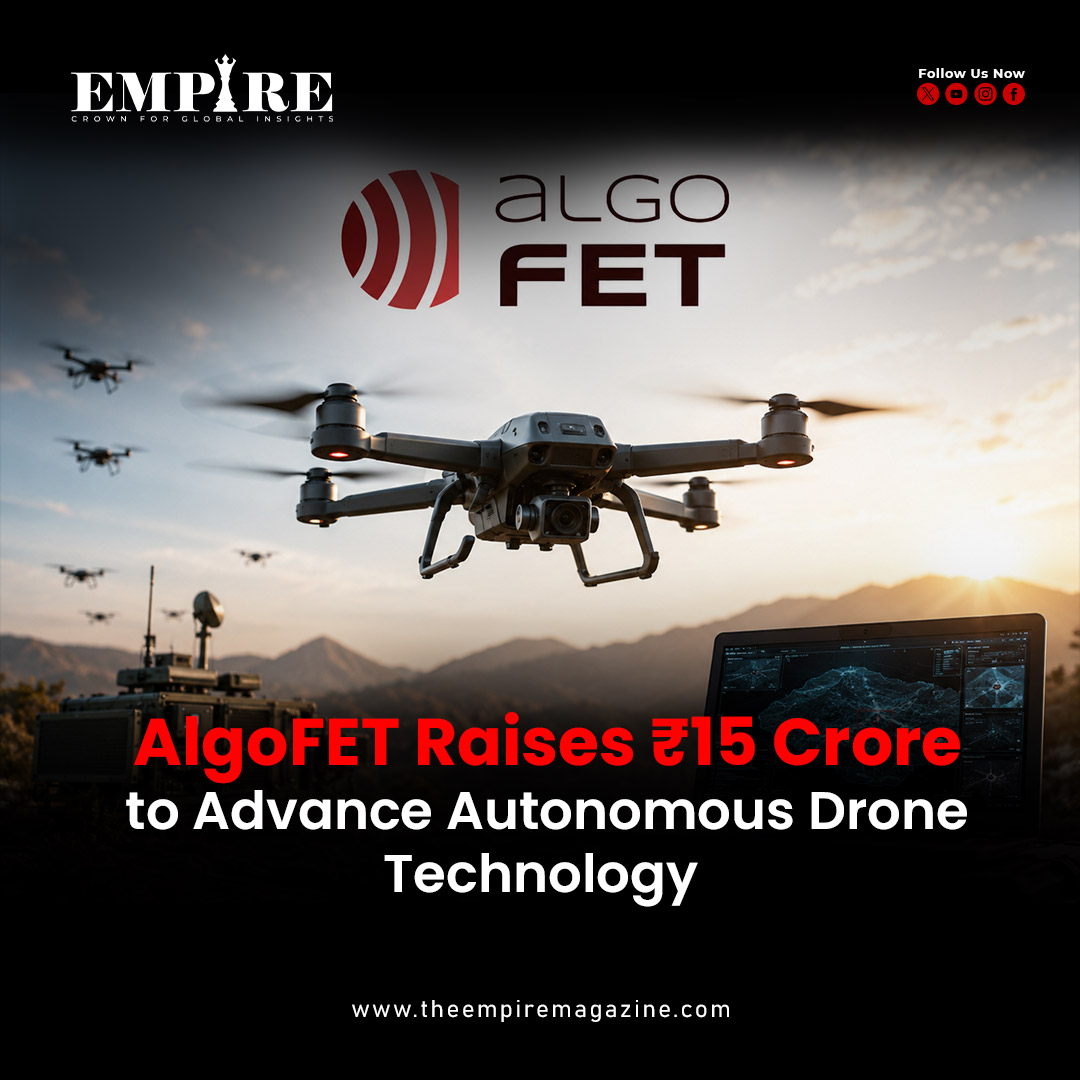
AlgoFET raises ₹15 crore in Pre-Series A funding led by Piper Serica to scale autonomous drone infrastructure, manufacturing, and global deployments. AlgoFET has raised ₹15 crore in a Pre-Series A funding round led by Piper Serica to advance autonomous drone technology and infrastructure. The Bengaluru-based deep-tech startup plans to expand manufacturing, strengthen proprietary technology, develop next-generation drone systems, and scale deployments across defence, enterprise, and international markets.
AlgoFET Raises ₹15 Crore in New Funding
AlgoFET has raised ₹15 crore in a Pre-Series A funding round led by Piper Serica, marking an important step for the Bengaluru-based deep-tech startup as it works to build the infrastructure needed for more autonomous drone operations. The funding was announced on August 19, 2026, with the company saying the fresh capital will support product development, in-house manufacturing, proprietary intellectual property, and deployments across defence, enterprise, and international markets.
The announcement comes at a time when drones are moving beyond limited pilot projects and becoming operational tools across defence, agriculture, logistics, surveillance, infrastructure inspection, and industrial applications. Yet the aircraft itself is only one part of the equation. A drone may be capable of autonomous flight, but charging, battery management, landing, and preparing for the next mission can still require human involvement.
That is the gap AlgoFET is attempting to address. Founded in December 2023 by Ankit Mishra, the company is developing autonomous ground infrastructure designed to allow drones to recover, recharge, and return to service with minimal human intervention.
The Vision Behind AlgoFET Autonomous Drone Technology
The central idea behind AlgoFET autonomous drone technology is straightforward but strategically important: true drone autonomy cannot depend entirely on what happens in the air. For drones to operate continuously, the infrastructure on the ground must also become intelligent, reliable, and automated.
AlgoFET describes itself as a technology startup focused on drone operation infrastructure, including autonomous docking, charging, battery management, and fleet monitoring. Its official platform highlights products such as AlgoDOCK for autonomous drone docking, wireless charging solutions, intelligent battery charging, and smart battery monitoring.
The company is incubated at ARTPARK, an innovation ecosystem associated with the Indian Institute of Science, Bengaluru. Its work reflects a broader shift in Indian deep-tech entrepreneurship: instead of competing only at the visible layer of a technology, startups are increasingly targeting the underlying systems that determine whether that technology can operate reliably at scale.
For AlgoFET, that means treating the drone dock, charging system, battery intelligence, electronics, firmware, and fleet software as parts of one connected ecosystem.
How AlgoFET Is Building Drone Infrastructure
AlgoFET’s approach extends beyond building a conventional charging station. The company says its proprietary technology covers five integrated layers: autonomous docking mechanisms, intelligent battery management, high-power charging systems, embedded electronics and firmware, and cloud-based fleet monitoring. Together, these layers are designed to create a vertically integrated infrastructure stack for autonomous drone operations.
This integrated approach matters because every stage of a drone mission affects the next one. A drone must land accurately, connect with the charging infrastructure, manage its battery safely, communicate operational information, and become ready for another mission. If one of these stages requires constant manual intervention, the promise of continuous autonomous operation becomes harder to achieve.
AlgoFET’s technology is therefore aimed at reducing the human involvement between missions. Instead of treating charging as a separate activity, the company is positioning power management and docking as fundamental components of autonomous drone operations.
The startup’s official product portfolio reflects this broader strategy, combining docking, wireless charging, intelligent battery management, and monitoring tools into a unified ecosystem.
AlgoFET Funding to Expand Manufacturing
The ₹15 crore AlgoFET funding round is not being positioned simply as a research investment. A significant part of the capital will go toward strengthening the company’s manufacturing capabilities and operational capacity.
According to the company’s funding announcement, AlgoFET has a 12,000-square-foot fully operational manufacturing facility. The new capital is expected to help expand in-house manufacturing, strengthen quality systems, support working capital requirements, and prepare the company to deliver its technology at a larger scale.
This is a significant transition for a hardware-focused deep-tech company. Developing a working prototype is very different from manufacturing thousands of reliable units. Production requires supply-chain discipline, testing, quality control, inventory planning, after-sales support, and repeatable processes.
AlgoFET has reported that more than 2,000 units have already been deployed and that it has an order pipeline exceeding 4,000 units. The company also reports an order book of ₹100 crore and says it works with leading Indian drone vendors and the Indian Army.
If these deployments and orders convert successfully into recurring commercial scale, the funding could help AlgoFET move from a promising deep-tech startup toward a larger industrial technology company.
Why Autonomous Drone Infrastructure Matters
The importance of autonomous drone infrastructure becomes clearer as drone fleets become larger and missions become longer. A single drone can be manually charged and relaunched without creating much operational complexity. But managing dozens or hundreds of drones across remote locations presents an entirely different challenge.
Defence surveillance, infrastructure inspection, logistics, agriculture, emergency response, and industrial monitoring can all require drones to operate repeatedly over extended periods. In such environments, sending personnel to retrieve, charge, inspect, and redeploy drones can reduce efficiency and increase operating costs.
Autonomous infrastructure offers a potential solution by turning the ground station into an intelligent operational hub. A drone can return to a designated location, dock, recharge, undergo battery-related monitoring, and prepare for another mission with substantially less human involvement.
That is why AlgoFET’s strategy extends beyond charging. Its focus on battery management, docking, embedded systems, and cloud-based fleet monitoring aims to create an infrastructure layer that can support continuous drone operations.
AlgoFET and India’s Defence Drone Market
Defence is emerging as one of the most important markets for autonomous drone technology in India, and AlgoFET is positioning its infrastructure for this growing demand. The company says it already works with the Indian Army and leading drone vendors, giving it exposure to a sector where reliability and operational readiness are critical.
For defence users, autonomous drone infrastructure could have practical advantages. Remote surveillance missions, border monitoring, reconnaissance, and other applications may require aircraft to remain operational without frequent human intervention. A dependable docking and charging system could therefore become as important as the drone itself.
India’s broader push toward indigenous defence technology also creates an opportunity for companies developing domestic components and infrastructure. AlgoFET’s origins in the ARTPARK and IISc-linked ecosystem reinforce its positioning as an Indian deep-tech company focused on building technology locally.
The company has already received recognition for its work. ARTPARK previously highlighted AlgoFET’s Innovation of the Year award at Drone Expo Mumbai for its contributions to drone battery management and autonomous charging technology.
AlgoFET Autonomous Drone Technology Goes Global
The latest AlgoFET funding round also signals an ambition beyond India. The company plans to scale deployments across international markets, including the United States and Europe, while continuing to serve defence and enterprise customers.
International expansion could significantly increase the addressable market for autonomous drone infrastructure. Drone adoption is growing across multiple industries globally, but operators face the same basic challenge: aircraft need reliable systems between flights if autonomous operations are expected to run continuously.
For an Indian deep-tech company, entering these markets will require more than technological capability. Certification, customer trust, regulatory compliance, local partnerships, manufacturing consistency, and long-term service support will all become important.
The company’s integrated technology stack could provide differentiation if it can demonstrate reliability across different drone platforms and operating environments. Its ability to combine hardware, firmware, battery intelligence, charging, docking, and cloud monitoring may also allow it to develop deeper relationships with drone manufacturers and operators.
Challenges Ahead for AlgoFET
The opportunity surrounding AlgoFET is significant, but scaling autonomous drone technology will not be without challenges. Hardware companies face a different growth equation from software startups because every additional deployment requires physical manufacturing, components, testing, logistics, installation, and maintenance.
The company will therefore need to demonstrate that its reported order pipeline can translate into sustainable revenue and repeat customers. Its proprietary technology must also perform consistently in demanding environments where weather, battery conditions, connectivity, landing accuracy, and power availability can all affect operations.
Competition is another factor. As autonomous drone adoption grows, more companies are likely to focus on docking stations, charging systems, fleet management, and supporting infrastructure.
AlgoFET’s ability to maintain technological differentiation while expanding manufacturing will be central to its next phase. The ₹15 crore investment provides additional resources, but execution will ultimately determine whether the company can turn its technology and reported deployments into a scalable global business.
The Road Ahead for AlgoFET
The next stage for AlgoFET will be defined by execution. The company has already moved beyond the early prototype phase, with more than 2,000 units deployed according to its own figures, a reported pipeline of more than 4,000 units, and a ₹100 crore order book.
Now, the challenge is to convert that momentum into a larger and more repeatable operating model.
The new capital gives AlgoFET room to accelerate next-generation products, expand manufacturing, strengthen intellectual property, and increase deployments. It also gives the company an opportunity to build the operational systems required for international growth.
If autonomous drones are to become truly unattended systems, the infrastructure supporting them will need to evolve alongside the aircraft. AlgoFET is betting that this less visible layer could become one of the most important parts of the drone ecosystem.
What AlgoFET Funding Means for India
AlgoFET raises ₹15 crore at an important moment for India’s deep-tech and drone technology ecosystem. The investment is not simply about one company’s expansion; it reflects growing investor interest in the infrastructure required to make autonomous systems commercially useful.
India has built significant capabilities in drones, robotics, artificial intelligence, and electronics. The next challenge is connecting these technologies into reliable systems that can operate continuously in the real world.
AlgoFET’s focus on autonomous docking, charging, battery management, embedded electronics, and fleet monitoring addresses exactly that requirement. Its technology could help bridge the gap between a drone that can fly autonomously and a drone fleet that can actually operate with minimal human intervention.
The ₹15 crore funding round led by Piper Serica gives the company additional capital to pursue that ambition.
For India’s growing drone economy, the bigger story may be what happens after the drone takes off. As autonomous operations become more common, the infrastructure that keeps aircraft powered, monitored, and mission-ready could become just as important as the aircraft itself.
AlgoFET is now positioning itself to build that infrastructure from India.
Previous article: https://theempiremagazine.com/rayhan-papar/
Magazine Feautures | Podcasts: Empire Global Talks
Follow The Empire Magazine on Facebook | Instagram | LinkedIn | YouTube
The Empire Magazine | Crown for Global Insights