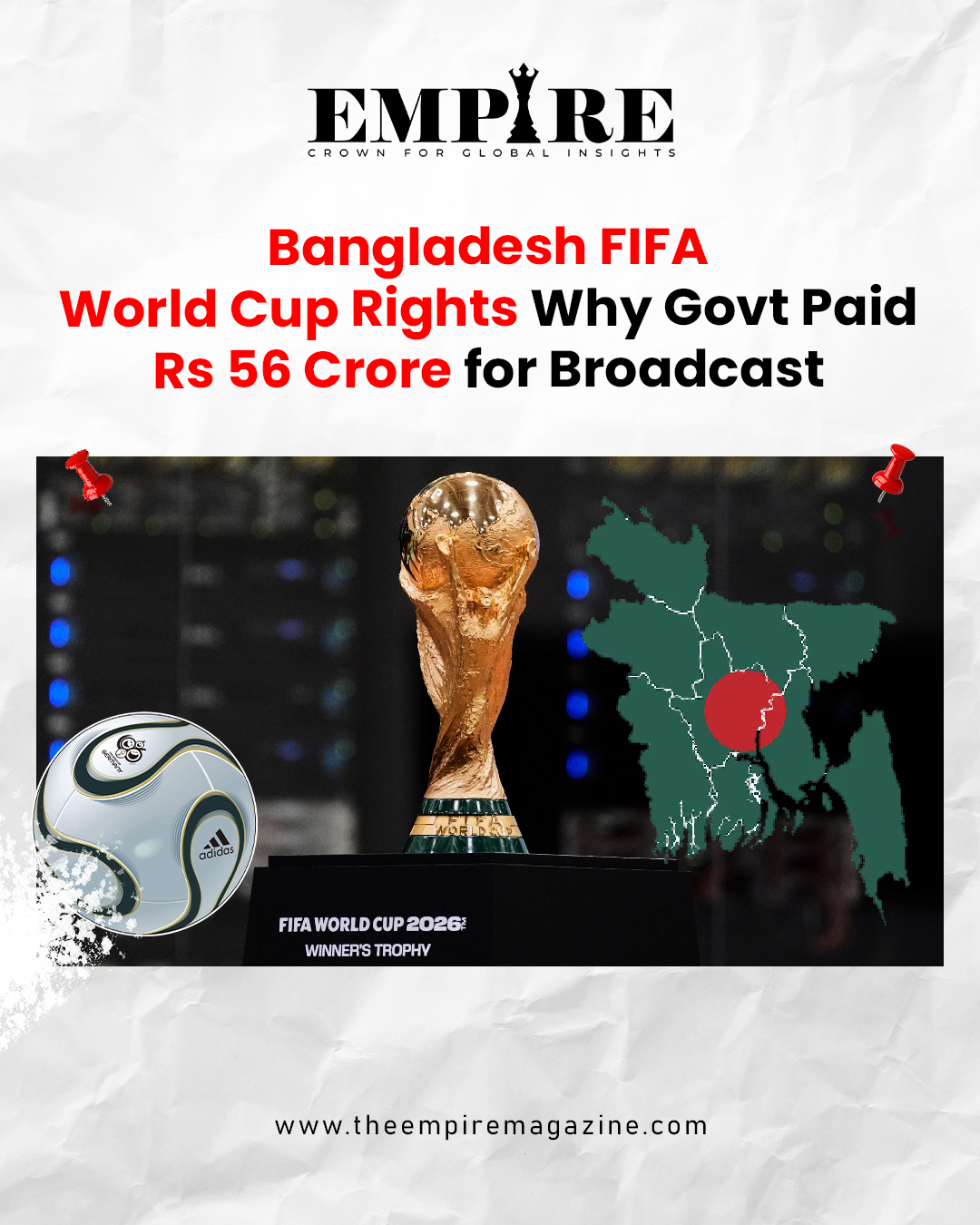
Bangladesh FIFA World Cup Rights have become a major talking point after the government stepped in to secure the broadcast rights for the upcoming FIFA World Cup. The tournament, which will feature 48 teams, will now be aired live on state-owned Bangladesh Television, also known as BTV. The deal is worth Tk 72.70 crore, which is around Rs 56 crore in Indian currency.
The decision was not part of the original broadcasting plan. The Bangladesh government was not FIFA’s first choice for the media rights, and the state broadcaster was not initially expected to air the tournament. However, after complications with a Singapore-based company that had earlier secured the rights, the government had to act quickly to make sure football fans in Bangladesh could watch the World Cup live.
This development shows how sports broadcasting rights have become a serious business issue. Major tournaments are no longer only about games, teams, and fans. They also involve media rights, payment deadlines, advertising potential, timing challenges, public access, and national broadcasting responsibility.
Bangladesh FIFA World Cup Rights and the Government’s Last-Minute Move
Bangladesh FIFA World Cup Rights became a government matter after the earlier media-rights arrangement collapsed. FIFA had initially sold the Bangladesh broadcast rights to Springbok Pte Ltd, a company based in Singapore. That deal was reportedly worth around Tk 88 crore.
However, the arrangement did not continue smoothly. Reports said the deal was cancelled after issues between FIFA and Springbok, including the company’s failure to meet payment deadlines on multiple occasions. As a result, the rights situation reopened close to the tournament, creating uncertainty for viewers in Bangladesh.
This left football fans in a difficult position. The FIFA World Cup is one of the most-watched sports events in the world, and Bangladesh has a passionate football audience. Even though Bangladesh is not a World Cup-playing nation, fan interest in teams such as Argentina, Brazil, France, Germany, and Portugal is extremely strong.
To avoid a blackout or limited access, the Bangladesh government stepped in and secured the rights through the state broadcaster. This ensured that the matches would be available live on BTV.
Why the Government Bought the Broadcast Rights
The main reason the Bangladesh government bought the rights was public access. If no broadcaster had secured the rights in time, millions of football fans could have missed live coverage of the tournament. For a country with a large and passionate football audience, that would have created public disappointment.
State broadcasters often play an important role in making major national and international events accessible to wider audiences. BTV’s involvement means the tournament can reach viewers beyond premium sports packages and private platforms.
The government’s move also reflects the cultural value of the FIFA World Cup. In Bangladesh, the World Cup is not just a sports event. It becomes a national viewing moment, with homes, shops, streets, cafes, and public spaces filled with football discussions and celebrations.
Public Demand and Football Culture in Bangladesh
Football has a strong emotional connection in Bangladesh. World Cup seasons often bring visible support for global teams, especially Argentina and Brazil. Flags, jerseys, social media debates, watch parties, and community screenings are common during the tournament.
Because of this demand, the broadcast-rights issue became more than a commercial matter. It became a public-interest issue. The government had to consider whether fans would have easy access to live matches.
By securing the rights for BTV, the government helped protect mass access to the tournament. This is especially important for viewers who may not have access to paid platforms or private sports channels.
The Role of Springbok Pte Ltd
Springbok Pte Ltd had originally secured the Bangladesh media rights from FIFA. The deal was reportedly valued at around Tk 88 crore. However, the deal later faced problems and was cancelled.
According to reports, the cancellation was linked to Springbok’s failure to meet payment deadlines. Once the company could not continue with the arrangement, the rights had to be handled again.
This created an opportunity for the Bangladesh government to negotiate directly and secure the rights at a lower value than the earlier reported Springbok deal. The final government deal was Tk 72.70 crore, which is lower than the earlier Tk 88 crore figure.
This shows how payment timing and commercial confidence are critical in sports rights deals. Even if a company secures rights initially, it must meet financial obligations on time. If it fails, the rights can return to the market or be reassigned.
Why the Deal Value Was Lower Than Before
The new deal value is lower than the amount paid for the 2022 FIFA World Cup in Qatar. Bangladesh had also aired the last World Cup through government involvement, and the rights for that tournament were reportedly bought for Tk 98 crore.
This time, the cost is lower despite the tournament expanding from 32 teams to 48 teams. On the surface, a larger tournament might seem more valuable because it includes more matches and more participating countries. However, broadcast value depends on more than the number of teams.
One major factor is timing. The upcoming World Cup will be played across Canada, Mexico, and the United States. Because of the time-zone difference, many matches may air at difficult hours for audiences in Bangladesh and the wider Indian subcontinent.
Time-Zone Challenge for South Asian Broadcasters
Time-zone differences can strongly affect sports broadcasting value. A match that airs during prime time can attract more viewers and advertisers. A match that airs late at night or early in the morning may attract fewer casual viewers.
For South Asian broadcasters, the North American timing creates a challenge. Even if the FIFA World Cup has huge global appeal, inconvenient match times can reduce advertising potential and commercial confidence.
This is one reason why some broadcasters in the Indian subcontinent have been cautious about finalising deals with FIFA. If the audience size is expected to be lower during difficult time slots, broadcasters may not want to pay very high rights fees.
Why Indian Broadcasters Were Also Cautious
The same timing issue affected interest from Indian broadcasters. Reports suggested that FIFA was struggling to sell media rights in India because the match timings would not be ideal for Indian audiences.
India and Bangladesh are both football-viewing markets, but the commercial value of rights depends heavily on viewership timing, advertiser interest, and platform strategy. If matches take place during inconvenient hours, advertisers may reduce spending expectations.
This makes the 2026 World Cup different from the 2022 Qatar World Cup. Qatar’s time zone was much more suitable for audiences in Bangladesh and India. As a result, broadcast value in the subcontinent was stronger.
The North American edition may still attract strong football fans, but casual viewership could be affected by late-night and early-morning schedules.
What the Deal Means for BTV
For BTV, securing the FIFA World Cup rights is a major broadcasting opportunity. State-owned television channels often compete with private media platforms for audience attention. A global event like the World Cup can bring millions of viewers back to the national broadcaster.
Live sports remain one of the strongest forms of television content because people want to watch matches in real time. Unlike films, dramas, or web content, sports lose value if viewers already know the result. This gives broadcasters a powerful reason to invest in live rights.
For BTV, the tournament can increase reach, public relevance, and national visibility. It may also create advertising and sponsorship opportunities around match coverage, analysis shows, highlights, and football-related programming.
Public Broadcasting and National Access
The deal also highlights the role of public broadcasting. Private broadcasters may focus mainly on commercial returns, but state broadcasters also consider public access. When a major event has mass cultural value, a government-backed broadcaster can step in to make sure citizens are not excluded.
This does not mean the cost is small. Tk 72.70 crore is a significant amount. However, the government’s decision suggests that the World Cup’s public importance was considered strong enough to justify the spending.
Business Lessons From the Broadcast Rights Issue
The Bangladesh FIFA World Cup rights story offers several business lessons. First, sports rights are valuable but risky. Companies must calculate not only fan interest but also match timing, advertising demand, payment capacity, and distribution strategy.
Second, rights deals can change quickly if payment obligations are not met. Springbok’s reported payment issues created a new situation that allowed the Bangladesh government to enter.
Third, public demand can shape business decisions. In Bangladesh, football passion created pressure to make sure the tournament was available. The government’s move was not only a media transaction; it was also a response to public expectation.
Why Broadcast Rights Matter in Modern Sports
Broadcast rights are one of the biggest revenue sources in global sports. FIFA, cricket boards, Olympic committees, football leagues, and other major sports organizations earn huge sums from selling media rights. Broadcasters pay because live sports can attract large audiences and advertisers.
However, the value of these rights depends on market conditions. A tournament may be globally popular, but each country has different viewing habits, time-zone realities, advertising markets, and platform competition.
Bangladesh’s final deal shows that rights pricing can shift when a market faces timing challenges or failed commercial negotiations. The tournament is bigger than before, but the local value still depends on how many people can watch comfortably and how much advertisers are willing to pay.
What Fans Can Expect
With the government securing the rights, fans in Bangladesh can expect live World Cup coverage on BTV. This removes uncertainty and ensures that the tournament will be available through the state broadcaster.
For many viewers, this is the most important outcome. The business side of the deal may involve rights fees, missed payments, and negotiation pressure, but fans mainly care about access to live matches.
The decision also confirms that the World Cup remains one of the rare global events that can push governments, broadcasters, and rights holders into urgent action. Football’s emotional power continues to shape business decisions far beyond the stadium.
Readers can also explore more innovation and technology insights through this related article: AI-Designed Vaccine: How a World-First Trial Could Change Pandemic Protection.
For more updates from The Empire Magazine, follow us on Facebook and Instagram.
– The Empire Magazine
Crown For Global Insights