
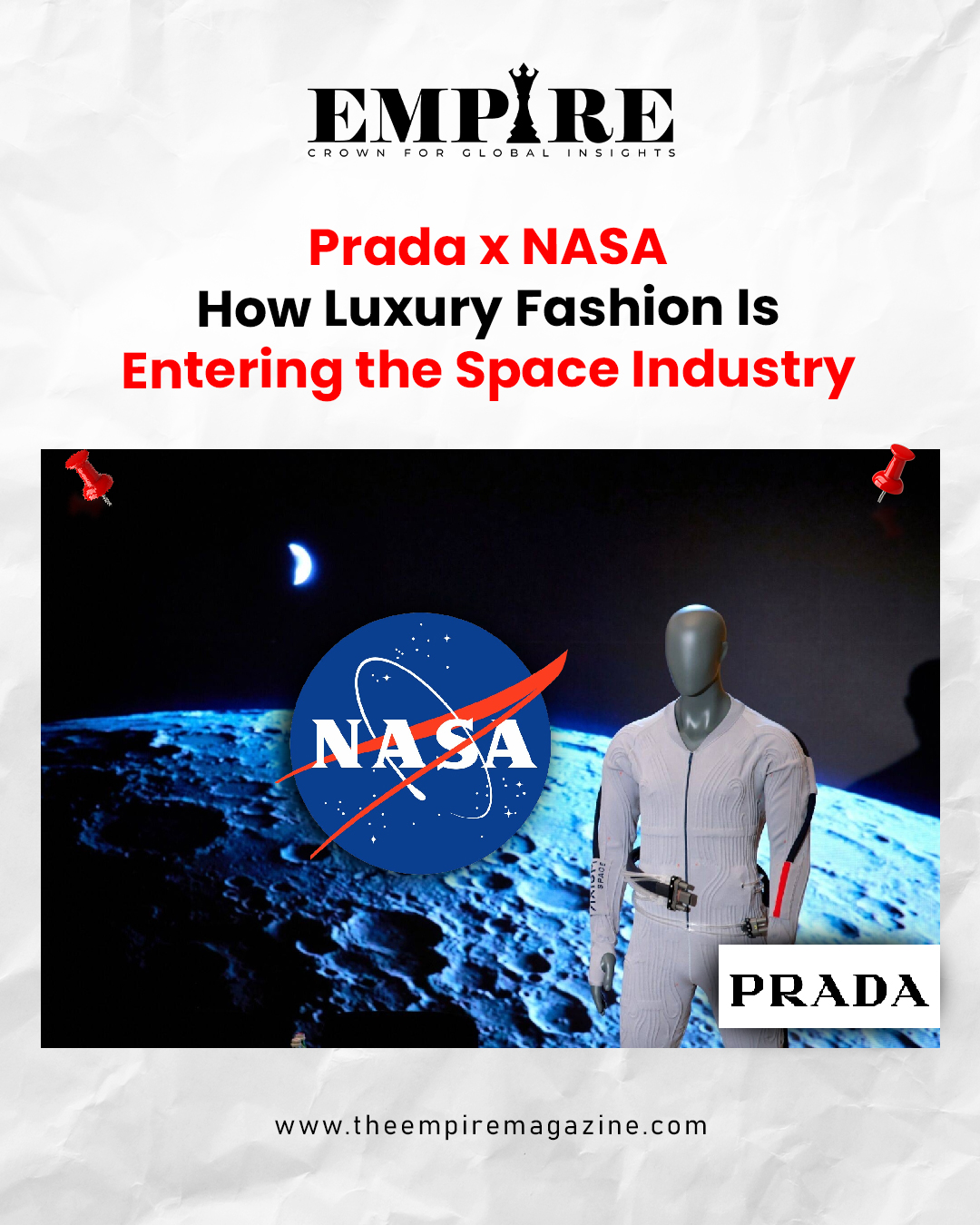
Prada x NASA has become one of the most surprising and important examples of how luxury fashion is entering the space industry. The partnership connects Italian luxury house Prada with Axiom Space, the Houston-based space company developing next-generation spacesuits for NASA’s Artemis lunar missions. It shows that fashion, materials science, engineering, and space exploration are no longer separate worlds.
Prada is not designing a spacesuit simply for style. Its role is connected to materials, construction, comfort, sewing expertise, and performance design. Axiom Space is leading the development of the Axiom Extravehicular Mobility Unit, known as AxEMU, for NASA’s Artemis program. Prada has contributed expertise in high-performance materials and garment construction, showing how luxury fashion knowledge can support advanced technical products.
This collaboration matters because future space missions require more than rockets and spacecraft. Astronauts also need equipment that protects the human body in extreme environments. A spacesuit is both a life-support system and a wearable technology platform. That makes it a natural area where fashion expertise, textile innovation, and aerospace engineering can meet.
Prada x NASA and the New Space-Fashion Partnership
Prada x NASA became widely discussed after Prada and Axiom Space announced their collaboration in 2023. Axiom Space had already been selected by NASA to develop spacesuits for Artemis missions, and Prada joined the project to support the design and development process.
The Artemis program is NASA’s effort to return astronauts to the Moon and build a foundation for longer-term lunar exploration. Artemis III is planned as the first crewed Moon landing mission of the program, and it is expected to include the first woman and first person of color to land on the lunar surface.
For Prada, the project represents entry into one of the most advanced technical fields in the world. For Axiom Space, the collaboration brings knowledge from a luxury brand with long experience in materials, craftsmanship, clothing performance, and product quality.
This partnership also changes how people think about fashion. Luxury fashion is often associated with runway shows, handbags, couture, retail stores, and celebrity campaigns. Prada’s space collaboration shows that fashion houses can also contribute to engineering challenges.
Why Luxury Fashion Matters in Space Technology
Luxury fashion matters in space technology because clothing is not simple when the environment is extreme. On Earth, fashion must consider comfort, movement, heat, durability, and design. In space, those requirements become much more serious.
A lunar spacesuit must protect astronauts from vacuum, dust, radiation, extreme temperature changes, and physical stress. It must allow movement, support scientific tasks, help regulate body temperature, and remain reliable during spacewalks.
Prada’s experience in high-performance textiles and construction can help with parts of this challenge. The company has a long history of working with advanced materials, including technical fabrics used in sports, travel, and performance-oriented fashion. That knowledge can be useful when designing garments that must fit, move, breathe, and protect.
From Runway Craft to Mission-Critical Design
The Prada x NASA story is not about turning astronauts into fashion models. It is about applying garment expertise to mission-critical design. A luxury fashion house understands how fabric behaves, how seams affect movement, how construction impacts durability, and how comfort changes over long periods of wear.
A spacesuit must work with the body, not against it. Astronauts need mobility in shoulders, elbows, knees, gloves, boots, and torso sections. They may need to bend, kneel, collect samples, carry tools, and operate equipment on the lunar surface.
Small design improvements can matter. Better mobility can reduce fatigue. Better thermal regulation can improve safety. Better sizing can allow more astronauts to use the suit effectively. This is why fashion and aerospace collaboration can have practical value.
Axiom Space and the AxEMU Spacesuit
Axiom Space is the company responsible for developing the AxEMU spacesuit for NASA’s Artemis missions. The suit is designed for lunar surface operations and is expected to support astronauts working near the Moon’s South Pole.
The Moon’s South Pole is an important target because it may contain water ice in permanently shadowed regions. That makes it scientifically valuable and potentially useful for future long-term exploration. However, the environment is difficult. Astronauts may face harsh lighting, uneven terrain, abrasive lunar dust, and major temperature differences.
The AxEMU suit is being designed to improve mobility, safety, and fit compared with older spacesuit systems. NASA has reported that the suit has passed a contractor-led technical review, and testing has included simulated lunar surface tasks with NASA astronauts and spacesuit engineers.
What Makes the New Suit Important
The new suit is important because NASA’s Artemis missions require equipment designed for modern exploration goals. Apollo-era suits were built for short Moon visits. Artemis aims to support more complex missions, broader astronaut participation, and eventually longer-term lunar operations.
Modern suits need to fit a wider range of body types. They must also support more advanced tools, communications, life-support systems, and surface activities. A spacesuit is essentially a personal spacecraft that astronauts wear.
This makes design quality extremely important. The suit must be safe, functional, comfortable, and durable. Axiom Space brings aerospace systems expertise, while Prada contributes knowledge from the world of advanced garment making.
Prada’s Technical Role in the Collaboration
Prada’s technical role includes support around materials, sewing techniques, and garment design knowledge. The company is known for combining luxury aesthetics with technical experimentation. Its experience with high-performance materials gives it a useful perspective for a spacesuit project.
Luxury brands often work with precision, durability, and complex manufacturing. In a spacesuit, these qualities are essential. Seams, layers, panels, reinforcement, ventilation, and thermal comfort must all be considered carefully.
Prada’s role also highlights the importance of interdisciplinary innovation. The space industry can benefit from experts outside traditional aerospace. Fashion designers, textile engineers, industrial designers, materials scientists, and product developers can all contribute to better human-centered space systems.
The Inner Layer and Astronaut Comfort
Recent reports have also focused on Prada’s involvement in a Liquid Cooling and Ventilation Garment. This type of garment is worn under the outer spacesuit and helps regulate astronaut body temperature. It can include ventilation and cooling systems that support comfort and safety during physically demanding work.
Astronauts working on the Moon may face intense heat from sunlight and extreme cold in shaded areas. Their bodies also generate heat during movement. A cooling and ventilation layer helps manage these conditions.
This is a clear example of how fashion-related expertise can move into space technology. The garment is not decorative. It is part of the life-support and comfort system that helps astronauts perform safely.
Why the Collaboration Is Good for Prada’s Brand
Prada x NASA also has strong brand value for Prada. Luxury brands increasingly want to be seen as innovative, future-facing, and culturally relevant. A partnership connected to lunar exploration gives Prada a powerful story that goes beyond fashion week.
The collaboration places Prada in a conversation about science, engineering, space exploration, and human progress. That can strengthen the brand’s image as a house that is not only stylish but also technically serious.
For luxury brands, storytelling is essential. Prada’s connection to space gives it a rare story: a fashion house helping build equipment for astronauts who may walk on the Moon. This creates global attention and positions the brand at the intersection of luxury and advanced technology.
How Space Is Becoming a New Luxury Frontier
Space is becoming a new frontier for luxury branding because it represents rarity, ambition, exclusivity, and the future. These are themes luxury brands understand well. As commercial spaceflight grows, private space stations, space tourism, lunar missions, and orbital research may create new opportunities for premium brands.
Luxury brands may not all build spacesuits, but they may enter space through hospitality, design, materials, travel experiences, watches, luggage, apparel, architecture, and lifestyle products. Prada’s role with Axiom Space shows one possible path: contributing real technical expertise rather than only using space as a marketing theme.
This matters because consumers can tell the difference between a shallow campaign and a meaningful collaboration. Prada’s involvement is significant because it is connected to a real NASA mission architecture through Axiom Space.
Luxury Consumers and Space Aspirations
The growth of private space companies has created a new kind of aspirational market. Wealthy individuals, investors, entrepreneurs, and global luxury consumers are increasingly interested in space experiences, innovation, and future travel.
Brands that connect with space early may gain cultural advantage. They can build associations with exploration, technology, human ambition, and exclusivity. Prada’s collaboration does exactly that while still remaining grounded in the brand’s technical strengths.
Space also fits luxury because access is limited. Not everyone can go to space, and not every brand can work on mission equipment. That scarcity creates symbolic value.
The Business Impact of Fashion Entering Space
The Prada x NASA collaboration shows that the space industry is becoming more open to cross-industry partnerships. Aerospace companies need expertise from many sectors, including robotics, software, materials, medicine, construction, communications, and wearable design.
Fashion’s role may grow because human spaceflight requires clothing systems, pressure garments, thermal layers, comfort solutions, and mission apparel. As missions become longer and more common, astronaut clothing and interior design may become more important.
Commercial space stations may also create demand for clothing, interiors, uniforms, sleep systems, and human-centered design. These are areas where fashion and luxury brands could contribute.
Challenges of Fashion-Space Collaboration
Fashion-space collaborations must be practical. Space equipment cannot prioritize style over safety. Every component must meet strict technical standards and pass testing. Materials must perform under extreme conditions, and designs must support mission needs.
This creates a challenge for luxury brands. They must adapt to aerospace discipline, long development cycles, testing requirements, and engineering limits. A spacesuit cannot be treated like a seasonal product.
Prada’s collaboration works because it is tied to technical expertise, not only branding. The success of such partnerships depends on whether fashion knowledge can improve comfort, construction, materials, or performance.
Why Prada x NASA Matters for the Future
Prada x NASA matters because it shows how luxury fashion can become part of serious technological progress. The collaboration with Axiom Space and NASA’s Artemis program proves that design expertise can have value in aerospace when it is applied to real human needs.
The partnership also shows how the meaning of luxury is changing. Luxury is no longer only about heritage, exclusivity, or craftsmanship. It is also about innovation, performance, cultural relevance, and participation in the future.
As space exploration becomes more commercial and more international, more industries will enter the field. Prada’s role in the Artemis spacesuit story may be remembered as one of the first major examples of luxury fashion stepping into the space economy with a real technical contribution.
Readers can also explore more space business insights through this related article: SpaceX Reusable Rockets: How Space Technology Became a Business Revolution.
For more updates from The Empire Magazine, follow us on Facebook and Instagram.
– The Empire Magazine
Crown For Global Insights