
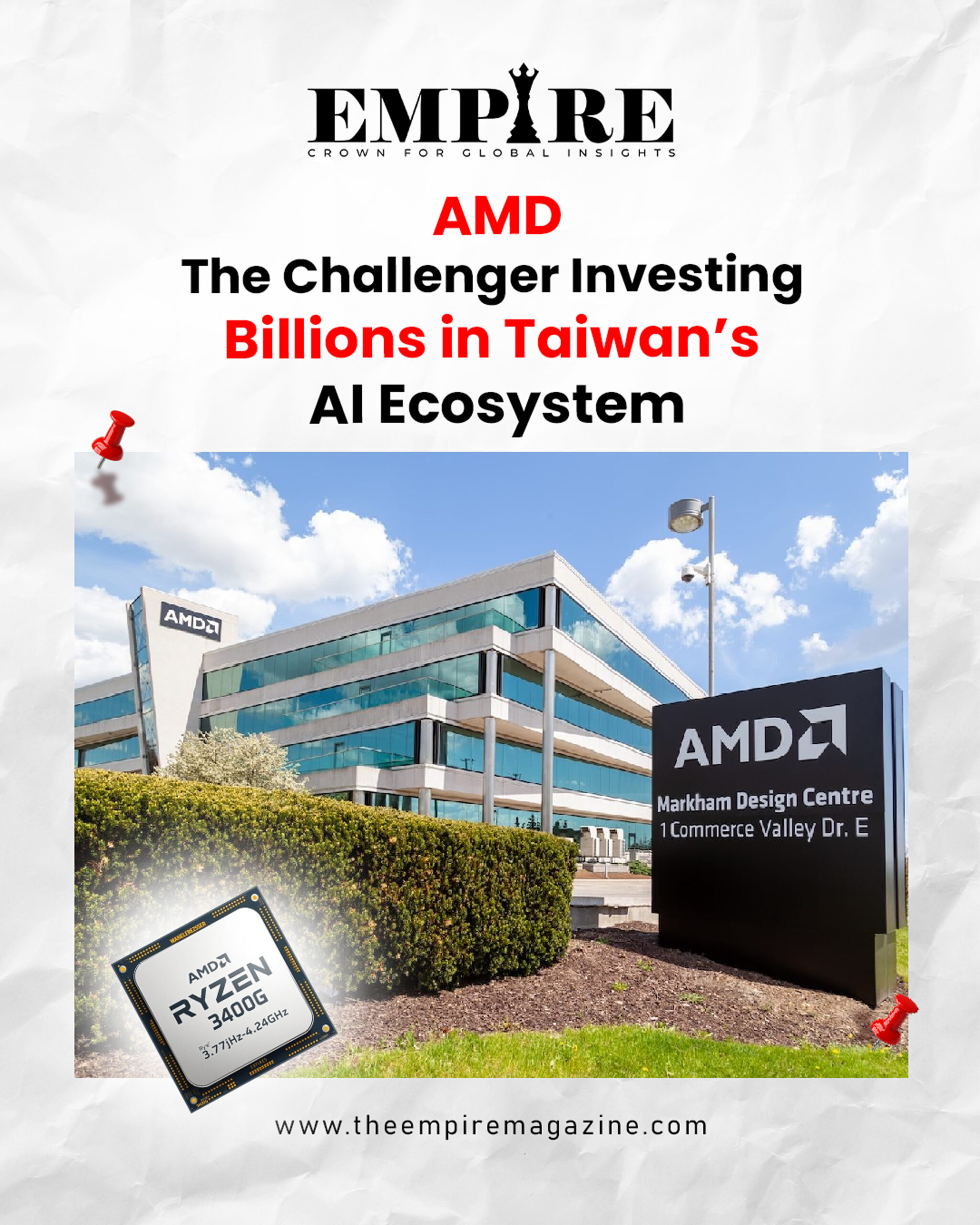
AMD Is Strengthening Its Role in the AI Chip Race
AMD is becoming one of the most important challengers in the global AI hardware market. The company, officially known as Advanced Micro Devices, has long competed in processors, graphics chips, data center products, and high-performance computing. In the artificial intelligence era, AMD is positioning itself as a major alternative to Nvidia, the company currently dominating advanced AI accelerators.
In May 2026, AMD announced more than $10 billion in investments across Taiwan’s technology ecosystem. The company said the investment is designed to expand strategic partnerships and scale advanced packaging manufacturing for next-generation AI infrastructure. This move shows how important Taiwan has become to the future of AI chips, data centers, and semiconductor supply chains.
AMD’s investment is not only about one factory or one product. It is about building stronger capacity around advanced packaging, substrates, manufacturing, AI systems, and rack-scale infrastructure. These areas are essential because modern AI hardware requires more than powerful chips. It needs a complete ecosystem that can design, assemble, connect, cool, and deploy AI systems at scale.
Why Taiwan Matters to AMD
Taiwan is one of the most important semiconductor hubs in the world. It is home to Taiwan Semiconductor Manufacturing Company, known as TSMC, which manufactures chips for many leading global technology companies. Taiwan also has major companies in chip packaging, testing, server assembly, substrates, electronics manufacturing, and supply chain engineering.
Taiwan’s Semiconductor Ecosystem
Taiwan’s strength comes from its complete semiconductor network. Chip design companies, foundries, packaging firms, testing providers, server makers, component suppliers, and engineering talent work closely together. This makes Taiwan especially important for companies building AI infrastructure.
AMD depends on advanced semiconductor manufacturing and packaging partners to bring its AI chips and processors to market. By investing more deeply in Taiwan, AMD can strengthen relationships with suppliers and improve the speed and scale of its AI hardware production.
Advanced Packaging Is Central to AI Infrastructure
AMD’s Taiwan investment focuses heavily on advanced packaging. Advanced packaging is one of the most important technologies in AI hardware because AI chips need to move huge amounts of data quickly between processors, memory, and other components.
Traditional chip performance is no longer only about making transistors smaller. AI systems now require chiplets, high-bandwidth memory, interconnects, substrates, and packaging technologies that allow multiple components to work together efficiently.
Why Packaging Matters for AI Chips
AI accelerators require high performance and energy efficiency. Advanced packaging helps connect compute chips with memory and other components in ways that improve speed and reduce power loss. This is especially important for training and running large AI models.
AMD has been a major supporter of chiplet design, where different chip components are combined into one package. This approach can improve flexibility, performance, and manufacturing efficiency. Taiwan’s advanced packaging capacity helps AMD scale this strategy for AI workloads.
AMD’s AI Product Strategy
AMD’s AI strategy includes GPUs, CPUs, adaptive computing, networking, and software. The company’s Instinct GPU family is designed for data centers and AI workloads. AMD also offers EPYC server processors, which are used in cloud computing, enterprise servers, and high-performance computing environments.
The company has positioned itself as a full AI infrastructure provider, combining CPUs, GPUs, adaptive computing, and open software. This matters because AI data centers need complete systems rather than isolated chips.
AMD Instinct and EPYC
AMD Instinct GPUs are built for AI training and inference workloads. These chips compete in a market where demand for AI accelerators has increased sharply because of generative AI, large language models, recommendation systems, and enterprise automation.
AMD EPYC processors are also important because AI systems need powerful CPUs to support GPUs, manage workloads, and run data center operations. AMD has highlighted its 6th Generation EPYC CPUs, codenamed “Venice,” as part of its future AI infrastructure roadmap.
The Helios Rack-Scale Platform
AMD has also discussed its Helios rack-scale platform, which combines EPYC CPUs and AMD Instinct MI450X GPUs. Rack-scale systems are important because AI computing increasingly happens at the level of full server racks, not only individual chips or servers.
Why Rack-Scale AI Systems Matter
Large AI workloads require thousands of processors working together. A rack-scale platform is designed to connect compute, memory, networking, and power systems more efficiently. This helps cloud providers, AI companies, and enterprise customers deploy infrastructure for large-scale AI.
AMD said its Helios platform is expected to support multi-gigawatt deployments beginning in the second half of 2026. This shows how AI hardware is becoming an infrastructure business connected to energy, data centers, and global supply chains.
AMD as the Challenger to Nvidia
Nvidia remains the dominant company in AI accelerators, but AMD is one of the strongest challengers. Analysts and investors view AMD as a key competitor because it has strong chip design capabilities, major cloud customers, and a broad data center product portfolio.
Why Customers Want More AI Chip Options
Cloud providers and enterprise customers do not want to depend on only one supplier for AI chips. Demand for AI hardware has been extremely high, and supply constraints have made access to advanced GPUs a major issue. More competition can help customers manage costs, improve availability, and create more flexible infrastructure plans.
AMD’s investment in Taiwan supports this competitive position. By expanding manufacturing and packaging capacity, the company can improve its ability to supply AI hardware at scale.
Partnerships With Taiwan Companies
AMD said its Taiwan ecosystem investment will deepen strategic partnerships. Reports highlighted work with Taiwanese packaging and testing companies such as ASE Technology Holding and Siliconware Precision Industries, known as SPIL.
Building a Stronger Supply Chain
AI chips require close coordination between design companies and manufacturing partners. AMD’s investment helps strengthen the supply chain needed for advanced AI processors, substrates, packaging, and rack-scale systems.
This is important because the AI hardware market is moving quickly. Companies that can secure capacity and coordinate production earlier may have an advantage when demand rises.
Taiwan’s Role in the Global AI Economy
Taiwan’s importance is increasing as AI infrastructure expands. Major companies including AMD, Nvidia, Apple, Microsoft, Amazon, Google, and others rely on Taiwan-linked semiconductor and electronics manufacturing networks.
From Chips to AI Systems
Taiwan is no longer only important for making chips. It is also central to AI servers, advanced packaging, data center hardware, and electronics supply chains. This makes the island a major part of the global AI economy.
AMD’s $10 billion-plus investment confirms Taiwan’s role as a strategic technology partner for the next generation of AI infrastructure.
Business Impact of AMD’s Investment
AMD’s Taiwan investment could help the company improve production capacity, strengthen partnerships, and compete more effectively in the AI chip market. It also shows that AI hardware companies are investing heavily in supply chains, not only chip design.
For investors, customers, and technology partners, the move signals AMD’s commitment to long-term AI infrastructure growth. For Taiwan, it reinforces the country’s position as a core hub for advanced semiconductor and AI system development.
For more technology and business insights, read this feature on The Empire Magazine.
Follow The Empire Magazine on Instagram and Facebook.
– The Empire Magazine
Crown For Global Insights