
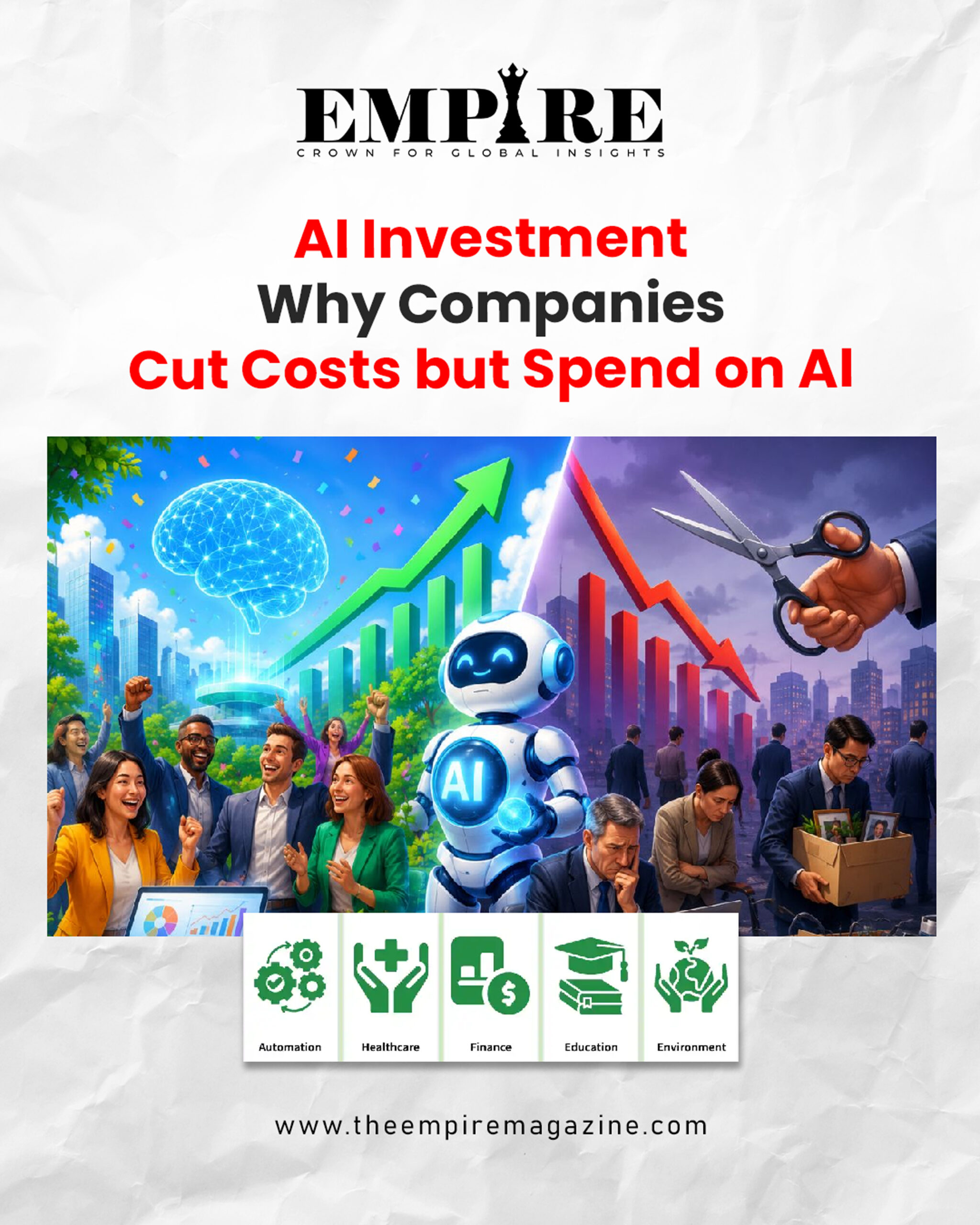
AI Investment Is Rising While Companies Reduce Costs
AI Investment has become one of the most important business trends as companies cut costs in many areas while increasing spending on artificial intelligence. This may look contradictory, but it reflects a major shift in corporate strategy. Businesses are reducing expenses in traditional operations, slow-growth projects, office costs, manual processes, and non-core activities while directing more capital toward AI systems that can improve productivity, automation, customer service, data analysis, and long-term competitiveness.
Companies are not investing in AI only because it is a technology trend. Many organizations are treating AI as a tool for efficiency, growth, and survival. In a competitive market, businesses need faster decision-making, lower operating costs, better customer experiences, and stronger digital infrastructure. AI is becoming part of that transformation.
Why Companies Are Cutting Costs
Cost-cutting usually happens when companies face pressure from inflation, slower demand, higher interest rates, investor expectations, or operational inefficiency. Businesses often review spending across departments to protect margins and improve financial discipline.
Common cost-cutting areas include hiring freezes, office space reduction, travel budgets, marketing experiments, vendor contracts, underperforming projects, and manual administrative work. For public companies, profitability and cash flow are closely watched by investors. For startups, cost control can extend runway and reduce dependency on new funding rounds.
Efficiency Has Become a Boardroom Priority
Efficiency is now a major business priority. Companies want to do more with fewer resources. This does not always mean reducing ambition. It means spending money on systems that can deliver measurable returns.
Artificial intelligence fits into this strategy because it can support automation, faster analysis, predictive planning, and improved customer engagement. Many companies see AI as a way to reduce waste while improving output.
Why AI Spending Is Increasing
AI spending is increasing because companies believe it can create long-term business value. AI can help teams analyze large amounts of data, automate repetitive work, personalize customer experiences, detect fraud, improve forecasting, and support product development.
In many industries, AI is moving from pilot projects to real business use. Banks use AI for risk analysis and fraud detection. Retailers use AI for inventory planning and customer personalization. Manufacturers use AI for predictive maintenance. Healthcare companies use AI for diagnostics support and workflow management. Software companies use AI to improve coding, support, and product features.
AI Is Seen as a Productivity Tool
One of the main reasons companies invest in AI during cost-cutting periods is productivity. AI tools can help employees complete tasks faster. In customer service, chatbots and AI assistants can handle common questions. In marketing, AI can support content planning and campaign analysis. In finance, AI can help process reports and identify anomalies.
This makes AI different from many other expenses. Companies may reduce spending in areas that do not improve productivity, while increasing spending in areas that can reduce future costs.
The Shift From Experimentation to Business Integration
During the early stage of generative AI adoption, many companies tested tools without clear business use cases. Now, more organizations are trying to integrate AI into workflows. The focus is shifting from experimentation to measurable impact.
Businesses are asking practical questions: Can AI reduce support costs? Can it improve sales conversion? Can it speed up software development? Can it improve supply chain decisions? Can it help employees work faster without reducing quality?
AI Must Show Return on Investment
AI projects are increasingly being judged by return on investment. Companies want proof that AI spending leads to efficiency, revenue growth, better service, or stronger decision-making. This is why many businesses are focusing on specific use cases rather than broad AI adoption without strategy.
The strongest AI investments are usually connected to clear business problems. These include reducing customer wait times, improving fraud detection, automating document review, forecasting demand, or improving internal knowledge search.
How AI Helps Reduce Operating Costs
AI can reduce operating costs by automating repetitive tasks and improving decision-making. For example, AI-powered tools can manage routine customer queries, summarize documents, detect errors, monitor systems, and support compliance work.
In large companies, even small efficiency gains can create major savings. If AI reduces manual work across thousands of employees or millions of customer interactions, the financial impact can be significant.
Automation in Back-Office Work
Back-office departments such as finance, HR, legal, procurement, and operations often handle repetitive documentation, reporting, and approval processes. AI can support these tasks by extracting information, organizing data, generating summaries, and flagging risks.
This does not remove the need for human review. Instead, it helps professionals spend less time on repetitive work and more time on judgment-based decisions.
AI Investment and Workforce Changes
AI investment is also linked to workforce restructuring. Some companies are reducing roles in areas where automation can handle repetitive tasks. At the same time, they are hiring or training employees in AI, data science, cybersecurity, cloud systems, and automation.
This creates a mixed picture. Companies may reduce headcount in some functions while expanding teams in AI-related areas. The goal is often to reshape the workforce around digital capabilities.
Reskilling Is Becoming Important
As AI becomes part of business operations, employees need new skills. Many companies are investing in AI training, prompt engineering, data literacy, workflow automation, and responsible AI practices.
Reskilling is important because AI tools are most valuable when employees know how to use them effectively. Businesses that only buy AI software without training teams may struggle to achieve results.
Why Investors Support AI Spending
Investors often support AI spending when it is connected to efficiency and growth. In recent years, many investors have pushed companies to control costs and improve margins. AI investment can support both goals if it leads to productivity gains and stronger competitive positioning.
Technology companies, financial institutions, consulting firms, manufacturers, and retailers are all exploring AI because they do not want to fall behind competitors. In fast-changing markets, underinvesting in AI can become a strategic risk.
Competitive Pressure Is Driving Adoption
Companies are watching how competitors use AI. If one business improves customer service, reduces costs, or launches faster products with AI, others may feel pressure to respond. This competitive pressure is helping drive AI adoption across industries.
AI is becoming less optional in sectors where speed, personalization, automation, and data intelligence are important.
Risks of Spending More on AI
AI investment also carries risks. Companies can waste money if they adopt tools without clear goals. Poor data quality, weak governance, cybersecurity risks, privacy concerns, and inaccurate AI outputs can reduce value.
Businesses also need to manage legal and ethical risks. AI systems must be monitored to avoid bias, misinformation, privacy violations, and poor decision-making.
Responsible AI Governance
Responsible AI governance includes data protection, model testing, human oversight, transparency, and compliance with regulations. Companies investing more in AI need strong controls to make sure the technology supports business goals safely.
AI can improve efficiency, but only when used with proper management and accountability.
The Future of AI Investment
AI Investment is expected to remain a major business priority because companies are looking for tools that support efficiency and growth at the same time. Cost-cutting does not always mean reduced innovation. In many cases, it means shifting money away from lower-value spending and toward technology that can improve long-term performance.
For more business and technology insights, read this feature on The Empire Magazine.
Follow The Empire Magazine on Instagram and Facebook.
– The Empire Magazine
Crown For Global Insights