
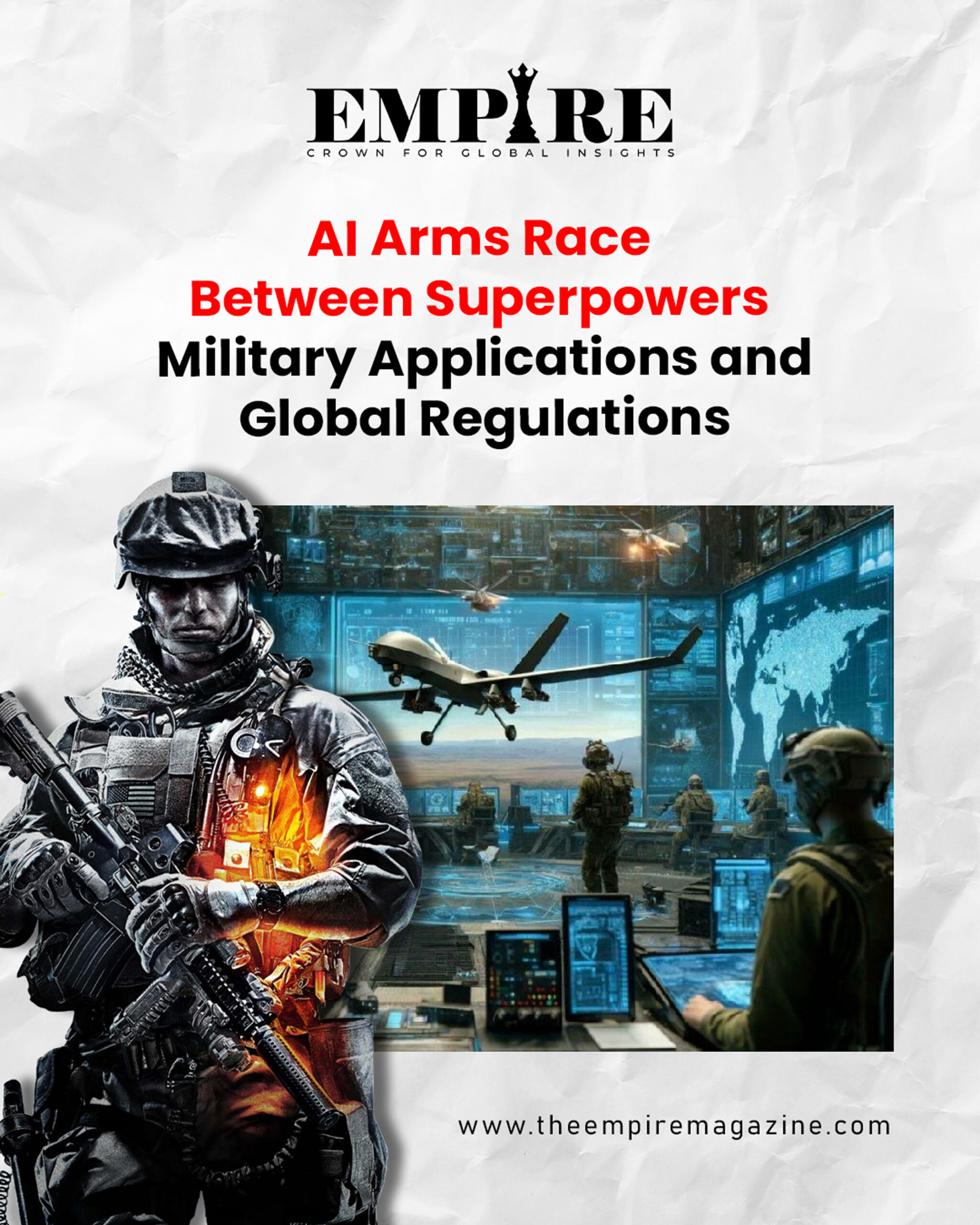
AI Arms Race Between Superpowers is rapidly becoming one of the most critical geopolitical issues of our time. In 2026, the United States, China, and Russia are locked in an intense competition to dominate artificial intelligence for military purposes. This technological race is reshaping global security, military strategy, and international relations.
The New Battlefield: AI Arms Racein Modern Warfare
Artificial intelligence is no longer limited to commercial applications. Militaries worldwide are integrating AI into core defense systems with unprecedented speed.
United States The US maintains a significant lead in many AI technologies. The Department of Defense has heavily invested in autonomous drones, AI-powered intelligence analysis, predictive logistics, and cyber defense systems. Projects like the Joint All-Domain Command and Control (JADC2) aim to create a fully connected battlespace where AI processes vast amounts of data in real time to support decision-making.
China China is aggressively pursuing military AI under its “Military-Civil Fusion” strategy. The People’s Liberation Army is developing AI-enabled swarms of drones, autonomous underwater vehicles, facial recognition for surveillance, and AI systems for rapid battlefield decision-making. China aims to become the world leader in AI by 2030, with clear military objectives.
Russia While behind in some commercial AI areas, Russia is focusing on AI for electronic warfare, hypersonic weapons guidance, and information operations. The country has demonstrated the use of AI in Ukraine for targeting and drone operations.
Key Military Applications of AI Arms Race
- Autonomous Weapons Systems: Lethal Autonomous Weapons (LAWs) that can select and engage targets with minimal human intervention.
- Intelligence, Surveillance, and Reconnaissance (ISR): AI analyzing satellite and drone footage far faster than humans.
- Cyber Warfare: AI systems capable of launching and defending against sophisticated cyber attacks.
- Logistics and Supply Chain: Predictive maintenance and autonomous resupply systems.
- Decision Support: AI assisting commanders with real-time battlefield analysis and scenario simulation.
- Swarm Technology: Coordinated attacks using hundreds of low-cost AI-enabled drones.
Risks of the AI Arms Race
The rapid militarization of AI raises serious concerns:
- Escalation Risks: AI systems may react faster than humans, potentially triggering unintended conflicts.
- Accidents and Miscalculation: Errors in AI judgment could lead to catastrophic outcomes.
- Arms Race Dynamics: Nations feel pressured to deploy AI weapons before they are fully tested or ethically evaluated.
- Proliferation: Advanced AI tools could fall into the hands of non-state actors or rogue nations.
- Strategic Instability: The fear that one side might achieve decisive AI superiority could encourage preemptive actions.
Global Regulation Efforts
International efforts to regulate military AI are progressing slowly. The United Nations has hosted discussions on Lethal Autonomous Weapons Systems, but major powers remain divided.
- The US and its allies generally support “meaningful human control” over lethal decisions.
- China has called for a complete ban on lethal autonomous weapons while simultaneously advancing its own programs.
- Russia has been more resistant to strict regulations.
Currently, there is no binding international treaty specifically governing military AI. Most regulation exists at the national level, with varying degrees of transparency and enforcement.
The Ethical Dilemma
The core question remains: Where should humans draw the line? Many experts argue that certain decisions — especially those involving taking human life — must always remain under meaningful human control. Others believe AI can reduce casualties by making warfare more precise and reducing human error.
What Lies Ahead AI Arms Race
The AI arms race shows no signs of slowing down. As the technology becomes more powerful, the gap between leading nations and others may widen, creating new imbalances in global power.
Nations that successfully integrate AI into their defense strategies while maintaining strong ethical frameworks and international cooperation will likely hold significant advantages in future conflicts.
The coming years will be decisive. The world must find a balance between national security needs and the responsible development of AI to prevent a dangerous and unstable new arms race.
AI Arms Race Between Superpowers: Military Applications and Global Regulations is no longer a distant future scenario — it is happening now, with profound implications for global peace and security.
For more technology and geopolitics insights, explore related coverage here: https://theempiremagazine.com/?p=6603
Follow The Empire Magazine on Instagram and Facebook for the latest updates.
– The Empire Magazine
Crown For Global Insights