
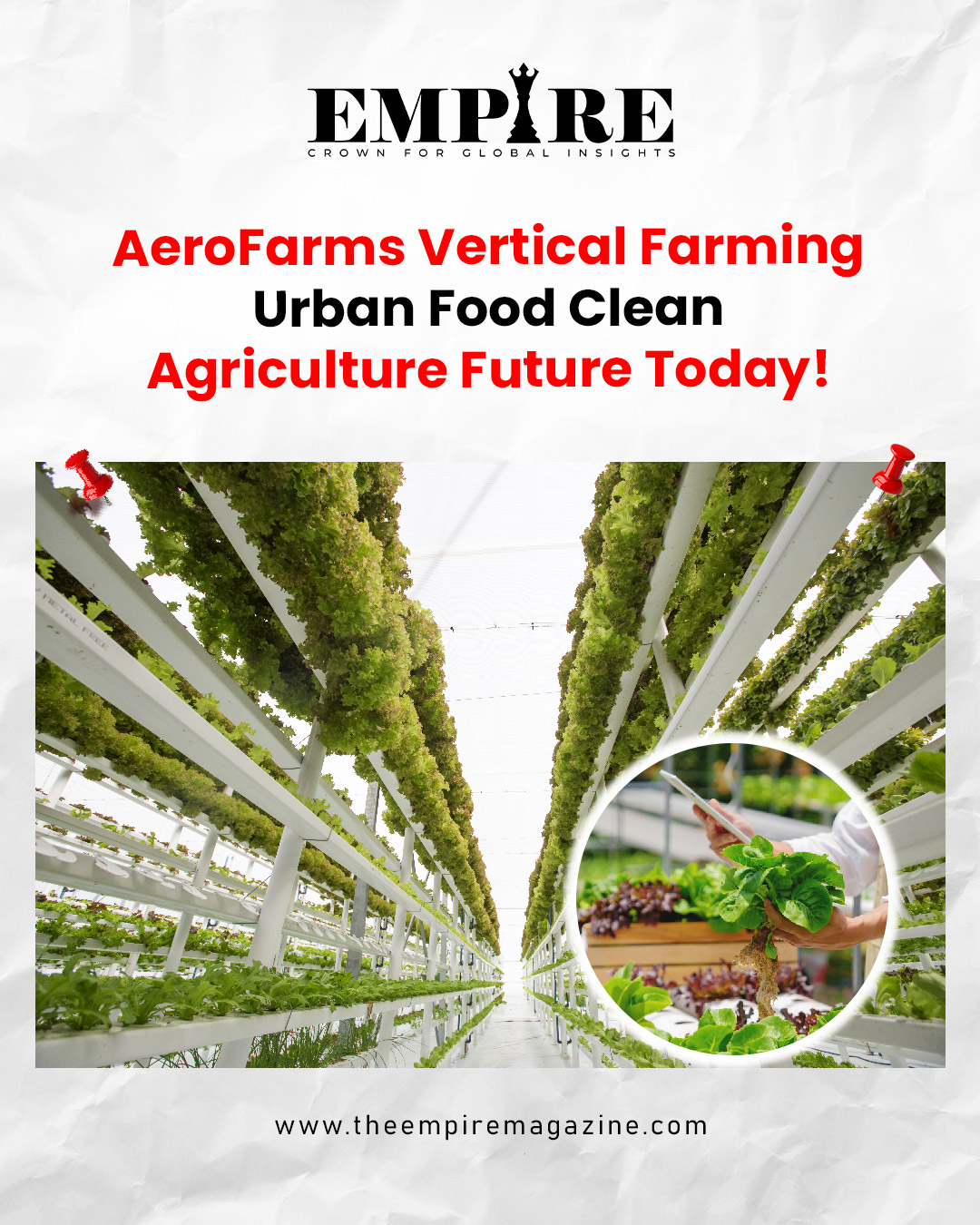
AeroFarms Vertical Farming is one of the most important stories in the future of urban food, clean agriculture, and controlled-environment farming. The company has become known for growing leafy greens and microgreens inside indoor vertical farms, using aeroponic technology instead of traditional soil-based agriculture.
AeroFarms was founded with a mission to rethink how food can be grown closer to cities. Instead of depending only on large outdoor farms, long-distance transport, and weather-sensitive growing conditions, the company uses indoor systems where light, nutrients, humidity, temperature, and water can be managed carefully.
This matters because the global food system is under pressure. Climate change, water scarcity, urban population growth, land use, supply chain disruption, and food waste are all forcing companies to search for new farming models. Vertical farming is one of the most visible answers because it brings food production into controlled spaces and closer to consumers.
AeroFarms focuses mainly on microgreens and leafy greens. These crops are valuable for vertical farming because they grow quickly, need less space than many field crops, and can be produced consistently in indoor environments. The company’s journey also shows both the promise and the difficulty of scaling vertical farming as a business.
AeroFarms Vertical Farming and How Indoor Agriculture Works
AeroFarms Vertical Farming uses indoor growing systems where plants are stacked vertically in layers. This allows more production in a smaller physical footprint compared with traditional field farming. Instead of growing crops across large fields, vertical farms grow upward inside buildings.
The company uses aeroponics, a method where plant roots receive a mist of water and nutrients. This is different from hydroponics, where roots are often grown in water, and different from soil farming, where plants depend on soil conditions. Aeroponics allows precise control over what the plant receives and how it grows.
AeroFarms also uses LED lighting, data systems, sensors, automation, and controlled environments. These tools help the company manage plant growth across different stages. The goal is to produce consistent flavor, texture, nutrition, and quality throughout the year.
AeroFarms Vertical Farming and Aeroponic Technology
AeroFarms Vertical Farming is strongly connected to aeroponic technology. Aeroponics is important because it can reduce water use and eliminate the need for soil. AeroFarms has stated that its system can use up to 90% less water and much less land than traditional field farming, while growing produce without pesticides.
This is important for cities and regions facing water stress. Agriculture is one of the world’s largest users of freshwater. If some crops can be grown with less water, it can support more efficient food production.
Aeroponics also helps protect crops from many outdoor farming risks. Because plants are grown indoors, they are less exposed to extreme weather, pests, drought, floods, and changing seasons. This gives vertical farming one of its biggest advantages: reliable year-round production.
AeroFarms Vertical Farming and Microgreens
AeroFarms Vertical Farming has focused strongly on microgreens. Microgreens are young, tender greens harvested early in the plant’s growth cycle. They are used in salads, bowls, sandwiches, smoothies, restaurant dishes, and premium food products.
Microgreens are a smart fit for vertical farming because they have short growth cycles and high value per square foot. They do not need the same long growing periods as grains, fruits, or large vegetables. This makes them easier to produce in an indoor system where electricity, labor, and technology costs must be carefully managed.
AeroFarms offers products such as micro arugula, micro broccoli, micro kale, baby bok choy, watercress, and mixed greens. These crops allow the company to focus on flavor, freshness, and quality rather than competing directly with low-cost field crops.
AeroFarms Vertical Farming and Nutrient-Dense Greens
AeroFarms Vertical Farming positions microgreens as nutrient-dense food. Microgreens are often valued for flavor, color, texture, and nutritional appeal. They can be used by chefs, grocery shoppers, restaurants, and health-conscious consumers.
This focus is important because vertical farming must find crops that justify the cost of indoor production. Growing commodity crops such as wheat, rice, corn, or potatoes indoors is usually not practical because those crops are low-value and require large volumes. Microgreens, herbs, and some specialty greens make more business sense.
By focusing on premium greens, AeroFarms has built a product category that fits both urban food trends and controlled-environment farming economics.
AeroFarms Vertical Farming and Urban Food Supply
AeroFarms Vertical Farming is part of a larger movement toward urban food production. Cities are growing, and food often travels long distances before reaching consumers. This can create freshness challenges, transport costs, waste, and supply chain vulnerability.
Vertical farms can be located closer to cities, distribution centers, grocery stores, and restaurants. This can reduce the distance between farm and plate. For fresh greens, shorter supply chains may help improve shelf life and reduce spoilage.
Urban food systems are becoming more important as cities look for resilience. Weather events, droughts, transport disruptions, and global supply chain shocks can all affect food availability. Indoor farms cannot replace traditional agriculture, but they can add another layer to the food system.
AeroFarms Vertical Farming and Local Production
AeroFarms Vertical Farming supports the idea of local production. By growing indoors near demand centers, vertical farms can supply fresh produce without depending entirely on distant farms.
This is especially valuable for delicate crops. Leafy greens can lose freshness quickly and are vulnerable to contamination risks in outdoor environments. Controlled indoor systems can reduce some of those risks by managing water, air, sanitation, and handling practices carefully.
Local production also gives retailers and foodservice companies a more predictable supply. Instead of depending only on seasonal field conditions, indoor farms can plan harvests more consistently.
AeroFarms Vertical Farming and Sustainability Claims
AeroFarms Vertical Farming is often discussed through sustainability metrics. The company has stated that its vertical farming model can use up to 90% less water and 230 times less land than traditional field farming, while growing without pesticides. Other AeroFarms materials have also highlighted major water and land savings compared with traditional agriculture.
These claims are important because land and water are major limits in agriculture. Vertical farms can reduce land pressure by stacking production. They can reduce water use by recycling and precisely delivering water to roots. They can reduce pesticide use because the environment is sealed and controlled.
However, sustainability must also include energy use. Indoor farms use electricity for lighting, climate control, automation, and operations. If electricity is expensive or fossil-fuel-heavy, the environmental and business case becomes more difficult. This is one of the biggest challenges for the entire vertical farming sector.
AeroFarms Vertical Farming and Energy Challenges
AeroFarms Vertical Farming must deal with the same energy challenge that affects many indoor farms. Plants need light. Outdoors, sunlight is free. Indoors, LED lighting must replace the sun, and climate systems must manage temperature and humidity.
This creates a cost issue. If energy prices rise, indoor farming becomes more expensive. This is why vertical farming works best for crops that are high value, fast growing, and suitable for controlled environments.
Energy efficiency is improving as LED technology, automation, and farm design improve. Still, vertical farming companies must prove that they can produce food sustainably and profitably at commercial scale.
AeroFarms Vertical Farming and the Business Reset
AeroFarms Vertical Farming also shows the financial difficulty of the indoor agriculture industry. AeroFarms filed for Chapter 11 bankruptcy protection in 2023 and later emerged from restructuring. The company refocused on its Danville, Virginia facility and microgreens strategy as part of its path back toward financial stability.
This is important because vertical farming has faced a reality check. Many startups raised large amounts of capital with promises of transforming agriculture. But the business has proven difficult because farms are expensive to build, operations are complex, energy costs matter, and not every crop works economically indoors.
AeroFarms’ restructuring shows that the industry is moving from hype to discipline. The strongest companies must focus on profitable crops, efficient operations, reliable customers, and realistic expansion.
AeroFarms Vertical Farming and Danville Facility
AeroFarms Vertical Farming became closely tied to its Danville, Virginia facility after restructuring. The Danville farm was designed as a large commercial indoor vertical farm focused on microgreens. After emerging from Chapter 11, AeroFarms concentrated resources on this site.
The Danville facility matters because vertical farming needs proof at commercial scale. A pilot farm can show technology, but a large farm must prove production reliability, cost control, distribution, quality, and customer demand.
The company’s focus on microgreens shows a more disciplined strategy. Instead of expanding too quickly across many crops and locations, AeroFarms moved toward a narrower model built around high-value greens and operational efficiency.
AeroFarms Vertical Farming and Retail Distribution
AeroFarms Vertical Farming products have been sold through grocery and retail channels. The company has expanded availability through major retail relationships, helping bring indoor-grown microgreens to everyday consumers.
Retail distribution is important because vertical farming companies need steady demand. Restaurants and chefs can create brand visibility, but grocery distribution can create larger volumes. Consumers buying microgreens at stores can support the scale needed for commercial farms.
However, retail also creates pressure. Grocery buyers expect quality, consistency, reliable delivery, food safety, and competitive pricing. Vertical farms must meet those standards while managing their own production costs.
AeroFarms Vertical Farming and Food Safety
AeroFarms Vertical Farming benefits from controlled-environment food safety systems. Indoor farms can reduce exposure to outdoor contamination sources such as field runoff, wildlife, soil pathogens, and unpredictable weather. AeroFarms has highlighted certifications and clean growing standards across its operations.
Food safety is especially important for leafy greens, which have faced contamination concerns in traditional supply chains. Controlled growing does not remove every risk, but it can give producers more control over water, air, surfaces, handling, and sanitation.
For retailers and consumers, this can be a major part of the value proposition. Clean, consistent, pesticide-free greens grown indoors can appeal to health-conscious shoppers.
AeroFarms Vertical Farming and Technology
AeroFarms Vertical Farming uses technology as the backbone of production. Sensors, data analytics, robotics, automated conveyance, LED lighting, and environmental controls all help manage the farm.
This is why vertical farming is often described as both agriculture and technology. The farmer is not only working with soil, weather, and irrigation. The farm also depends on software, hardware, engineering, biology, and operations management.
Data can help improve recipes for plant growth. Different crops may need different light, nutrients, airflow, and humidity. By testing and measuring plant responses, companies can improve yield, flavor, texture, and efficiency.
AeroFarms Vertical Farming and AI in Agriculture
AeroFarms Vertical Farming has used data-driven systems and automation to improve production. Artificial intelligence and machine learning can support controlled agriculture by identifying patterns in crop growth, predicting problems, and improving conditions.
AI can help indoor farms become more efficient, but it does not remove the need for strong agricultural knowledge. Plants are living systems. Technology must work with biology, not replace it.
The future of vertical farming will likely depend on companies that combine plant science, engineering, data, and disciplined business models.
AeroFarms Vertical Farming and Industry Challenges
AeroFarms Vertical Farming operates in an industry that has faced major challenges. Several vertical farming companies have closed, restructured, or reduced operations in recent years. The main challenges include high construction costs, high electricity use, labor needs, crop limitations, supply chain costs, and competition from traditional farms.
Vertical farming is not likely to replace outdoor agriculture. Field farms remain essential for grains, fruits, vegetables, livestock feed, and many staple foods. Indoor farms are more likely to focus on specific high-value categories where freshness, consistency, local supply, and controlled production matter.
AeroFarms’ story shows that vertical farming can survive, but only if the business model is focused and realistic.
AeroFarms Vertical Farming and Crop Selection
AeroFarms Vertical Farming proves that crop selection is critical. Microgreens make sense because they grow quickly and command premium value. Other crops may be harder to grow profitably indoors.
Some companies are experimenting with strawberries, herbs, leafy greens, and specialty crops. The industry is still learning which crops work best at scale. The best answer may vary by region, energy cost, customer base, and farm design.
For vertical farming, the future is not about growing everything indoors. It is about growing the right crops indoors.
AeroFarms Vertical Farming and the Future of Urban Food
AeroFarms Vertical Farming remains relevant because cities need more resilient food systems. Climate change, water stress, farmland pressure, and supply chain uncertainty are not going away. Indoor farming can help create more stable local supply for certain crops.
The future of urban food will likely include a mix of traditional farms, greenhouses, vertical farms, local growers, controlled-environment agriculture, and better logistics. AeroFarms is part of that mix because it has helped show what indoor farming can do and what challenges it must overcome.
Its experience also offers a business lesson. Innovation must be matched with operational discipline. Clean agriculture startups need strong technology, but they also need profitable products, realistic costs, reliable customers, and focused growth.
For more startup and food technology insights, read more on The Empire Magazine.
Follow The Empire Magazine on Facebook and Instagram.
– The Empire Magazine
Crown For Global Insights