
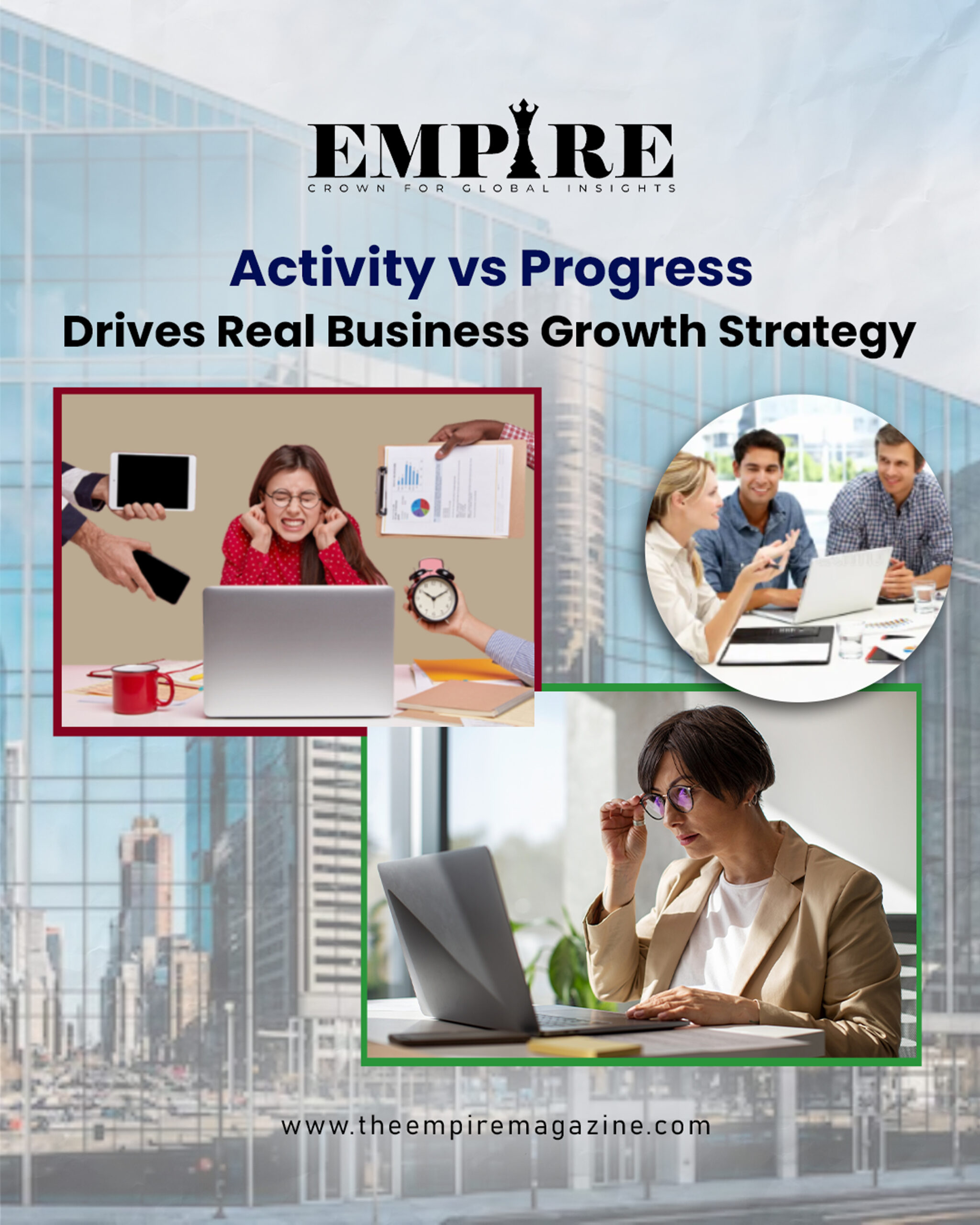
Activity vs Progress drives real business growth strategy by helping companies focus on outcomes, eliminate wasted effort, and achieve meaningful, scalable success.
Activity vs Progress drives real business growth strategy, yet it remains one of the most misunderstood concepts in modern organizations. In fast-moving startups and growing businesses, there is often a strong belief that being busy equals being successful. Teams operate at high speed, calendars are packed, tasks are constantly completed, and momentum appears strong. However, beneath this visible activity lies a critical question: is all this effort actually leading to meaningful progress?
Understanding the difference between activity and progress is essential for any business that aims to scale sustainably. Without this clarity, companies risk falling into a silent growth trap where effort increases but results remain stagnant.
The Illusion of Constant Activity
In today’s business environment, speed is often celebrated. Organizations pride themselves on quick execution, rapid responses, and continuous output. While speed can be a competitive advantage, it becomes dangerous when it lacks direction.
Many teams mistake motion for momentum. They:
- Send countless emails
- Schedule multiple meetings
- Publish large volumes of content
- Generate numerous leads
All of these actions create the appearance of productivity. However, if they are not aligned with clear goals, they do not contribute to real growth. This is the core of the Activity vs Progress challenge.
Speed without clarity does not produce results—it creates noise.
Why Businesses Confuse Activity with Progress
1. Activity Is Easier to Measure
One of the main reasons businesses focus on activity is because it is easy to track. Metrics such as the number of calls made, emails sent, or tasks completed are simple to quantify.
Progress, on the other hand, requires deeper analysis. It involves measuring outcomes like conversions, customer retention, and revenue growth—metrics that are more complex but far more meaningful.
2. Lack of Clear Goals
When organizations do not define clear objectives, any form of movement feels like progress. Without a destination, teams keep moving without knowing whether they are heading in the right direction.
This creates a cycle where effort increases but impact remains limited.
3. Comfort in Being Busy
Busyness provides a sense of accomplishment. It feels productive to complete tasks, respond quickly, and stay occupied throughout the day. However, this comfort can become misleading.
Being busy often masks the absence of strategic thinking and prioritization.
4. Misaligned Metrics
Many organizations measure success based on volume rather than value. For example:
- Marketing teams focus on traffic instead of qualified leads
- Sales teams track meetings instead of conversions
- Content teams measure output instead of engagement
These metrics encourage activity, not progress.
The Hidden Cost of Activity Without Progress
The gap between effort and results is where businesses lose their true potential. When companies prioritize activity over outcomes, several issues arise:
- Resources are spent on low-impact tasks
- Employees feel overwhelmed without seeing results
- Strategic opportunities are missed
- Decision-making becomes reactive
Over time, this leads to frustration within teams. Despite working harder, they struggle to achieve meaningful growth. This is not a problem of effort—it is a problem of direction.
Start With the End in Mind
Real progress begins with clarity. Before taking action, businesses must define their desired outcomes.
Key questions include:
- What is the goal we are trying to achieve?
- What does success look like?
- How will we measure progress?
Without answering these questions, activity becomes disconnected from results.
For example:
- Instead of measuring website traffic, measure conversions
- Instead of tracking calls, measure deals closed
- Instead of counting content pieces, measure engagement impact
This shift transforms how teams approach their work.
Focusing on Outcomes Over Activity
To overcome the Activity vs Progress trap, organizations must adopt an outcome-driven mindset.
Define Clear Goals
Every task should contribute to a specific objective. If it does not, it should be reconsidered or eliminated.
Measure What Matters
Replace activity-based metrics with outcome-based metrics. Focus on results, not just effort.
Prioritize High-Impact Work
Not all tasks are equally valuable. Identify the actions that create the most significant impact and focus on them.
Eliminate Wasted Effort
A large portion of business activity does not contribute to meaningful progress. Removing these tasks improves efficiency and clarity.
The Power of Focused Execution
Successful businesses and entrepreneurs do not measure their success by how busy they are. They measure it by what they achieve.
A practical approach is identifying the top three tasks each day that truly move the business forward. These tasks are strategic, not routine.
This method:
- Forces clarity
- Improves decision-making
- Enhances accountability
Over time, it creates a culture of intentional work rather than reactive activity.
Speed Needs Direction to Create Progress
Speed is not the problem—lack of direction is.
Speed acts as an amplifier. If the direction is correct, speed accelerates success. If the direction is wrong, speed accelerates failure.
This is why alignment is critical. Businesses must ensure:
- Clear strategy
- Defined goals
- Team alignment
- Outcome-focused execution
When these elements are in place, speed becomes a powerful advantage.
Building a Progress-Driven Culture
Creating a culture focused on progress requires consistent effort and leadership.
Encourage Strategic Thinking
Teams should be encouraged to question the purpose behind their actions.
Align Teams Around Goals
Everyone in the organization should understand how their work contributes to overall objectives.
Use Data for Decision-Making
Decisions should be based on outcomes and insights, not assumptions.
Reward Impact, Not Effort
Recognize employees for achieving results rather than simply being busy.
Long-Term Impact of Prioritizing Progress
Organizations that focus on progress rather than activity gain several advantages:
- Better resource utilization
- Higher employee satisfaction
- Stronger customer relationships
- Sustainable growth
Most importantly, they build a foundation for long-term success.
For more insights, visit:
https://theempiremagazine.com/?p=6051
Stay connected:
Instagram: https://www.instagram.com/the_empire_magazine/
Facebook: https://www.facebook.com/profile.php?id=61573749076160
– The Empire Magazine
Crown For Global Insights