Major trading economies challenge Washington’s allegations of excessive industrial production as proposed tariffs renew uncertainty over international trade agreements and global supply chains.
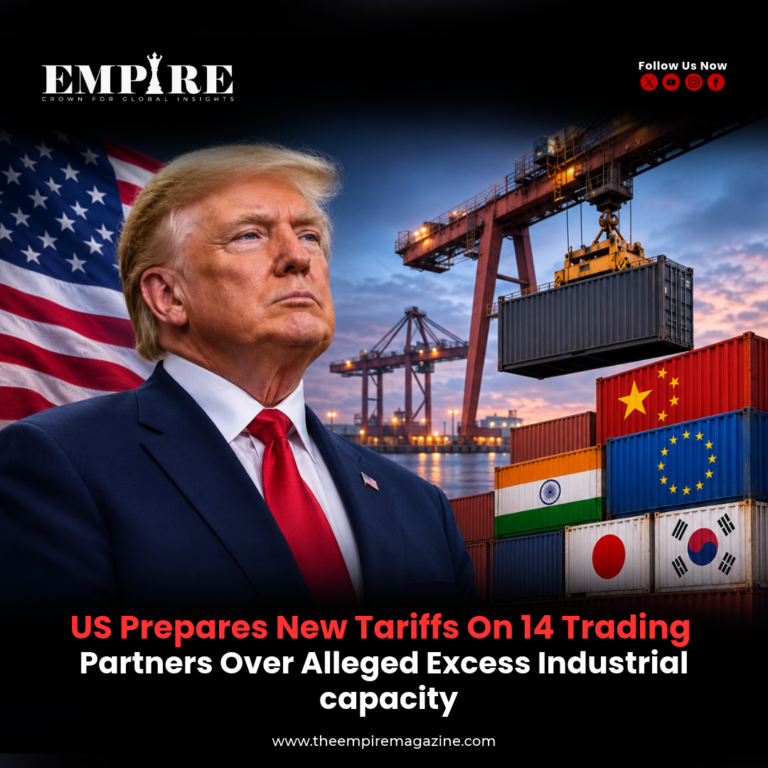
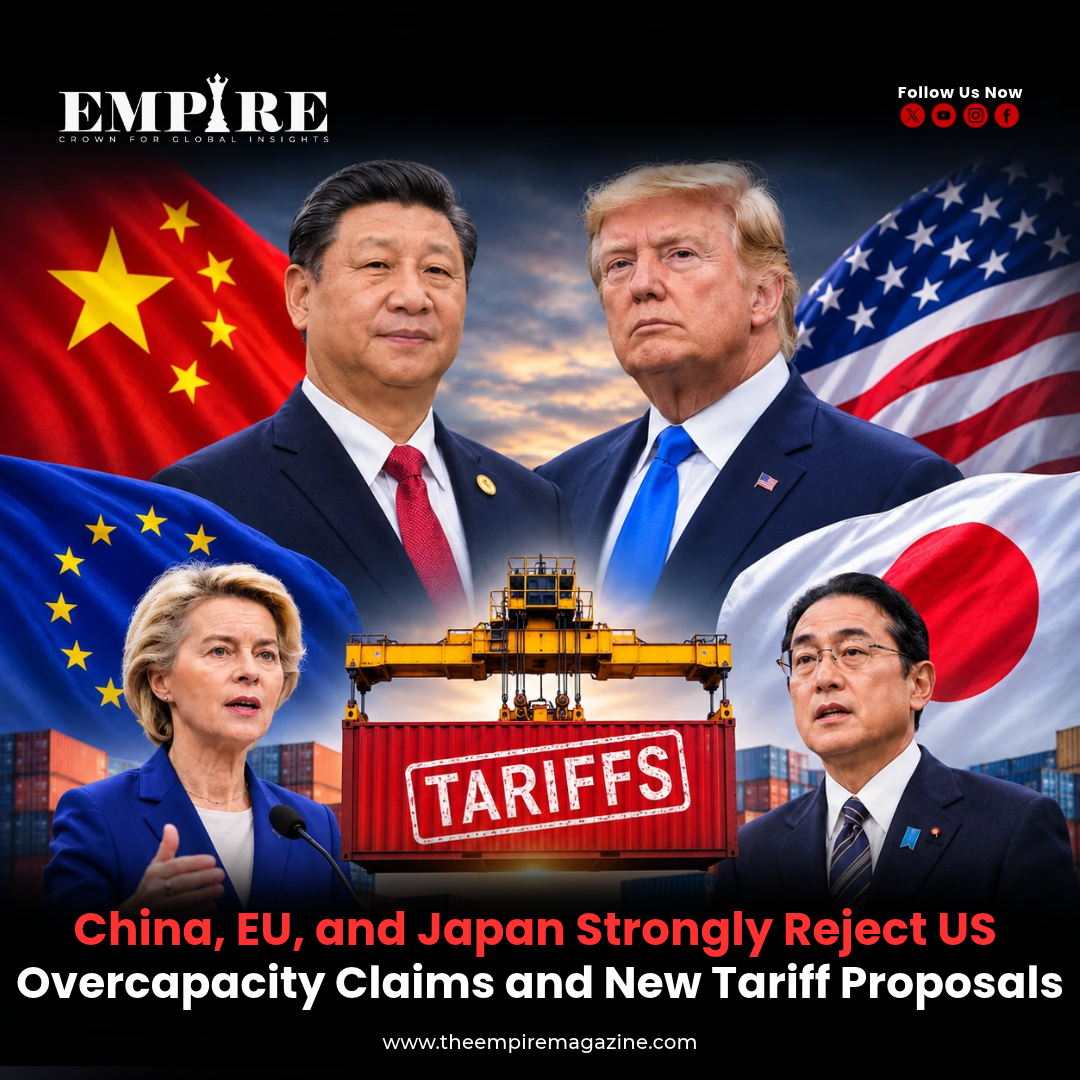
US tariff proposals have drawn strong opposition from China, the European Union and Japan after Washington announced new trade measures targeting 14 economies on 25 November 2026, citing structural excess capacity in manufacturing sectors.
The Office of the United States Trade Representative (USTR) concluded that certain industrial policies and manufacturing practices across the targeted economies were restricting American commercial interests.
The proposed measures include tariff rates of up to 20% for China, 15% for the European Union and 15% for Japan, subject to existing duties, product exemptions and other conditions.
The announcement has renewed disagreements over industrial competitiveness, government support for manufacturing and the future of international trade cooperation.
Understanding the Overcapacity Claims Behind US Tariff Proposals
Industrial overcapacity generally occurs when manufacturing capacity persistently exceeds the level of demand that can commercially sustain it.
While temporary excess capacity is common during economic downturns, structural overcapacity can persist when financial incentives, government support or other economic policies encourage production despite weak market demand.
Washington argues that such practices can disadvantage American manufacturers by increasing international competition, placing downward pressure on prices and reducing opportunities for domestic investment.
The investigations were launched on 11 March 2026 under Section 301 of the Trade Act of 1974, initially covering 16 economies. The November announcement established findings against 14, while determinations concerning Mexico and Norway remained pending.
However, the governments involved dispute whether their industrial policies constitute unfair trade practices or create the structural imbalances identified by Washington.
China Rejects Allegations and Reserves the Right to Respond
China has firmly opposed the US tariff proposals, challenging both the overcapacity allegations and Washington’s use of unilateral trade measures.
On 26 November, Chinese Ministry of Commerce spokesperson He Yadong argued that the Section 301 investigation undermined international economic cooperation and violated World Trade Organization rules.
Beijing maintains that industrial competition should not be treated as evidence of unfair economic practices simply because manufacturers in one country achieve significant production scale or international competitiveness.
China also warned that additional trade restrictions could disrupt supply chains, increase costs for businesses and consumers, and weaken global economic cooperation.
The Chinese government called for negotiations while reserving the right to introduce measures to protect its economic interests.
This position does not amount to an announcement of immediate retaliation, but it leaves open the possibility of further trade measures if negotiations deteriorate.
European Union Challenges Washington’s Assessment
The European Union has rejected the US tariff proposals on the grounds that Europe should not be characterised as a source of structural industrial overcapacity.
European Commission spokesperson Olof Gill acknowledged that global overcapacity remains a legitimate economic concern but maintained that European industries are themselves exposed to the consequences of excessive production elsewhere.
Brussels has also emphasised the importance of respecting existing transatlantic trade commitments, including the tariff arrangements negotiated in 2025.
The distinction is significant. The European Union does not necessarily reject Washington’s broader concerns about global industrial imbalances. Instead, it disputes the assessment of Europe’s own role and the appropriateness of targeting European exports.
For European manufacturers, particularly those operating across international markets, uncertainty over future tariff treatment could complicate investment decisions, export pricing and long-term commercial planning.
Japan Defends Its Industrial Policies
Japan has similarly expressed opposition to the US tariff proposals, despite the proposed 15% rate broadly reflecting its existing bilateral tariff agreement with Washington.
Chief Cabinet Secretary Minoru Kihara rejected allegations that Japan maintains non-market industrial practices or structural excess production capacity.
The Japanese government communicated its objections to Washington and expressed regret over its inclusion in the proposed measures.
Japan’s response highlights an important distinction between accepting previously negotiated tariff arrangements and accepting the economic allegations used to justify new trade restrictions.
For Japanese businesses, particularly automotive, electronics and advanced manufacturing companies, predictable access to the American market remains important to long-term investment and production strategies.
Existing Trade Agreements Face Renewed Uncertainty
The US tariff proposals do not necessarily mean that import duties will immediately increase by the full headline percentages.
Washington’s proposed rates account for certain existing tariffs and negotiated trade arrangements, with exemptions and adjustments varying by economy and product.
For the European Union and Japan, the proposed 15% rates incorporate ordinary customs duties and existing Section 301 tariffs under the specified arrangements. China’s proposed treatment follows a different structure, including adjustments for certain existing duties and product-specific provisions.
Consequently, the actual financial impact on individual businesses will depend on their products, applicable customs classifications and the final implementation rules.
How US Tariff Proposals Could Affect Global Supply Chains
Modern manufacturing depends on interconnected production networks that frequently extend across several national borders.
A tariff affecting one stage of production can therefore influence costs and commercial decisions throughout the wider supply chain.
The potential consequences include:
- Higher import costs: Businesses may face increased expenditure on components and finished products.
- Supply chain restructuring: Manufacturers could reassess sourcing locations and production arrangements.
- Investment uncertainty: Companies may delay expansion decisions until future market access becomes clearer.
- Pressure on consumer prices: Importers may transfer some additional costs to customers.
- Trade diversion: Exporters could seek alternative markets if access to the United States becomes more expensive.
These outcomes are possible scenarios rather than confirmed consequences of the latest announcement. Their scale will depend on final tariff rates, exemptions, corporate responses and subsequent negotiations.
What Comes Next for US Tariff Proposals?
The latest measures remain proposals rather than newly implemented tariffs.
The USTR has established 5 January 2027 as the deadline for written comments, with public hearings scheduled to begin on 25 January 2027.
The consultation process provides affected governments, manufacturers, importers and industry associations with opportunities to present their concerns before final decisions are reached.
Existing diplomatic and commercial arrangements could also influence the eventual structure of the measures.
The immediate priority for multinational businesses will be assessing their exposure under different tariff scenarios without assuming that every proposed duty will take effect unchanged.
The Broader Test for Global Trade Cooperation
The disagreement between Washington, Beijing, Brussels and Tokyo reflects a wider debate over how governments should balance industrial development, domestic economic security and international competition.
While Washington argues that persistent manufacturing imbalances require stronger intervention, the affected economies maintain that industrial competitiveness and legitimate economic development should not automatically justify trade restrictions.
The long-term significance of the US tariff proposals will depend on whether negotiations can address genuine market distortions while preserving predictable trade relationships.
For the global economy, the challenge is not simply determining how much countries manufacture, but establishing internationally credible rules governing how that production is supported, financed and traded.
Explore more global business, technology and innovation coverage in The Empire Magazine’s article archive.
Read our related coverage: ai-financing-risks-bank-of-england/
Follow The Empire Magazine:
Facebook | Instagram
The Empire Magazine | Crown For Global Insights