
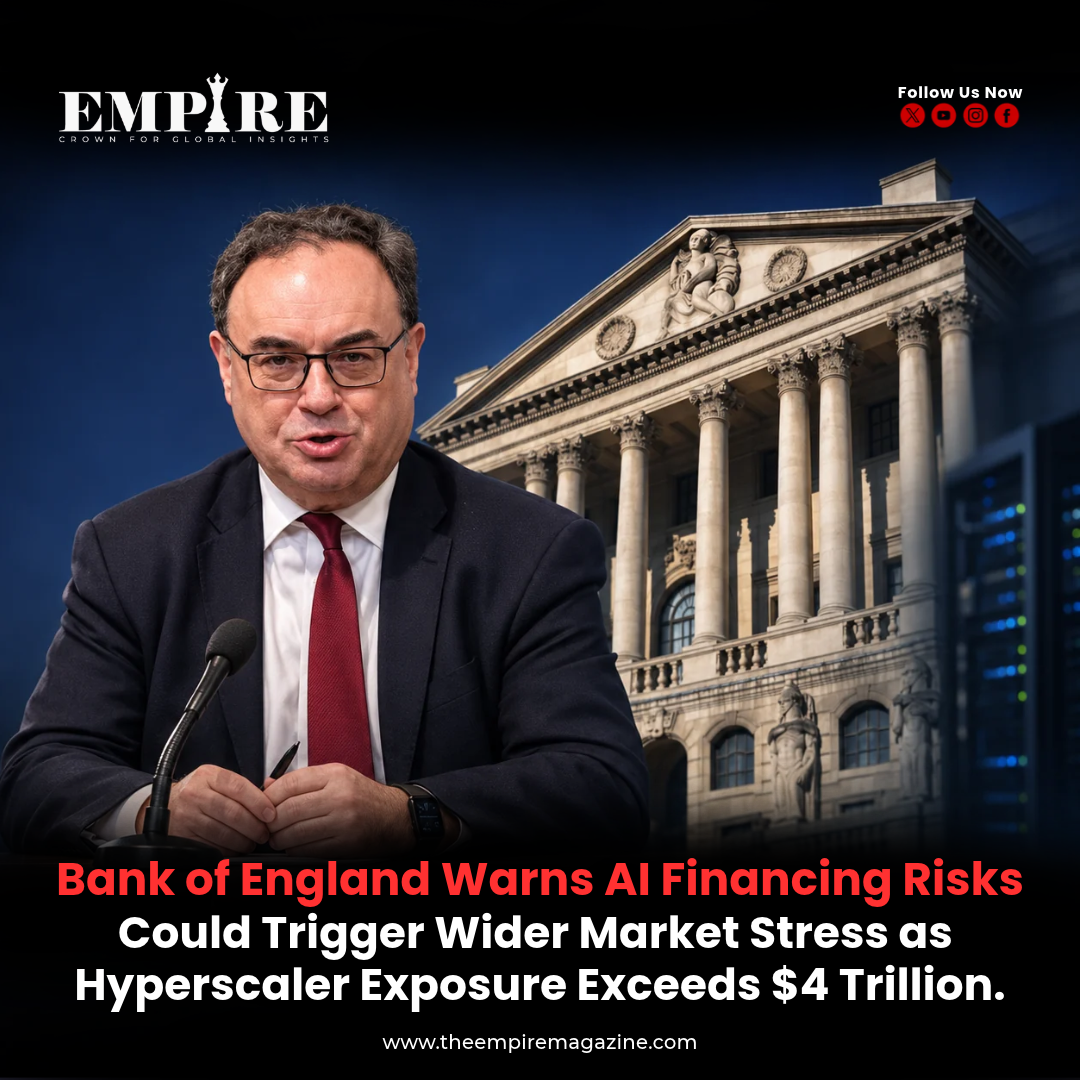
The central bank warns that borrowing and interconnected funding arrangements could transmit an AI-sector shock across lenders, investors and financial markets.
AI financing risks could turn a setback in the technology sector into wider financial-market stress, the Bank of England warned in its November 26, 2026 Financial Stability Report. The central bank highlighted growing borrowing and complex funding relationships that connect AI businesses with lenders and investors.
The Bank estimates hyperscalers’ total potential exposure at just over $4 trillion, combining debt with contractual commitments outside conventional borrowing. This measures financial exposure; it is not a forecast of losses.
The Meaning of the $4 Trillion Estimate
Understanding AI financing risks starts with identifying the obligations behind the headline number.
Hyperscalers are large technology and cloud businesses that provide computing capacity through extensive data-centre networks. The Bank’s estimate includes existing debt, leases, purchase commitments, guarantees and other financial backstops.
These obligations differ in timing and conditions. A guarantee, for example, may become payable only if a specified event occurs. Consequently, the total should not be interpreted as a single debt bill falling due immediately.
Debt Broadens the Reach of AI Financing Risks
The Financial Policy Committee expects hyperscalers to issue more than $305 billion in bonds during 2026, representing approximately 8% of global investment-grade bond issuance.
Its November meeting record also highlights the growing participation of public bond markets, private credit and other financing structures in AI investment.
Borrowing can help companies develop infrastructure before that infrastructure generates revenue. It also creates payment obligations that continue when business conditions weaken.
For lenders, the relevant question is how reliably future cash flows will cover interest, principal and contractual costs. A promising technology can still be financed through arrangements that become difficult to sustain if commercial adoption takes longer than expected.
Circular Financing Creates Overlapping Dependencies
One concern behind AI financing risks is that companies can occupy several positions within the same commercial relationship.
A cloud provider might invest in an AI developer that subsequently purchases computing services from it. The investment supports the developer, while the developer’s spending supports the provider’s revenue. If the developer struggles, the provider could face both a decline in its investment’s value and weaker customer revenue.
This illustrative example reflects a concern identified in the IMF’s October 2026 Global Financial Stability Report: investments in AI businesses can lose value precisely when the future revenues linked to those businesses deteriorate.
Such relationships can support expansion and align commercial interests. Assessing their resilience requires understanding how much of the revenue ultimately depends on the same underlying customers and sources of funding.
Private Credit Expands the Financing Network
Private lending adds another dimension to AI financing risks because exposures can extend beyond publicly traded companies and conventional bank loans.
In its September meeting record, the Bank’s Financial Policy Committee cited a Morgan Stanley estimate that private credit could finance $700 billion of data-centre capital expenditure between 2026 and 2028. That is a projection of financing over a period, distinct from the November estimate of hyperscalers’ potential exposure.
The committee also warned that rising indebtedness, limited transparency and circular arrangements could make risks harder to assess and amplify losses if expectations disappoint.
For market participants, the challenge is identifying where the ultimate risk sits when funding passes through funds, investment vehicles and multiple contractual relationships.
How a Revenue Shock Could Spread
AI financing risks could spread through a sequence such as this:
- Revenue disappoints: Demand or customer spending falls short of expectations.
- Repayment pressure rises: Borrowers struggle to cover debt and other commitments.
- Funding tightens: Investors demand higher returns, while lenders reduce new financing.
- Asset sales spread: Investors using borrowed money sell other holdings to reduce leverage.
This is an illustrative scenario. The committee warned that equity losses could prompt globally active investors to reduce leverage in other markets, including sovereign bonds.
Current Conditions Show Pressure and Resilience
The assessment of AI financing risks also contains an important distinction between financial pressure and market dysfunction.
The Bank reported that credit spreads had widened, particularly for weaker borrowers, while market functioning remained orderly.
Separately, the Financial Policy Committee judged that cross-market spillovers had remained limited and that the UK financial system had been resilient. It described UK banks as well capitalised, with substantial liquidity.
Higher borrowing costs can reflect investors demanding more compensation for risk. The financial stability concern is whether further losses would trigger forced selling, disrupt funding or reduce the availability of credit across otherwise unrelated businesses.
Why the Warning Matters for UK Supervision
AI financing risks are relevant to UK regulators because financial institutions and investors operate across borders, even when the underlying technology projects are located elsewhere.
At the November 26 press conference, Deputy Governor Katharine Braddick described resilience to a deterioration in AI investor sentiment as a supervisory priority.
Effective monitoring therefore involves examining connected exposures across borrowers, investors and funding providers. Looking at each company separately may miss a concentration that becomes visible only when their financing relationships are considered together.
The Commercial Test for AI Infrastructure
For businesses, the warning places greater emphasis on the relationship between investment commitments and the revenue expected to support them.
A project may have strong customer interest while still facing uncertainty over utilisation, pricing or the timing of payments. Those details affect how comfortably it can support long-term borrowing and operating commitments.
AI financing risks will ultimately depend on the durability of customer demand, the strength of borrowers’ cash flows and the capacity of investors and lenders to absorb disappointment. The next test for the investment boom is whether commercial performance can support the financial obligations being built around it.
Explore more global business, technology and innovation coverage in The Empire Magazine’s article archive.
Read our related coverage: maple-ai-seed-funding-private-chat/
Follow The Empire Magazine:
Facebook | Instagram
The Empire Magazine | Crown For Global Insights