
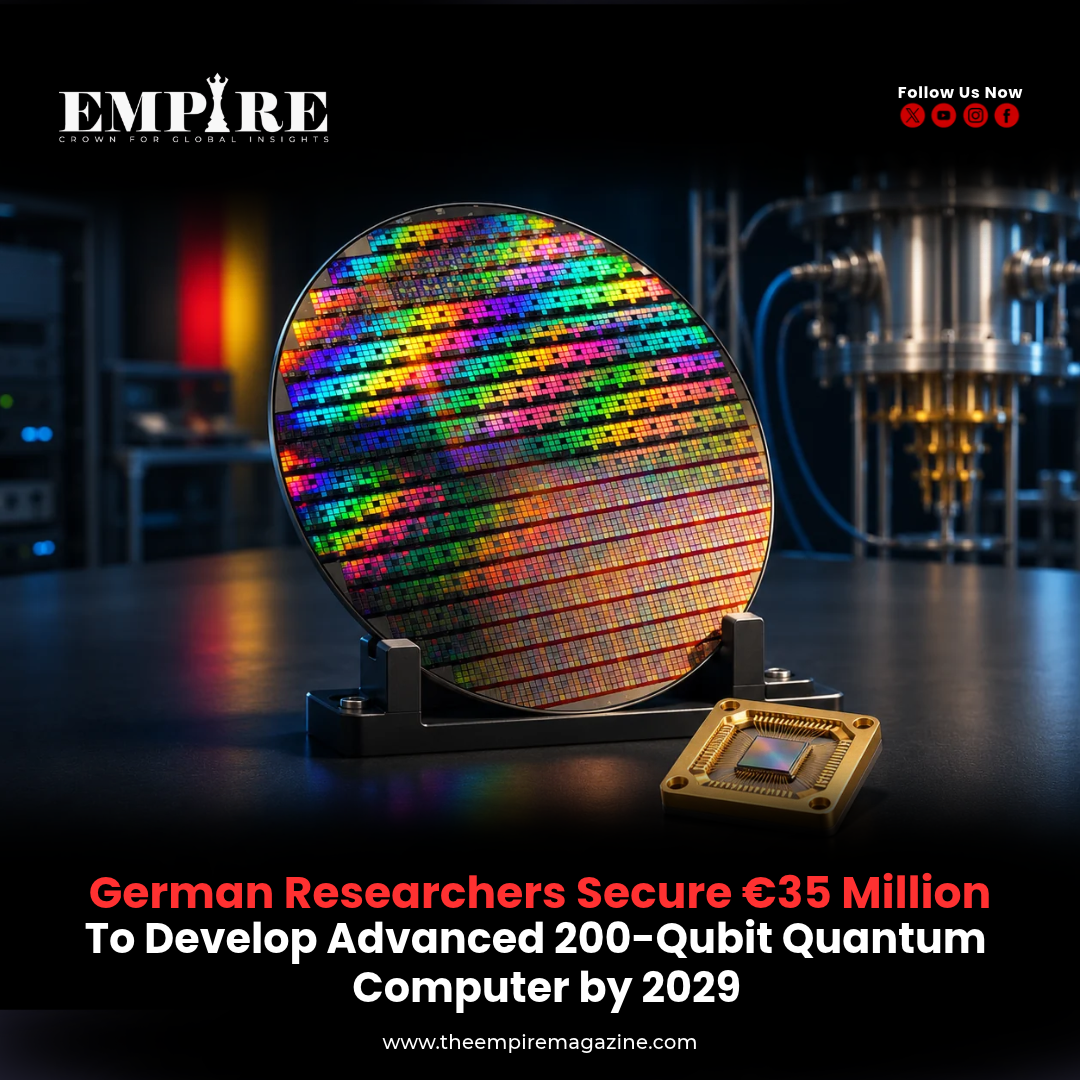
Forschungszentrum Jülich and ARQUE Systems are developing a semiconductor platform that moves electron qubits across a chip, with plans to connect the system to supercomputing infrastructure.
A German quantum computer project backed by approximately €35 million is targeting a system with up to 200 qubits by the end of 2029. Forschungszentrum Jülich outlined the programme, known as Q-STAR.NRW, on 24 November 2026, working with quantum technology company ARQUE Systems. fz-juelich.de
The initiative addresses a central engineering challenge: expanding a quantum processor while keeping its information stable, its operations accurate and its control hardware manageable. Its significance lies in testing whether a semiconductor architecture can make that expansion practical.
Funding and Partners Behind the German Quantum Computer
According to Jülich, 90% of the project’s funding comes from federal resources under Germany’s Coal Regions Investment Act. The remaining 10% contribution through Forschungszentrum Jülich is financed entirely by North Rhine-Westphalia.
Funding approval for Q-STAR.NRW was presented in September 2026, alongside other quantum initiatives in the state. The November announcement provides further details about the development programme and its timetable.
ARQUE Systems is a spin-off from Forschungszentrum Jülich and RWTH Aachen University. Its approach builds on research into electron spins in silicon and combines quantum-device development with semiconductor engineering.
The partnership brings together a hardware developer and a research centre with computing facilities and an established scientific user community.
From Five Qubits to a Larger System
The German quantum computer programme builds on an existing ARQUE system already integrated into Jülich’s quantum infrastructure. Known as JAQUI-5, that pilot contains five electron-spin qubits and uses an electron shuttle to move information across its chip.
Jülich lists a planned replacement with up to 200 qubits, which would also connect to the centre’s high-performance computing environment.
That expansion will require the team to coordinate many more quantum operations while maintaining dependable control. A successful demonstration would provide evidence that the architecture can grow beyond a small experimental device.
The 200-qubit figure remains a development target. The existing pilot provides a starting point for testing and integration, rather than evidence that the larger machine is already operational.
How Movable Electron Qubits Work
The design for the German quantum computer encodes information in the quantum properties of individual electrons. The distinctive feature is the ability to transport those electrons along controlled paths on the chip.
This process, called shuttling, allows information to move between locations where operations can take place. Jülich’s earlier description of the technology explains that moving the electrons enables interactions between qubits that would otherwise be spatially separated.
An accessible way to picture the design is a production line: information moves between processing locations instead of every operation requiring a permanently adjacent arrangement. The engineering challenge is preserving the delicate quantum state during that movement.
By changing how qubits reach one another, the architecture seeks to ease the layout and control constraints that become more demanding as processors grow.
Semiconductor Manufacturing Provides a Starting Point
The German quantum computer strategy draws on established semiconductor materials and manufacturing knowledge. ARQUE’s aim is to use the small size of spin qubits to support increasingly dense processors.
Earlier chip prototypes were produced at the Helmholtz Nano Facility in Jülich. The research centre also identifies Infineon as a development partner on a subsequent chip version.
This manufacturing background matters because a scalable processor needs reproducible components as well as a workable scientific concept. Building one successful device is only part of the challenge; future systems must also be fabricated, connected and operated consistently.
Established semiconductor expertise provides a foundation for that work. Quantum devices still require specialised engineering to preserve and manipulate their quantum states.
Connecting the German Quantum Computer to Supercomputers
The planned machine will become part of JUNIQ, the Jülich UNified Infrastructure for Quantum Computing, at the Jülich Supercomputing Centre.
JUNIQ already provides academic and industrial researchers with access to different quantum technologies and software emulators. Its integration with conventional high-performance computing supports hybrid workflows, combining quantum processors with classical machines.
In practical terms, researchers can explore how a quantum processor might handle a selected part of a larger calculation while conventional computers support the surrounding work.
Q-STAR.NRW also includes development of software, hybrid quantum algorithms, user support and training. These elements will help researchers move from access to hardware towards experiments they can run and evaluate.
Research Applications and Performance Testing
JUNIQ identifies materials simulation, chemistry, optimisation and machine learning among the areas motivating quantum research. Potential optimisation problems include vehicle routing and supply-chain planning.
For prospective users, the value of the new platform will be the opportunity to test algorithms under realistic operating conditions. Such experiments can help identify which problems suit the hardware and where current limitations remain.
Commercial usefulness will depend on measurable results: the quality of calculations, the resources required and performance against appropriate classical methods. Installing a larger processor creates opportunities for those comparisons.
Reliability Matters Alongside Qubit Counts
Evaluating the German quantum computer will require attention to the distinction between physical and logical qubits. Physical qubits are the hardware elements that carry quantum information. Error-correction methods encode information across physical qubits to create protected logical qubits.
The project’s stated hardware target should therefore not be read as a promise of 200 error-corrected logical qubits.
Shuttling itself also introduces errors that researchers must understand. A study published in the journal Quantum in September 2026 used simulations to examine how transport errors affect a proposed spin-qubit architecture. Its results suggested that error correction could remain viable under the modelled conditions, provided other operations were sufficiently accurate.
Those findings support further development, while leaving experimental validation at larger scale as an essential task.
Regional Investment With a Longer-Term Goal
The German quantum computer project also forms part of North Rhine-Westphalia’s plans to develop research and industrial activity in the Rhenish mining region.
The funding programme connects quantum infrastructure with industrial collaboration and the region’s economic transition. Its stated ambitions include strengthening local expertise and creating conditions for future technology businesses and employment.
For companies, access to shared research infrastructure could lower the practical barriers to exploring quantum applications. Realising that opportunity will require accessible tools, relevant expertise and problems that the hardware can address.
Milestones to Watch Through 2029
Progress on the German quantum computer will be judged by dependable operations as the system expands, successful integration with classical computing and useful access for researchers.
The programme offers a concrete test of semiconductor quantum computing: whether a design demonstrated with a small number of qubits can become a larger, usable research platform. Its strongest evidence of progress will come from published hardware performance and reproducible experiments as development advances.
Explore more global business, technology and innovation coverage in The Empire Magazine’s article archive.
Read our related coverage: bhp-copper-expansion-south-australia/
Follow The Empire Magazine:
Facebook | Instagram
The Empire Magazine | Crown For Global Insights