
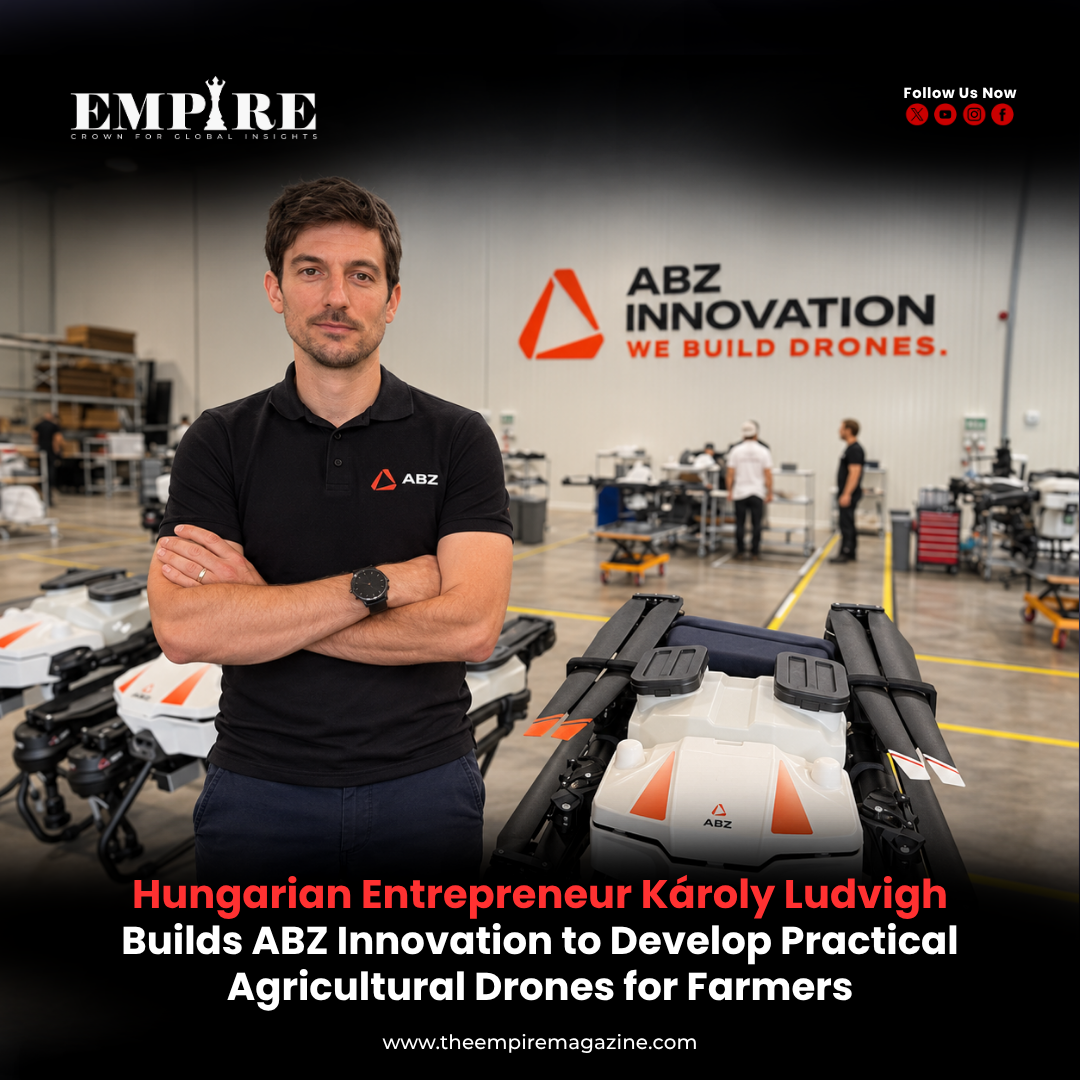
The Hungarian entrepreneur and his team are developing agricultural drones around farmers’ everyday needs, supported by new investment and expanded European manufacturing.
Hungary | Entrepreneurship and Agricultural Technology
Information checked on 8 November 2026.
ABZ Innovation, led by Hungarian entrepreneur Károly Ludvigh, is developing agricultural drones with a clear purpose: helping farmers complete spraying and spreading tasks reliably. As CEO and co-founder, Ludvigh has helped build a business focused on equipment that fits into real agricultural operations.
The company’s development reflects the practical demands facing agricultural technology businesses. Farmers need equipment that performs consistently, receives timely support and delivers value throughout the working season.
With a €7 million funding round announced in January 2026 and a manufacturing expansion in Szentendre later in the year, ABZ Innovation is increasing its capacity to serve agricultural and industrial customers internationally.
How Károly Ludvigh Entered the Drone Industry
Ludvigh’s background includes technology journalism and more than a decade of hands-on experience building drones.
An EU-Startups interview published on 5 November 2026 describes how his interest developed from experimenting with drone systems into building a commercial business. The company’s early experience offering drone-based crop spraying exposed a problem: the available equipment did not provide the reliability the team wanted.
That experience helped shape the decision to develop its own aircraft.
ABZ Innovation was established in 2021 through a collaboration involving ABZ Drone, MIB Invest Group and Széchenyi István University. The university contributed technical expertise, including software and application development.
This partnership brought together experience in drone operations, investment and research. It provided a foundation for developing products around problems the team had encountered while working with agricultural customers.
ABZ Innovation Focuses on Farmers’ Working Conditions
Agricultural equipment must function within tight operational windows. A treatment may be needed when soil conditions prevent conventional machinery from entering a field.
In an interview with FRUIT LOGISTICA, ABZ Innovation co-founder and Chief Commercial Officer Gyula Török identified this timing problem as a major reason for developing the company’s L50 drone.
An aircraft operating above the crop can provide access without driving machinery through the field. For growers, this creates a potential advantage when ground access is difficult, provided flying and application conditions are suitable.
The wider business case depends on how well the equipment fits into daily work. Flight planning, refilling, battery charging, maintenance and operator training all contribute to the usefulness of a drone system.
A machine’s advertised capacity is therefore only one part of the purchasing decision.
Agricultural Drones for Spraying and Spreading
ABZ Innovation’s agricultural range includes equipment with different tank capacities and compatible spreading systems.
Two examples illustrate how the company serves different operating requirements:
| Model | Spraying tank | Compatible spreading system | Advertised maximum field performance |
|---|---|---|---|
| L30 V2 | 30 litres | 50 litres | 21 hectares per hour |
| L50 | 50 litres | 70 litres | 24 hectares per hour |
Figures are manufacturer specifications. Actual productivity varies with application requirements, operating conditions and time spent refilling and charging.
Both models feature Controlled Droplet Application technology and LiDAR-based obstacle avoidance, according to their product specifications.
Controlled Droplet Application is designed to manage droplet delivery during spraying. LiDAR helps the aircraft sense its surroundings, supporting obstacle detection and operation around uneven terrain.
Compatible spreading equipment broadens the potential uses of the aircraft to include distributing solid materials such as seeds and fertiliser.
For customers, this flexibility can make the equipment useful across several tasks. Its financial value still depends on how frequently those capabilities are needed and how effectively the system performs in local conditions.
Reliability and Support Shape the Customer Experience
ABZ Innovation describes serviceability and predictable performance as central features of its approach. The company reports operating in more than 40 countries through a distributor and service network.
That support structure matters because purchasing a drone creates an ongoing relationship with the manufacturer and its local partners.
A farmer or agricultural service provider may need replacement parts, technical assistance, software support and help developing operator skills. Delays in any of these areas can reduce the equipment’s usefulness during a busy season.
From a business perspective, dependable support could help ABZ build repeat demand as its installed customer base grows. Maintaining that standard across different markets will remain an important part of its expansion.
€7 Million Funding Supports the Next Stage
On 22 January 2026, ABZ Innovation announced a €7 million investment round led by Vsquared Ventures, with participation from Day One Capital and Assembly Ventures.
The company said the funding would support manufacturing expansion, product development and its international distributor network.
These priorities address several requirements of a growing hardware business. Higher production volumes need manufacturing capacity, while customers require consistent product quality and accessible support.
ABZ also positions its European manufacturing base as part of its commercial proposition. Its strategy includes giving agricultural and industrial customers a European option for equipment used in demanding operations.
The investment provides resources to pursue that strategy. Its commercial results will depend on product demand, manufacturing execution and customer retention.
Manufacturing Expansion in Szentendre
ABZ Innovation opened a factory extension in Szentendre, Hungary, on 17 September 2026.
Reuters reported that Ludvigh described annual production capacity of approximately 2,000 drones on a single shift, rising to 3,500 with two shifts. These figures describe the facility’s stated capacity, rather than confirmed annual sales.
The expansion supports a product range that extends beyond agriculture. ABZ also develops drones for industrial cleaning and other specialised civilian applications.
However, scaling production carries substantial costs. Reuters reported that the company recorded a loss of approximately 1 billion Hungarian forints in 2025, associated with increasing production capacity. Ludvigh said the business hoped to reach break-even within a few years.
The next phase therefore involves converting increased manufacturing capacity into sustainable commercial activity.
Recognition for the L50 Agricultural Drone
The L50 received the 2026 FRUIT LOGISTICA Innovation Award in the Technology category.
Trade visitors selected the winners, with the award presented in Berlin on 6 February 2026. The recognition gave ABZ Innovation additional visibility among international agricultural businesses.
For a manufacturer expanding into new markets, such events also provide opportunities to demonstrate equipment and hear directly from potential customers.
In the FRUIT LOGISTICA interview, Török said visitors paid particular attention to flight endurance and operating costs. Those priorities reinforce the company’s emphasis on practical performance.
What ABZ Innovation’s Story Shows About Entrepreneurship
Ludvigh’s experience illustrates how working with customers can shape product development. The team encountered reliability problems while trying to deliver agricultural services, then organised engineering and manufacturing capabilities around addressing them.
Its continued progress will depend on execution across several areas: consistent equipment performance, manageable production costs, effective distribution and responsive support.
For farmers, the decisive measures remain concrete. Equipment needs to complete the required work, remain available when needed and justify its cost over time.
Explore more global business, technology and innovation coverage in The Empire Magazine’s article archive.
Read our related coverage: ai-superintelligence-ban-us-proposal/
Follow The Empire Magazine:
Facebook | Instagram
The Empire Magazine | Crown For Global Insights