
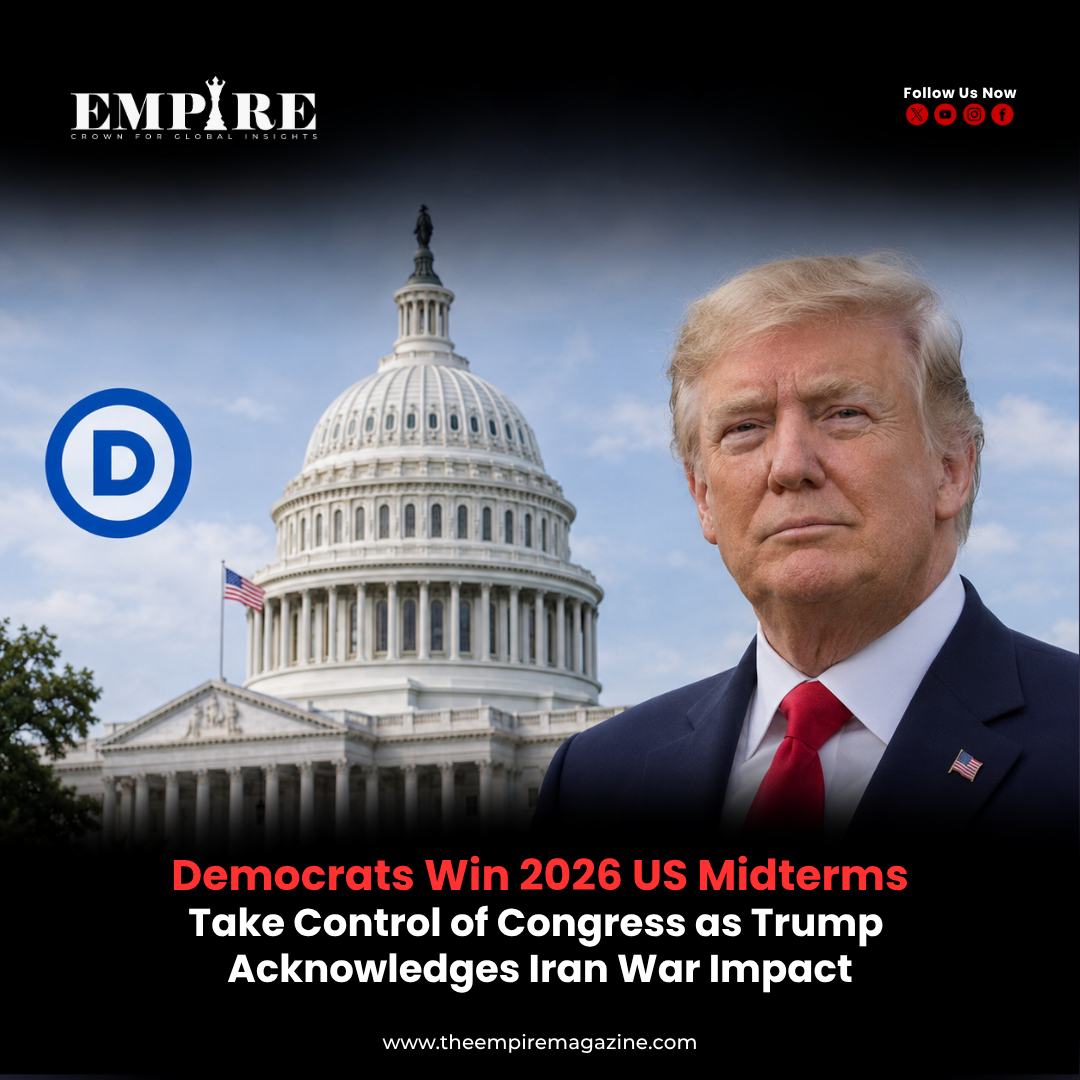
Democrats have won both chambers of Congress, setting up divided government as President Donald Trump acknowledges the electoral impact of the Iran war.
United States | Politics and Leadership
Information checked on 5 November 2026.
The 2026 US midterms have changed the balance of power in Washington, with Democrats winning the House of Representatives and Senate in the elections held on 3 November.
The result creates a tougher political environment for President Donald Trump. His administration will face an opposition-controlled Congress with greater influence over legislation, funding negotiations, investigations and presidential appointments.
Trump acknowledged that the Iran war contributed to Republican losses while defending his decision to pursue the conflict. His comments place foreign policy, household costs and political accountability at the centre of the post-election debate.
The new congressional terms begin on 3 January 2027. Trump remains president, meaning the election sets up divided government for the remaining two years of his term.
How the 2026 US Midterms Changed the Congressional Map
Democratic gains extended across competitive states and places where Republicans had maintained a strong electoral position.
Ballotpedia’s 4 November election roundup identified seven Republican-held Senate seats won by Democrats. Among the results were:
| State | Democratic winner | Republican opponent defeated |
|---|---|---|
| Kansas | Adam Hamilton | Roger Marshall |
| Maine | Troy Jackson | Susan Collins |
| North Carolina | Roy Cooper | Michael Whatley |
| Ohio | Sherrod Brown | Jon Husted |
| Texas | James Talarico | Ken Paxton |
These victories illustrate the geographical reach of the party’s gains. They also give Democrats influence over both sides of the congressional process: the House’s legislative agenda and the Senate’s role in considering legislation and appointments.
Individual race calls and official certification are separate stages. The reported outcome establishes the direction of congressional control, while final certified totals follow the states’ election procedures.
Trump Acknowledges the Iran War’s Electoral Impact
Speaking to reporters on 4 November, Trump responded to Vice President JD Vance’s assessment that the war had driven Republican losses.
“I think it’s largely true,” Trump said, linking the conflict to a short-term increase in gasoline prices.
He continued to defend the military campaign, arguing that preventing Iran from obtaining a nuclear weapon justified his decision. He also said he would take the same course again.
The remarks acknowledge the political cost while maintaining the administration’s stated security rationale. They leave a central question for the next Congress: how lawmakers will scrutinise the war’s objectives, expenditure and consequences.
For Republicans, the discussion now extends to how the party responds to voters who connected overseas military action with pressure on their household budgets.
Voters Raised Concerns Beyond the War
The 2026 US midterms cannot be explained through a single issue.
The ABC News Voter Poll found that respondents voting in House elections identified several concerns as crucial to their decisions:
| Issue | Share of House voters describing it as crucial |
|---|---|
| Government corruption | 55% |
| Cost of living | 49% |
| War in Iran | 34% |
These figures describe separate priorities and should not be treated as parts of one total.
The polling suggests that Trump’s explanation captures one element of a broader voter response. Concerns about prices, governance and the conflict overlapped during the campaign.
That distinction matters for the incoming majority. Addressing the war alone would not necessarily satisfy voters who also expect progress on affordability and accountability.
What Democratic Control of Congress Changes
Winning both chambers gives Democrats several tools to challenge the administration and advance their priorities.
Legislation and Spending
The House and Senate must agree on legislation before sending it to the president. Democratic majorities can influence which proposals advance and negotiate over federal spending.
Trump retains the power to veto legislation. Consequently, electoral victory does not guarantee that the party’s programme will become law.
Oversight and Investigations
Congressional committees examine government activity, hold hearings and investigate alleged wrongdoing.
With control of committee leadership, Democrats will be better placed to question administration officials and examine how policies are implemented. Hearings can also put disputed decisions and spending choices before the public.
The practical value of oversight will depend on the evidence obtained and whether it leads to corrective action.
Presidential Appointments
The Senate considers many presidential nominations, including federal judges, Cabinet officials and ambassadors.
A Democratic majority can scrutinise, delay or reject nominees requiring Senate confirmation. This gives the party influence over future appointments while leaving the president responsible for choosing whom to nominate.
Leadership Challenges for Democrats and Republicans
The 2026 US midterms create different leadership tests for the two parties.
House Democratic leader Hakeem Jeffries is positioned to seek the speakership. If elected by House members, he would become the first Black speaker. The leadership decision still requires a vote; the election result does not automatically install him.
Senate Democratic leader Chuck Schumer has acknowledged that some voters who supported Democratic candidates remain sceptical of the party.
For the incoming majority, that creates pressure to demonstrate practical results. Leaders will have to manage competing priorities, decide which measures to pursue first and explain what can be achieved with a Republican president.
Republicans face the task of reviewing their campaign strategy and responding to dissatisfaction while preparing to operate in the congressional minority.
From a leadership perspective, the next test is how each party turns its reading of the election into decisions that address the concerns voters expressed.
What the Result Could Mean for Business and Global Policy
The business implications of the 2026 US midterms will emerge through policy decisions and negotiations.
Three areas deserve attention:
- Federal spending: Negotiations between Congress and the White House could influence programmes, contracts and funding priorities.
- Trade policy: A change in congressional control does not automatically remove tariffs or rewrite existing trade arrangements.
- Regulatory leadership: Senate scrutiny of nominees could affect the timing and composition of leadership at agencies whose senior appointments require confirmation.
Council on Foreign Relations analysis highlights the constraints Democrats will face in trying to reverse the administration’s policies, particularly where Trump can use his veto.
For businesses, this points to the importance of distinguishing proposals from enacted changes. An announced investigation, a bill introduced in Congress and a law taking effect have different practical consequences.
International partners will also watch how congressional pressure affects the administration’s handling of Iran. The election creates additional political pressure, but it does not establish a settlement or a timetable for ending the conflict.
Can the New Congress Change the Course of the Iran War?
Congress can challenge the administration through spending decisions, legislation and oversight. These powers give lawmakers ways to question military policy and seek greater accountability.
Their effectiveness will depend on the measures proposed, support across the parties and the administration’s response.
Analysis published by the Carnegie Endowment for International Peace stresses that investigations and political pressure do not necessarily compel a president to change course. Congress would need to translate its objections into measures capable of influencing executive decisions.
The next phase will therefore involve both public scrutiny and institutional negotiation.
What to Watch After the 2026 US Midterms
The immediate developments to follow are congressional leadership elections, the incoming majority’s legislative priorities and negotiations over government funding.
Once the new terms begin in January, committee agendas and nomination proceedings will provide clearer evidence of how Democrats intend to use their majority.
For voters, the practical tests will be progress on living costs, the quality of congressional oversight and the administration’s response to concerns about the war. For political leaders, the challenge is to connect their promises with decisions that can command support and produce measurable results.
Explore more global business, technology and innovation coverage in The Empire Magazine’s article archive.
Read our related coverage: disney-job-cuts-cost-savings/
Follow The Empire Magazine:
Facebook | Instagram
The Empire Magazine | Crown For Global Insights