
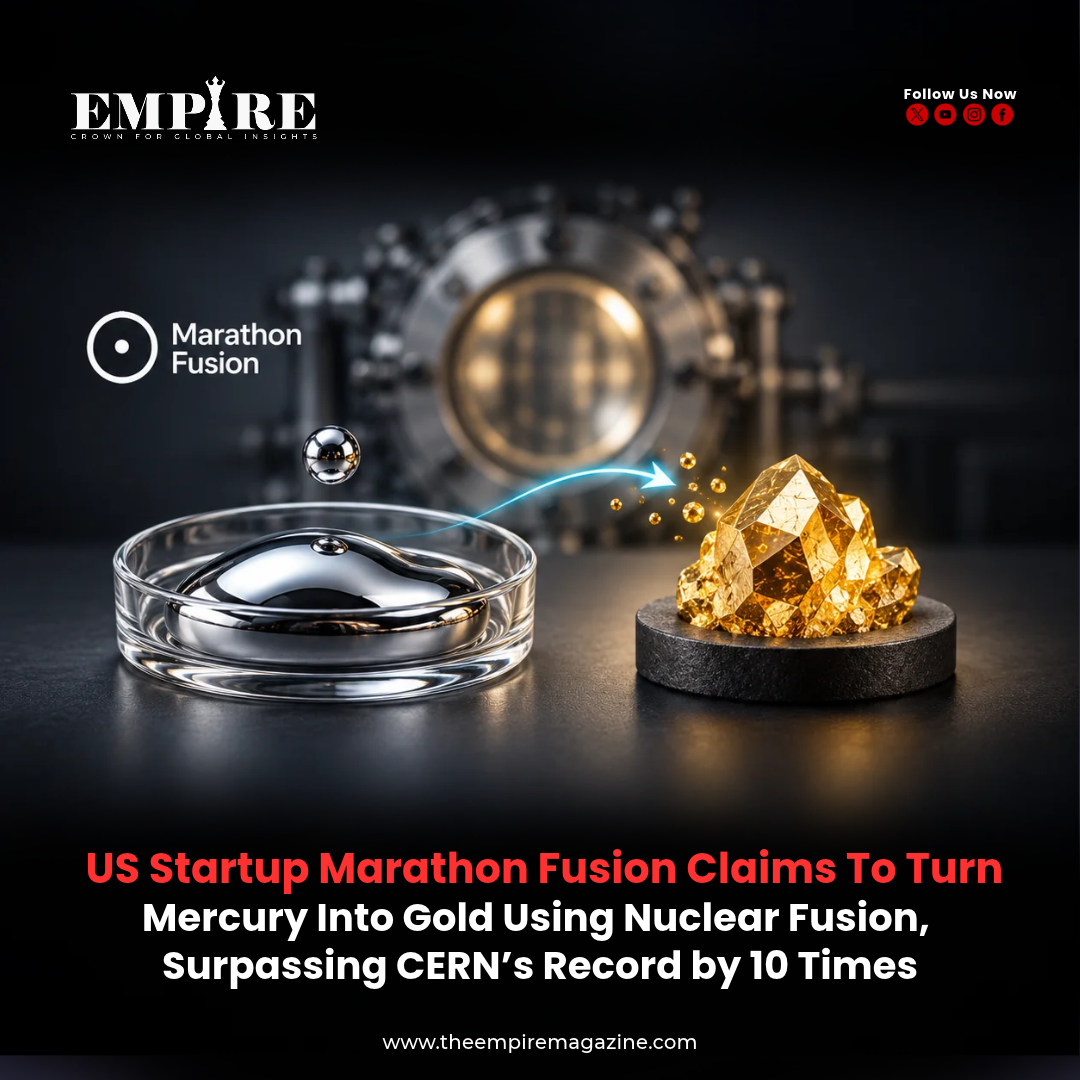
The company reports an experimental result as its earlier research explores whether gold production could improve the economics of fusion power.
United States | Startups, Technology and Innovation
Information checked on 25 October 2026.
Marathon Fusion, a San Francisco startup, says it has converted mercury into stable gold and exceeded a CERN benchmark by a factor of ten. The company announced the claim on 21 October 2026, describing work it said took place the previous month.
The announcement has attracted attention because it connects nuclear science with a commercially valuable material. However, the amount of gold produced, the detailed basis for the comparison and the cost of production remain important unanswered questions. Independent verification of the reported result has not been established in the coverage reviewed.
What Marathon Fusion Has Announced
In its public statement, Marathon Fusion described a demonstration of mercury-to-gold conversion and said it was building a fusion reactor in San Francisco. Reporting by Moneycontrol and Euronews distinguishes this experimental claim from the company’s earlier proposals for industrial production.
The announcement does not establish that the startup has an operating commercial fusion power plant or a profitable gold-manufacturing business. A successful nuclear reaction would be one milestone. Producing a useful quantity repeatedly, recovering it and selling it at a competitive cost would require further evidence.
How Mercury Can Become Gold
Marathon Fusion proposed process uses energetic neutrons from the fusion of deuterium and tritium, two forms of hydrogen. Those neutrons interact with mercury-198, an isotope of mercury. Isotopes are forms of the same element with different numbers of neutrons in their nuclei.
In the reaction described by the company, mercury-198 emits two neutrons after being struck by one. The resulting mercury-197 subsequently decays into stable gold-197. This is nuclear transmutation: a change in an atomic nucleus that produces a different element.
Fusion provides the neutron source; mercury is the material being transformed. Describing the approach this way helps explain why it requires specialised nuclear equipment rather than a conventional chemical process.
What CERN Actually Reported
CERN’s announcement on 8 May 2025 described a different mechanism. At the Large Hadron Collider, near-miss interactions between fast-moving lead nuclei can remove three protons, producing gold nuclei. The ALICE experiment measured a maximum rate of approximately 89,000 gold nuclei per second at its collision point.
CERN also estimated that about 86 billion gold nuclei, equivalent to 29 picograms, were produced across the four main experiments during Run 2, from 2015 to 2018. These nuclei rapidly fragmented after striking equipment; they were not collected as usable gold.
The 2025 announcement date therefore should not be confused with the period covered by that mass estimate. A production rate and a cumulative mass are also different measurements.
Until Marathon Fusion supplies a clearly defined comparison, its tenfold claim cannot establish how much recoverable gold it produced or how economically it did so. The headline multiplier alone is insufficient to compare the two approaches.
The Industrial Output Estimate Comes From a Simulation
A 2025 preprint by Adam Rutkowski, Jake Harter and Jason Parisi models a fusion-reactor arrangement capable of producing about two tonnes of gold per gigawatt of thermal power annually. This is a simulation result, not the measured yield of the September 2026 demonstration.
The thermal-power unit matters: it refers to heat output, not electricity delivered to the grid. Translating the model into an operating business would require sustained reactor performance and effective material processing.
A useful comparison would examine actual annual output after maintenance, recovery losses and downtime. The projected figure provides a design target; it does not establish a current production capacity.
Stable Gold Does Not Make Every Output Immediately Marketable
Gold-197 is stable, but the preprint also considers radioactive isotopes in the recovered material. The authors model storage lasting years while unwanted isotopes decay. The timing depends on feedstock purity and the activity threshold being applied; their scenarios do not establish a universal date when gold becomes suitable for sale.
Commercial assessment must therefore consider the composition of the complete product. Producing stable gold atoms and releasing a batch of material for everyday use are separate milestones.
Any delay between production and sale would also affect financing. A company might need to pay for equipment, operations and storage long before receiving revenue. That changes the value of the output even if the underlying conversion works.
Why Marathon Fusion Links Gold to Its Energy Business
Marathon says it began in 2023 by developing tritium fuel systems for commercial fusion. Its current work also covers neutron production, isotope separation and materials needed by fusion equipment.
The company presents gold as an additional product of future fusion plants. Its proposed mercury-based system would multiply neutrons while supporting the production of tritium, which is needed to sustain the fuel cycle. Marathon argues that this could add revenue alongside electricity.
The business logic is understandable: a plant producing several useful outputs may have more ways to recover its costs. However, additional revenue creates value only if the extra equipment, feedstock, processing and storage are affordable.
The relevant commercial measure is the margin remaining after those expenses. A theoretical quantity multiplied by a market gold price does not establish operating profit or investment returns.
What Would Demonstrate Commercial Progress
The next stage needs evidence that connects the nuclear result with a repeatable production process. Several disclosures would make the opportunity easier to assess:
| Evidence needed | Why it matters |
| Quantity and measurement method | Establishes the actual yield and the basis of the CERN comparison. |
| Independent confirmation | Tests whether the result can be checked and reproduced. |
| Recovery and product composition | Shows how much usable material remains after processing. |
| Operating duration and reliability | Clarifies whether output can be sustained beyond a short demonstration. |
| Full production and storage costs | Allows assessment of commercial margins and the timing of revenue. |
A reactor may generate the intended isotope while still facing difficult engineering requirements elsewhere. Reliable fuel handling, material durability and recovery systems would all have to work together. Progress in one part of that chain should be evaluated alongside the remaining work.
Could the Technology Change the Gold Market
The scale of the established market provides perspective. The World Gold Council’s full-year 2025 report put global mine production at approximately 3,672 tonnes. Marathon’s modelled output for a single gigawatt of thermal power would represent a small addition to that annual total.
A wider effect on supply would depend on how many facilities could operate, what they cost and when their output became available for sale. The startup’s announcement does not establish those conditions.
It therefore offers no reliable basis for predicting an imminent collapse in gold prices. A laboratory result can open a new technical possibility without immediately changing the economics of a global commodity market.
The Next Test for Marathon Fusion
The next meaningful milestone would be a detailed experimental report showing the amount produced, how it was measured and the precise benchmark used. Independent assessment could then help establish what the demonstration proves.
For Marathon Fusion, the longer-term opportunity is to turn a nuclear process into a dependable part of an energy business. Its commercial significance will depend on repeatable output, usable material and credible economics.
Explore more global business, technology and innovation coverage in The Empire Magazine’s article archive.
Read our related coverage: https://theempiremagazine.com/us-halloween-candy-sales/
Follow The Empire Magazine:
Facebook | Instagram
The Empire Magazine | Crown For Global Insights