
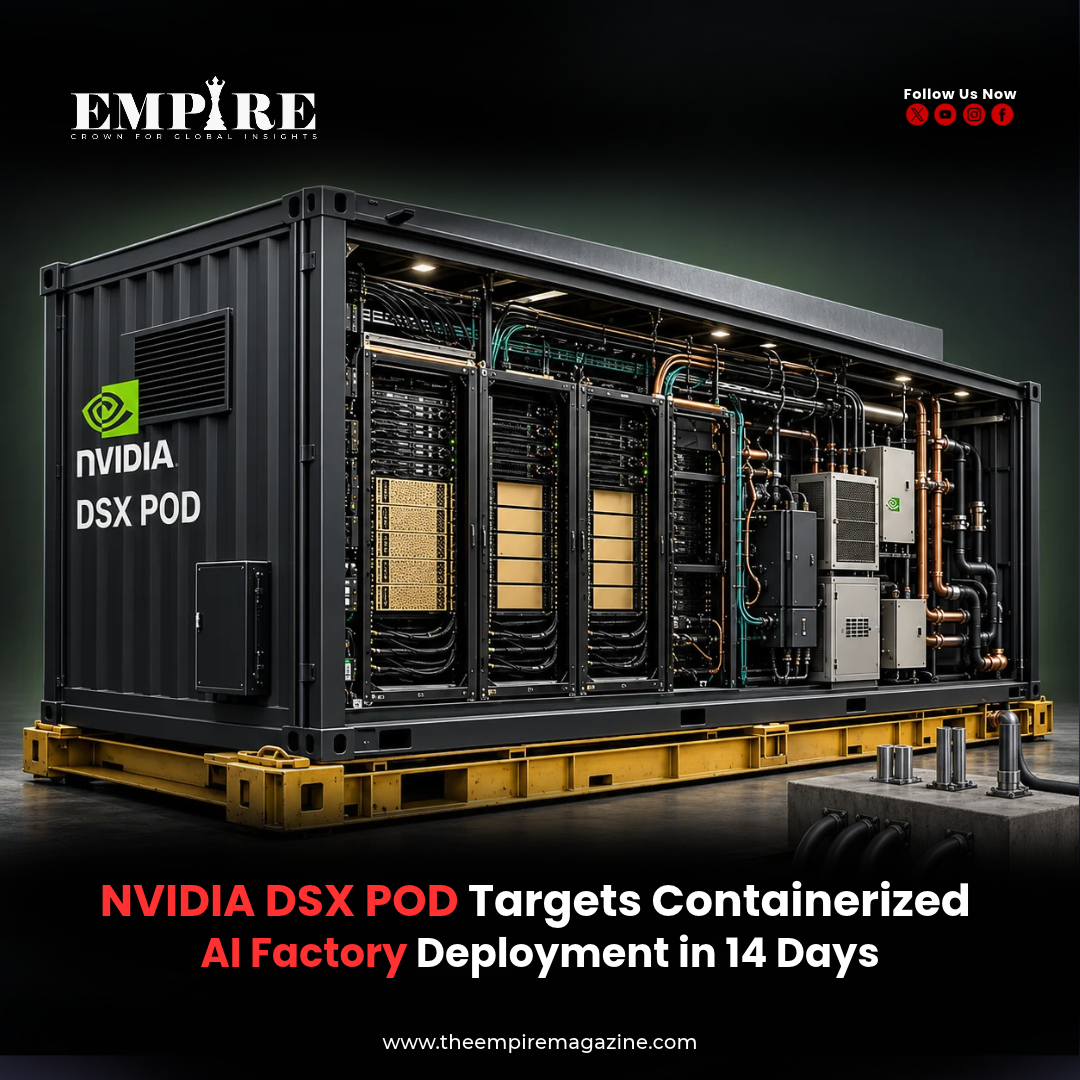
NVIDIA’s modular design brings more assembly and testing into the factory, aiming to shorten installation at prepared sites. Worldwide partner deliveries are planned for early 2027.
NVIDIA DSX POD is the company’s latest effort to make large AI infrastructure projects faster to deploy. Unveiled at GTC Berlin on October 21, 2026, the reference design packages Vera Rubin AI systems and supporting infrastructure into factory-integrated modular containers.
According to NVIDIA, deployment at a prepared site could take as little as 14 days, compared with the roughly six-month period cited in its announcement. That timetable starts with essential site infrastructure already in place. It does not cover the entire journey from buying land and securing electricity to operating an AI facility.
The distinction matters because the proposal tackles a specific bottleneck: the work required to assemble, connect and validate computing infrastructure after equipment reaches its destination. Moving more of that work into manufacturing could help operators put expensive hardware into productive use sooner.
What Is NVIDIA DSX POD
NVIDIA DSX POD is a reference architecture that delivery partners use to build modular AI infrastructure. NVIDIA supplies the validated system foundation, while partners engineer, manufacture, customize and support customer installations.
The initial focus is large, newly developed sites using liquid-cooled AI systems, including infrastructure for NVIDIA Cloud Partners. Operators can connect standardized units to prepared utilities and combine them into larger installations.
A reference design leaves room for implementation choices. Buyers still need to agree on capacity, equipment scope, support responsibilities and the conditions under which a deployment will be accepted.
What Makes an AI Factory Different
An AI factory is computing infrastructure organized around the AI lifecycle. It supports activities such as preparing data, training models, fine-tuning them for particular tasks and running inference, when a trained model responds to new inputs.
These facilities bring together accelerators, storage, networking and software so AI workloads can operate efficiently at scale. Their usefulness depends on how well those elements work together, as well as the performance of individual chips.
The word “factory” describes the production of AI outputs. For a text model, those outputs are generated as tokens, which can represent words or parts of words. Other AI systems process different types of information, including images and audio.
For readers following the announcement, the essential point is straightforward: DSX POD concerns the physical infrastructure that makes AI services possible. A container arriving at a site is only one stage in turning that infrastructure into a service people can use.
How Factory Integration Changes Deployment
NVIDIA’s technical explanation describes two activities happening in parallel. Partners assemble and validate the modular systems in a factory while site teams prepare foundations, utilities and external connections.
Factory work can include installing compute equipment, completing internal cabling and plumbing, establishing configuration baselines and testing integrated functions. Checks can cover network connections, sensors, power operation and cooling integrity.
After delivery, teams position the containers, connect them to one another and to site infrastructure, inspect for transport-related issues and complete commissioning. The objective is to reduce complicated integration work at the destination.
This changes where problems are discovered. An incorrectly connected component or configuration mismatch found during factory testing can be addressed before shipment. In practical terms, that could reduce troubleshooting during the tightly scheduled final stages of a project.
What the 14 Day Deployment Claim Covers
The 14-day figure is NVIDIA’s stated best-case deployment claim for a prepared site. It should not be treated as a universal delivery promise or a construction schedule for an undeveloped location.
Customers still need suitable connections for electrical power, facility water, cooling and networking. Site readiness remains a separate part of the project.
A useful way to assess the claim is to ask what must be complete before the deployment clock starts. Procurement schedules should distinguish manufacturing, transport, site preparation, installation and acceptance testing. Combining those stages into one headline number can make a proposal appear faster than the overall project really is.
For prospective customers, a more meaningful comparison would measure the time from the same starting conditions to the same operational milestone. It should also record how much capacity is usable at that point and whether the intended workloads meet their performance requirements.
The Vera Rubin Technology Behind NVIDIA DSX POD
DSX POD is designed around NVIDIA’s Vera Rubin platform. NVIDIA lists 72 Rubin GPUs and 36 Vera CPUs in a Vera Rubin NVL72 rack, alongside networking and data-processing components.
NVLink 6 provides connections within the rack-scale system. NVIDIA also supports networking technologies such as Spectrum-X Ethernet and Quantum-X800 InfiniBand for communication across larger systems.
The rack specifications help explain the engineering challenge. A dense collection of processors needs coordinated power, cooling and communication. Packaging that equipment for transport adds further demands on mechanical support and service access.
Rack-level specifications should be kept separate from a complete partner quotation. The total number of racks, supporting equipment, site infrastructure and contracted performance must be established for the actual solution being purchased.
Why Faster Deployment Could Matter to Operators
The potential commercial benefit is a shorter interval between receiving equipment and using it for customer workloads. Hardware waiting for integration cannot contribute the same useful output as a functioning cluster.
NVIDIA describes AI factory economics through measures including token throughput, power efficiency, utilization and uptime. Processing tokens quickly can help an operator serve more work, but response latency and output quality also influence the service users experience.
Our assessment is that faster deployment would be most valuable when demand, software and operations teams are ready alongside the hardware. If any of those pieces are missing, bringing a cluster online earlier may produce less benefit than the installation schedule suggests.
Earlier availability also does not establish a financial return by itself. A project still needs a credible operating model, adequate demand and sustained reliability. Those considerations should remain part of the business case even when installation becomes simpler.
Who Could Benefit From the Modular Approach
The most direct fit is an operator expanding substantial AI capacity across prepared sites. A common deployment unit could make planning successive phases easier to compare.
For organizations considering regional AI capacity, the potential attraction is a more repeatable way to bring infrastructure into service. This is a possible application of the model, rather than confirmation of a specific national deployment.
Modularity could also change procurement conversations. Instead of comparing individual servers alone, buyers may evaluate an integrated delivery package, including commissioning, maintenance access and responsibility for faults spanning several systems.
Smaller organizations should judge the approach against their actual workload. Owning large physical infrastructure is a different decision from renting compute. The announcement does not demonstrate that every business needs its own AI factory.
Partners and Expected Availability
NVIDIA plans worldwide DSX POD deliveries through partners in early 2027. Its announced collaborators include Dell Technologies, HPE, Lenovo, Foxconn through Ingrasys, Schneider Electric and Vertiv, alongside other computing and infrastructure companies.
The launch announcement does not provide a public price. Buyers will need project-specific proposals to understand equipment, delivery, site integration and ongoing support costs.
What Remains to Be Demonstrated
The strongest evidence will come from completed installations with clearly defined starting conditions. Operators will want to know whether factory validation translates into consistent commissioning schedules across different sites.
Useful measures would include transport-related rework, time to accepted production capacity, service availability and the effort required to maintain or expand an installation. Those measures would make it easier to compare modular delivery with other approaches.
NVIDIA’s technical guidance also keeps conventional construction and other integration models in scope. DSX POD adds another option; the right choice will depend on the project.
The announcement makes deployment methodology a central part of the AI infrastructure discussion. Its practical success will depend on how reliably partners turn the design into working capacity under real operating conditions.
Explore more global business, technology and innovation coverage in The Empire Magazine’s article archive.
Read our related coverage: anthropic-ai-agents-internet-access-tests/
Follow The Empire Magazine:
Facebook | Instagram
The Empire Magazine | Crown For Global Insights