
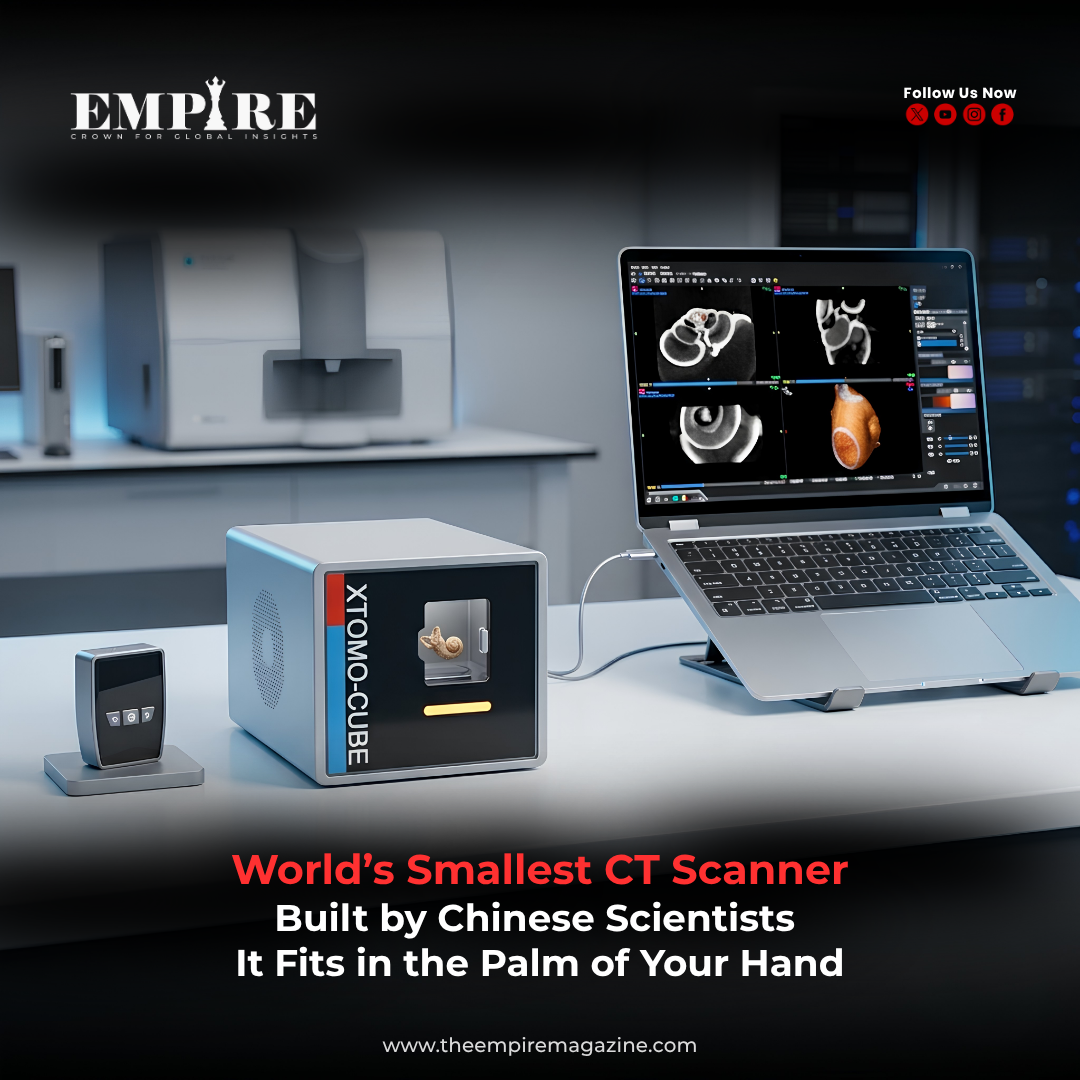
World’s Smallest CT Scanner Built by Chinese Scientists marks a major development in medical imaging technology as researchers explore how traditional hospital-sized scanning systems can be transformed into compact devices. The new miniature CT scanner represents a significant engineering achievement by reducing the size of computed tomography technology while maintaining the ability to produce detailed internal images.
Computed tomography, commonly known as CT scanning, has become one of the most important diagnostic technologies in modern medicine. Hospitals use CT scanners to detect injuries, diagnose diseases, and examine internal organs with detailed imaging.
However, conventional CT scanners are large, expensive machines that require dedicated rooms, complex infrastructure, and specialised operators. The development of a palm-sized CT scanner introduces a new possibility: bringing advanced imaging technology closer to patients and specialised environments.
Chinese scientists developing this compact CT technology are contributing to a global movement focused on making healthcare devices smaller, smarter, and more accessible.
World’s Smallest CT Scanner Built by Chinese Scientists Through Advanced Miniaturisation Technology
World’s Smallest CT Scanner Built by Chinese Scientists demonstrates how advances in engineering and medical technology are changing traditional healthcare equipment.
A conventional CT scanner works by rotating an X-ray source and detector around a patient to collect multiple images. These images are processed by computers to create detailed cross-sectional views of the body.
Reducing this technology to a handheld format requires solving several complex problems, including:
- Miniaturising X-ray components
- Maintaining imaging accuracy
- Reducing power requirements
- Managing radiation safety
- Improving computational efficiency
Researchers are using advancements in electronics, sensors, and computing to redesign traditional imaging systems.
This type of innovation reflects a wider trend in healthcare technology where smaller devices are being developed for faster and more flexible medical applications.
World’s Smallest CT Scanner Built by Chinese Scientists Could Transform Medical Imaging
The biggest potential impact of miniature CT technology is improved accessibility.
Traditional CT scanners are usually available only in large hospitals and diagnostic centres because of their size and cost.
A compact CT scanner could create opportunities for:
Point-of-Care Diagnosis
Doctors could potentially perform imaging closer to where patients receive treatment.
Emergency Healthcare
Portable imaging systems could support faster medical decisions in emergency situations.
Remote Healthcare
Smaller devices could help extend advanced diagnostic capabilities to areas with limited medical infrastructure.
Research Applications
Compact scanners could support scientific studies where large imaging equipment is not practical.
However, medical devices must undergo extensive testing and regulatory approval before widespread clinical use.
World’s Smallest CT Scanner Built by Chinese Scientists Uses Next-Generation Imaging Approaches
The development of a miniature CT scanner depends on several advanced technologies working together.
Compact X-Ray Technology
Traditional CT systems require powerful X-ray equipment. Miniature systems need smaller components while maintaining sufficient imaging capability.
Advanced Detectors
High-performance detectors are required to capture detailed information from X-ray scans.
Artificial Intelligence and Computing
Modern medical imaging increasingly uses software algorithms to process images and improve analysis.
Artificial intelligence is becoming an important technology in healthcare because it can assist with image interpretation, pattern recognition, and workflow improvement.
The combination of hardware innovation and AI-powered software is helping researchers develop more efficient medical imaging solutions.
World’s Smallest CT Scanner Built by Chinese Scientists Highlights the Future of Portable Healthcare
Healthcare technology is moving toward more portable and connected solutions.
In recent years, medical innovation has produced smaller versions of traditionally large equipment, including:
- Portable ultrasound devices
- Wearable health monitors
- Compact diagnostic tools
- Digital healthcare platforms
Miniature CT technology follows this broader movement.
The goal is to make advanced healthcare tools easier to access, especially in situations where traditional medical infrastructure may not be available.
Portable medical devices could become increasingly important as healthcare systems look for faster and more flexible diagnostic solutions.
World’s Smallest CT Scanner Built by Chinese Scientists Shows China’s Medical Technology Growth
China has invested heavily in scientific research, medical technology, artificial intelligence, and advanced manufacturing.
The development of compact medical imaging systems reflects the country’s broader focus on innovation in healthcare technology.
Chinese research institutions and technology companies have been working on technologies across areas such as:
- Medical imaging
- Robotics
- Artificial intelligence
- Biotechnology
- Semiconductor development
The miniature CT scanner project represents part of a larger global competition to develop next-generation healthcare solutions.
Countries and companies worldwide are investing in technologies that can improve diagnosis, reduce costs, and increase healthcare accessibility.
World’s Smallest CT Scanner Built by Chinese Scientists Faces Challenges Before Wider Adoption
Although miniature CT technology creates new possibilities, several challenges remain.
Image Quality
Small devices must provide images detailed enough for medical professionals to use confidently.
Safety Standards
CT scanners must meet strict requirements related to radiation exposure and patient safety.
Clinical Validation
New imaging technologies require extensive testing before being adopted in healthcare environments.
Manufacturing Costs
Producing advanced medical devices at scale requires efficient manufacturing processes.
These challenges determine how quickly experimental technologies can become practical healthcare solutions.
World’s Smallest CT Scanner Built by Chinese Scientists and the Future of Medical Innovation
The development of a palm-sized CT scanner represents a new direction in medical imaging.
Traditional CT scanners will continue playing an important role in hospitals, but compact imaging technologies could expand where and how diagnostic scans are performed.
The future of healthcare is increasingly focused on combining:
- Smaller hardware
- Advanced computing
- Artificial intelligence
- Digital connectivity
This transformation could help create healthcare systems that are faster, more flexible, and more accessible.
The same technology revolution can be seen across industries where innovation is making traditional systems smaller, smarter, and more efficient.
Read more technology and innovation insights here: https://theempiremagazine.com/google-launches-gemini-3-8-live/
Follow The Empire Magazine for global business, technology, innovation, and leadership insights:
Facebook: https://www.facebook.com/profile.php?id=61573749076160
Instagram: https://www.instagram.com/the_empire_magazine/
The Empire Magazine | Crown For Global Insights