
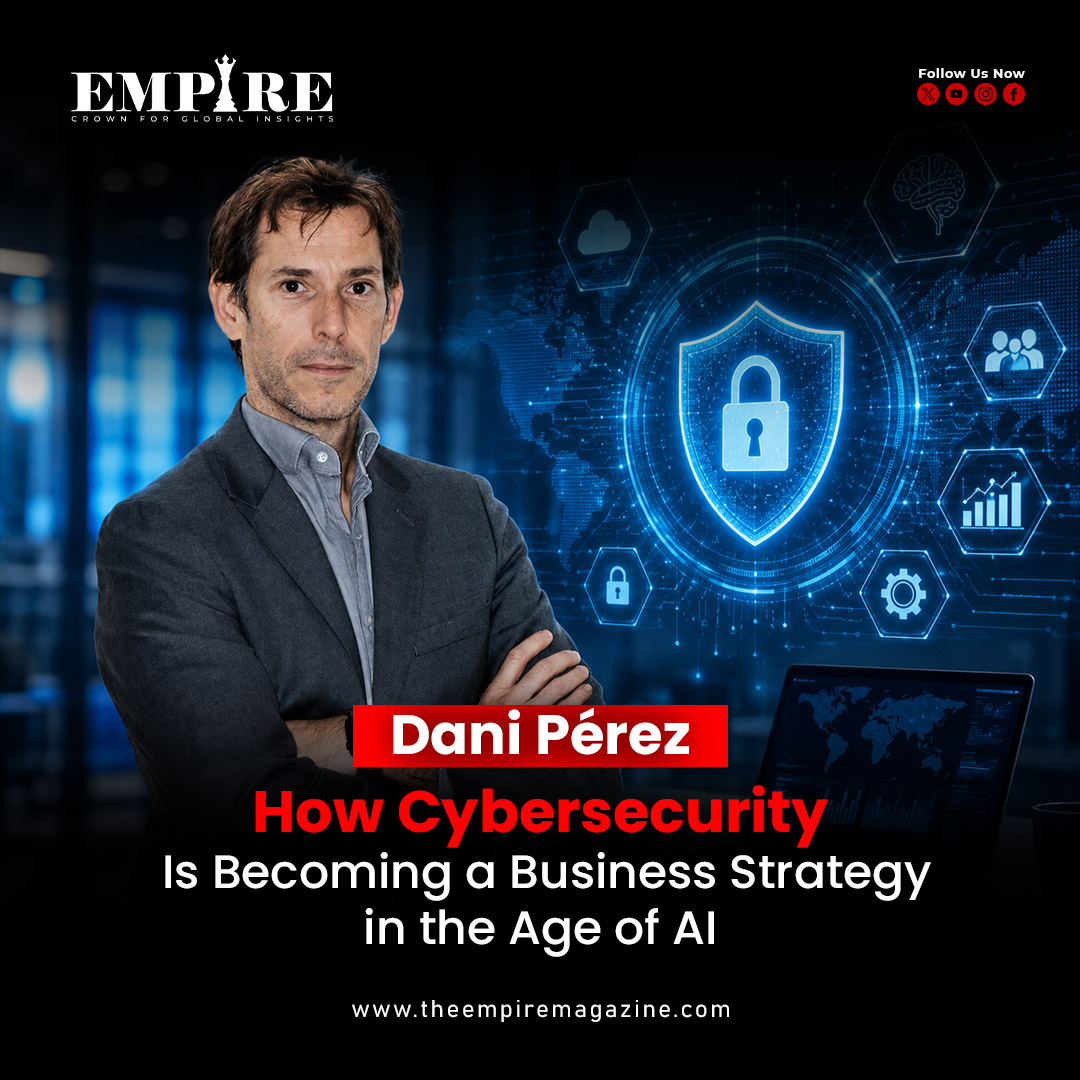
Dani Pérez is transforming cybersecurity leadership by connecting AI, business strategy, risk management and digital security to enable safer business growth. Dani Pérez is redefining cybersecurity leadership by connecting digital security with business strategy, AI governance, operational resilience and innovation. His approach focuses on proactive risk management, customer-centric security and building a culture where cybersecurity becomes a shared business responsibility.
Cybersecurity is no longer confined to IT departments. As artificial intelligence, cloud computing, connected systems and digital transformation reshape businesses, security has become a board-level concern. Dani Pérez, Director of Cybersecurity, is advocating a more business-focused approach in which cybersecurity supports innovation, protects operational resilience and gives organizations the confidence to grow.
Dani Pérez Is Changing the Role of Cybersecurity Leadership
For years, cybersecurity was largely viewed as a technical responsibility focused on protecting networks, devices and data. That approach is becoming increasingly inadequate as digital systems become embedded across every part of modern business. Dani Pérez believes cybersecurity leaders must understand the organization’s commercial objectives and ensure that security enables those objectives rather than creating unnecessary friction.
His approach places business confidence, customer needs, governance and proactive problem-solving at the centre of cybersecurity leadership. Instead of waiting for vulnerabilities to become incidents, security teams need to identify risks early and work alongside business functions to find practical solutions. This shift turns cybersecurity from a defensive function into a strategic capability that can support sustainable digital transformation.
Why Dani Pérez Believes Cybersecurity Must Support Business Growth
The growth of digital businesses has created a difficult balance between innovation and risk. Organizations want to adopt new technologies quickly, but every new platform, connected system and digital process can introduce additional vulnerabilities. Dani Pérez argues that security should therefore be considered at the beginning of technology and business decisions rather than added after implementation.
This approach allows cybersecurity teams to become partners in innovation. When security professionals understand the organization’s objectives, they can help identify acceptable risks, recommend appropriate safeguards and allow projects to move forward with greater confidence. The objective is not to eliminate every possible risk, but to help businesses understand, manage and reduce the risks that could prevent them from achieving their goals.
AI Is Creating a New Cybersecurity Challenge for Businesses
Artificial intelligence is rapidly changing how organizations operate, but its adoption is also creating new cybersecurity concerns. One of the emerging challenges is the growing use of AI tools without formal organizational oversight. Employees may use external AI platforms to process information or perform work without fully understanding how sensitive business data could be exposed.
At the same time, AI is giving cybercriminals new capabilities. More convincing phishing messages, automated social engineering and increasingly sophisticated attacks can make traditional security awareness approaches less effective. Dani Pérez emphasizes the importance of visibility, governance and employee education as organizations expand their use of AI. Businesses need to understand not only what AI can do for productivity, but also what new risks it introduces.
Dani Pérez Highlights the Growing Importance of OT Cybersecurity
The cybersecurity challenge becomes even more complicated in industrial environments where information technology and operational technology increasingly intersect. Production systems were traditionally designed around reliability and availability, often in environments where connectivity was limited. Modern digital transformation has changed that separation, creating new pathways between operational systems and corporate networks.
For organizations operating industrial environments, a cyberattack can therefore become more than a data-security incident. It can disrupt production, affect supply chains and create significant operational and financial consequences. Dani Pérez’s approach emphasizes the need to understand the specific characteristics of operational technology while developing practical security measures that protect critical systems without compromising the availability that industrial operations require.
People Can Become a Stronger Cybersecurity Defence
Technology alone cannot create a resilient cybersecurity environment. Employees interact with systems, emails, applications and data every day, making security awareness an important part of an organization’s overall defence. Dani Pérez believes organizations should move away from treating employees simply as a potential weakness and instead build a culture where people actively contribute to security.
That requires communication that employees can understand and apply. Regular awareness programmes, practical guidance and simple explanations can help people recognize suspicious behaviour and make better security decisions. When employees understand why security practices matter, cybersecurity becomes a shared responsibility rather than something imposed by an IT department. This people-focused approach also reinforces Dani Pérez’s wider leadership philosophy, which places trust, communication and collaboration alongside technical controls.
Cybersecurity Leadership Is Becoming a Board-Level Responsibility
As cyber risks increasingly affect revenue, operations, reputation and business continuity, cybersecurity decisions are becoming increasingly relevant to senior leadership. Dani Pérez believes cybersecurity professionals need to communicate in business terms and explain how technical risks could influence organizational objectives.
This requires more than technical expertise. Modern cybersecurity leaders need to understand governance, risk management, business priorities and organizational behaviour. Their role is increasingly to help executives make informed decisions about technology and risk. Whether cybersecurity reports through a CIO, directly to senior leadership or through another organizational structure, Dani Pérez’s approach emphasizes that security must have a meaningful voice in strategic decision-making.
Dani Pérez Sees Trust as a Foundation of Cybersecurity
Security teams can sometimes be perceived as the people who say “no” to new projects or impose restrictions on employees. Dani Pérez advocates a different relationship between cybersecurity and the wider business. Security professionals should be involved early enough to understand what teams are trying to achieve and then help them find ways to achieve those objectives securely.
This collaborative model can strengthen trust between cybersecurity teams and business functions. When employees and executives see security as a partner rather than an obstacle, they are more likely to involve security teams before risks become difficult to address. For Dani Pérez, this is where cybersecurity creates its greatest business value: by allowing organizations to innovate while maintaining confidence in their systems, people and processes.
Dani Pérez and the Future of Cybersecurity Leadership
The future of cybersecurity will require leaders who can balance technological change with human judgment. Artificial intelligence and automation will increasingly support security teams, but they cannot replace the need for communication, empathy, accountability and sound decision-making. Dani Pérez believes these human qualities will remain essential as cybersecurity becomes more closely connected with business strategy.
His approach reflects a broader transformation taking place across the industry. The modern cybersecurity leader is no longer simply responsible for protecting infrastructure. The role increasingly involves helping organizations understand risk, build resilience, support innovation and create a culture in which security becomes everyone’s responsibility. As digital transformation accelerates, this combination of technology, business understanding and people-focused leadership will become increasingly important.
“The real value of cybersecurity shows up when it helps the business grow safely, without creating fear or friction.” — Dani Pérez
Read the complete feature here:https://theempiremagazine.com/magazine/dani-perez-the-most-trusted-cybersecurity-leader-shaping-digital-transformation-in-2026/
Read Previous Article here: https://theempiremagazine.com/camilla-maiorano/
Magazine Feautures | Podcasts: Empire Global Talks
Follow The Empire Magazine on Facebook | Instagram | LinkedIn | YouTube
The Empire Magazine | Crown for Global Insights