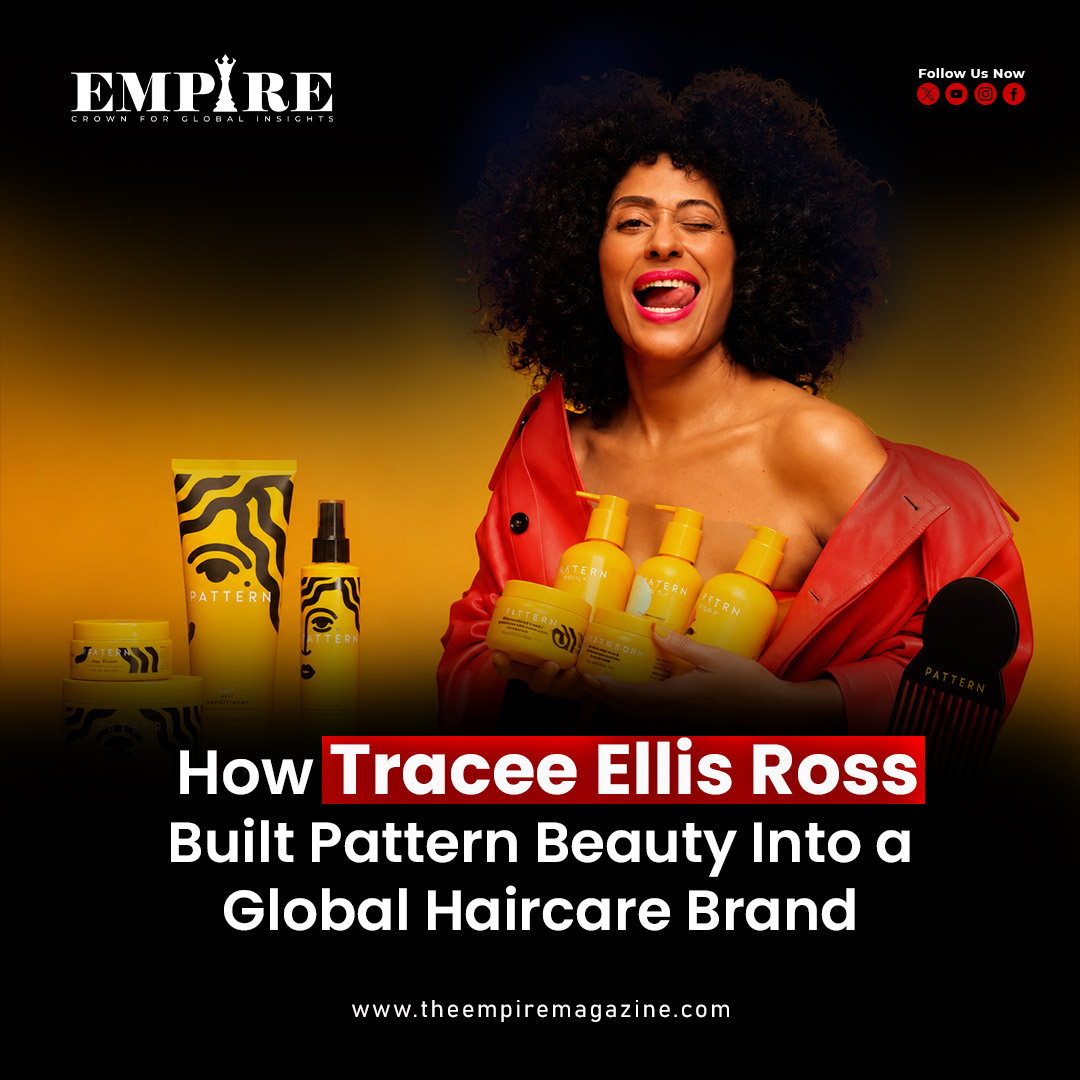
Discover how Tracee Ellis Ross built Pattern Beauty from a textured-hair vision into a fast-growing global beauty brand through community, innovation and inclusion. Tracee Ellis Ross built Pattern Beauty around the needs of people with curly, coily and tight-textured hair. Launched in 2019, the brand has expanded from seven products into a broad beauty portfolio spanning haircare, styling tools and body care, while building retail partnerships and a strong community-led identity.
Tracee Ellis Ross Pattern Beauty Began With a Personal Haircare Problem
For Tracee Ellis Ross, Pattern Beauty was never simply a celebrity entering the beauty business. The idea grew from years of living with curly, coily and tightly textured hair and struggling to find products that genuinely addressed its needs. Before Pattern Beauty launched in 2019, Ross had spent years thinking about what a haircare company designed around textured hair could look like. She has described the concept as a long process that included an initial brand pitch in 2008, years of development, work with chemists and dozens of product samples before the company reached consumers.
That background helps explain why Pattern Beauty has always positioned itself differently from a conventional celebrity beauty label. Ross was not simply attaching her name to existing formulas. She wanted to build a range around the actual experiences of people whose hair had often been treated as a problem to be controlled rather than a texture to be understood and celebrated. The brand’s mission centres on serving curly, coily and tight-textured communities, while its messaging consistently presents textured hair as versatile, expressive and worthy of specialised care. That philosophy became the foundation for everything Pattern Beauty would build later.
Pattern Beauty Turned an Underserved Market Into a Brand Opportunity
Pattern Beauty entered the market at a time when the beauty industry was increasingly recognising the commercial importance of textured hair consumers. Yet Ross saw something deeper than a business opportunity. She believed the language surrounding Black and textured hair needed to change. Instead of telling customers that their natural texture was something that required fixing, Pattern Beauty sought to create products that supported hair as it naturally grows.
The company launched with seven products and a limited retail footprint, but the proposition was clear. Pattern Beauty focused on hydration, definition, styling and maintenance for curls, coils and tight textures. According to NRF’s 2025 coverage, Ross estimated the U.S. textured-hair market opportunity at more than $31 billion, challenging the industry’s long-standing tendency to treat Black haircare as a niche category.
That distinction became important to the brand’s identity. Pattern Beauty’s audience was not presented as a narrow demographic to be marketed to; it was treated as a community whose needs could influence product development. The result was a brand that combined commercial ambition with cultural relevance. Instead of asking customers to adapt to the beauty industry’s existing assumptions, Pattern Beauty built its proposition around listening to customers first.
Tracee Ellis Ross Made Community the Core of Pattern Beauty
One of Pattern Beauty’s most important growth strategies has been its relationship with its audience. Ross has repeatedly described brand building as an ongoing conversation between the company and its customers. That approach has helped Pattern Beauty evolve beyond a collection of shampoos and conditioners into a broader ecosystem of haircare, styling and beauty products.
The strategy was visible from the beginning. When Pattern Beauty launched in 2019, it quickly generated consumer interest, selling out of several products on its first day and entering approximately 1,200 Ulta stores that September. Forbes also reported that the brand’s Instagram account gained 130,000 followers within its first week.
Those early results demonstrated the power of combining a recognisable founder with a clearly defined consumer need. Ross’s celebrity status created awareness, but the brand’s longer-term proposition depended on whether the products delivered something customers felt was missing. Pattern Beauty continued to expand its assortment and retail relationships rather than relying solely on Ross’s public profile. This distinction matters because celebrity visibility can create an initial audience, but community trust is what can turn attention into a sustainable beauty business.
Pattern Beauty Expanded From Haircare Into a Wider Beauty Ecosystem
Pattern Beauty’s evolution has not stopped at traditional haircare. Over time, the company expanded into tools and styling products, reflecting Ross’s belief that textured hair consumers deserve solutions for the full range of styles they may choose.
The brand entered heat styling with a blow-dryer in 2023 and followed with a curling iron in 2024. In August 2026, Pattern introduced another major step in that strategy: its Vibrating Flat Iron, alongside a Blow Out Primer and Detox Shampoo. The flat iron uses ceramic-coated plates and vibration technology intended to help hair move more smoothly through each pass, while the primer provides heat protection and the detox shampoo is designed to remove buildup without excessively stripping moisture.
The significance goes beyond three new products. Pattern Beauty is increasingly positioning itself around the idea that textured hair should have freedom of choice. Customers can wear curls, coils, protective styles or straightened looks without having to abandon the health and care principles that underpin the brand. That makes innovation part of Pattern’s original mission rather than a departure from it.
Pattern Beauty’s Retail Expansion Strengthened Its Global Ambitions
Distribution has been another important part of Pattern Beauty’s transformation. The company began with direct-to-consumer sales and Ulta Beauty, then expanded into additional retail partnerships. Macy’s became Pattern’s first department-store partner, bringing its products to the retailer’s website, mobile app and selected stores.
By 2025, NRF reported that Pattern Beauty had grown to 11 retail partners and more than 50 products, including hair tools such as a steamer, blow-dryer and interchangeable curling iron. The brand has also expanded its presence at Sephora, where its current assortment includes hair products, styling solutions, tools, gifts and body-care products.
This retail progression matters because physical distribution can transform a digitally recognised beauty company into a mainstream consumer brand. Customers can discover Pattern in stores rather than having to encounter it first through Ross’s social media presence. At the same time, the continued presence of the brand online allows Pattern to maintain a direct relationship with its community. The combination of retail scale and direct engagement gives the company a stronger platform for international growth.
Tracee Ellis Ross Took Pattern Beauty Beyond Haircare
Pattern Beauty’s expansion into body care in 2025 marked another important stage in Ross’s strategy. The company introduced Pattern Body with five products, including a Moisturizing Body Wash, Nourishing Body Oil, Hydrating Body Lotion, Moisture Rich Body Cream and Dry Exfoliating Body Scrub. The launch had reportedly been part of the brand’s roadmap since its inception.
The move was logical because Pattern’s core idea had always extended beyond individual hair products. Ross has connected beauty routines with self-care, identity and the experience of caring for oneself. Pattern Body allowed the company to take that philosophy into another category without abandoning its existing visual and cultural identity.
It also demonstrated that Ross was building a brand rather than simply launching products. Haircare remains Pattern’s foundation, but body care creates additional opportunities to engage consumers throughout their daily routines. The strategy resembles the way successful beauty companies grow: establish authority in one category, earn consumer trust, then extend that trust into adjacent categories. For Pattern, the challenge is to ensure that expansion feels authentic rather than opportunistic. So far, its body-care strategy has been presented as a natural continuation of the brand’s self-care philosophy.
Pattern Beauty’s Innovation Is Built Around Textured Hair Needs
What separates Pattern Beauty from many celebrity-founded beauty companies is the degree to which product development remains connected to the practical challenges of textured hair. The company’s latest heat-styling products provide a useful example. Rather than simply releasing another flat iron, Pattern focused on the specific issue of repeated passes, pulling and friction that can occur when styling textured hair.
The new Vibrating Flat Iron features 14 heat settings, reaches temperatures of up to 450 degrees and produces 12,000 vibrations per minute, according to Vogue’s August 2026 report. Pattern’s Blow Out Primer offers heat protection up to 425 degrees, while the Detox Shampoo is designed to remove buildup and prepare hair for styling.
This product philosophy reflects Ross’s broader approach: innovation should solve a real consumer problem. Pattern’s assortment has therefore grown from conditioners and styling creams into tools, treatments and preparation products that address different stages of a hair routine. That creates a more complete ecosystem around the consumer and strengthens the brand’s credibility within a highly specialised category.
The Future of Tracee Ellis Ross Pattern Beauty Is Bigger Than Hair
Pattern Beauty’s journey from a long-held idea to an expanding beauty company illustrates how personal experience can become a powerful foundation for entrepreneurship. Ross brought celebrity recognition to the business, but the brand’s growth has been driven by a clearer proposition: textured hair consumers deserve products, representation and innovation designed with their needs in mind.
In 2026, Pattern Beauty is entering another stage of its development. WWD reported that the company is prioritising brand awareness, continuing global expansion and scaling its body-care business beyond its original haircare foundation. Meanwhile, its newest heat-styling products show that the company continues to invest in innovation rather than simply expanding its catalogue.
The larger lesson from Tracee Ellis Ross Pattern Beauty is that authenticity alone does not build a global brand. It must be supported by product development, distribution, customer listening and the discipline to keep evolving. Ross started with a personal frustration and turned it into a business built around an underserved community. Pattern Beauty’s next chapter will determine how far that original vision can travel across markets and categories. But its trajectory already demonstrates the commercial power of building beauty products around people who have historically been asked to adapt to the industry, rather than the other way around.
Previous article: https://theempiremagazine.com/fei-fei-lis/
Magazine Feautures | Podcasts: Empire Global Talks
Follow The Empire Magazine on Facebook | Instagram | LinkedIn | YouTube
The Empire Magazine | Crown for Global Insights