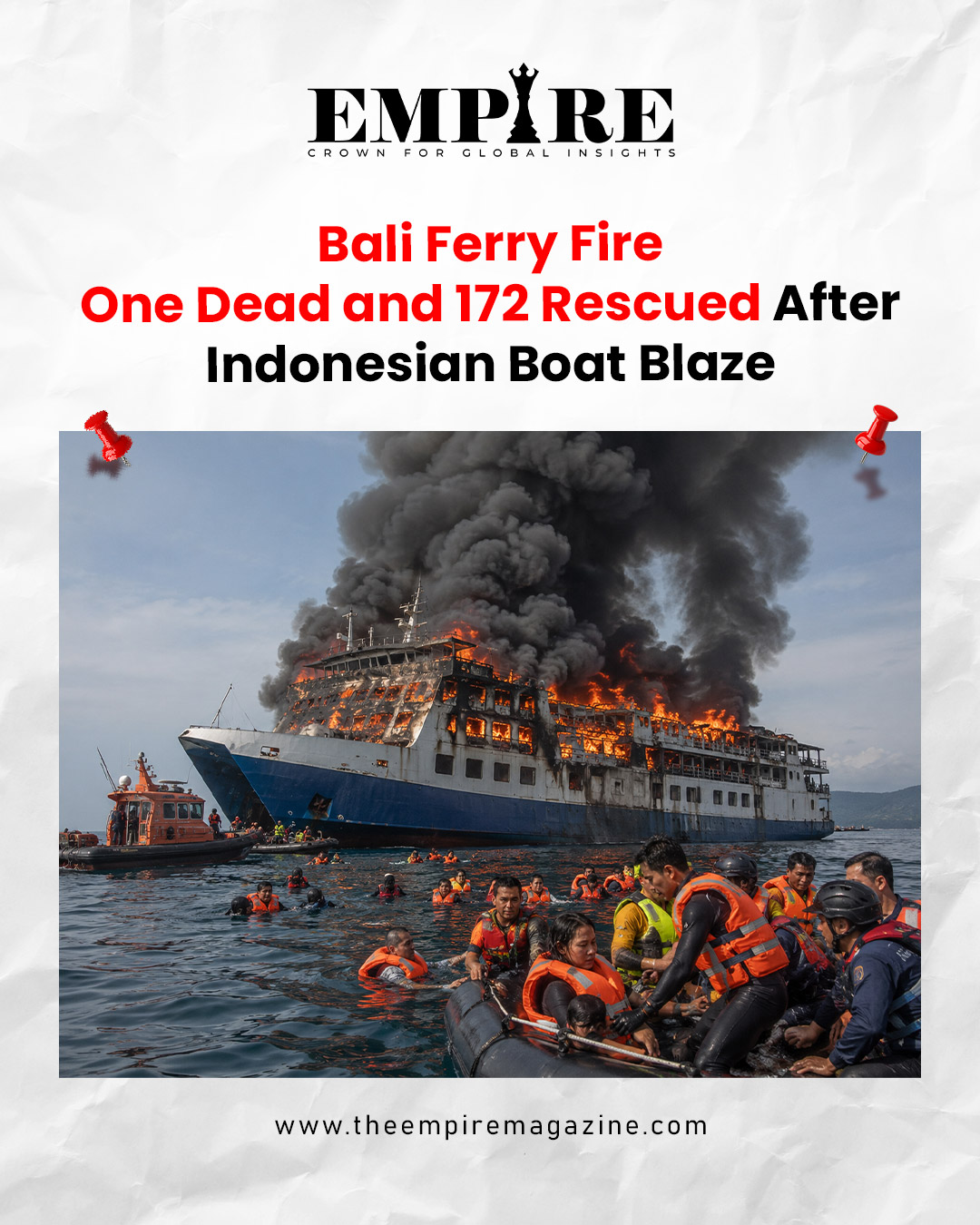
Bali ferry fire leaves one dead and 172 rescued after KM Putri Yasmin catches fire near Lombok, raising fresh concerns over ferry safety in Indonesia. The Bali ferry fire involving KM Putri Yasmin killed one passenger and led to the rescue of at least 172 people after the vessel caught fire in the Lombok Strait while travelling from Bali to Lombok. Rough seas complicated the emergency operation as authorities continued accounting for everyone on board.
Bali Ferry Fire Triggers Emergency Rescue
The Bali ferry fire turned an ordinary journey between two of Indonesia’s most popular islands into a desperate maritime rescue on Wednesday, August 12, 2026. The KM Putri Yasmin was travelling from Padangbai port in Bali to Lembar port in Lombok when a fire broke out in the Lombok Strait at around 4:15 a.m. local time. Thick smoke quickly spread across the vessel as passengers and crew were forced into an emergency evacuation. What followed was a large rescue operation involving Indonesian search and rescue teams, navy vessels, patrol boats, a helicopter and other ships operating in the area.
Early reports said 172 people had been rescued, which formed the basis of the initial death and rescue figures reported around the world. However, as authorities continued checking passenger records and rescue numbers, the total number evacuated increased. Reuters later reported that 212 people had been taken safely to ports in Bali and Lombok, while the Associated Press reported 211 people rescued. The changing figures underline the difficulty of accounting for everyone during a fast-moving maritime emergency.
Bali Ferry Fire Starts on Putri Yasmin
The Bali ferry fire began aboard KM Putri Yasmin while the vessel was carrying passengers, vehicles and motorcycles across the Lombok Strait. The Associated Press reported that the 62-metre ferry had 44 vehicles and 53 motorcycles onboard. Authorities initially relied on a passenger manifest that listed fewer people than were ultimately accounted for during the rescue, creating an immediate concern over how many individuals were actually travelling on the vessel.
The exact cause of the Putri Yasmin ferry fire has not yet been established. According to the Associated Press, the fire was reportedly believed to have originated from a cargo truck, but investigators had not reached a final conclusion on how the blaze started or how it spread. The ship itself was built in Japan in 1992 and was designed to carry up to 220 passengers and 55 vehicles. Indonesia’s official transport database also lists Putri Yasmin as operating on the Padangbai-Lembar route.
Bali Ferry Fire Rescue Faces Rough Seas
The Bali ferry fire rescue operation became more difficult because of severe weather and rough conditions in the Lombok Strait. Rescue authorities reported waves reaching around four metres, creating dangerous conditions for boats approaching the burning ferry and for passengers being transferred away from the vessel. The combination of darkness, smoke, fire and high waves made a normally familiar crossing suddenly extremely dangerous.
More than 200 rescue personnel were involved as Indonesian authorities worked to evacuate those aboard. The rescue effort included search and rescue vessels, navy ships, patrol boats, inflatable boats and a helicopter. Nearby vessels also assisted passengers during the evacuation. Despite the difficult conditions, hundreds of people were ultimately brought to safety. The operation demonstrated how critical rapid coordination becomes when a Bali ferry fire unfolds far from land, where every minute can change the outcome.
Bali Ferry Fire Leaves One Passenger Dead
The human cost of the Bali ferry fire was confirmed with the death of a 19-year-old Indonesian woman, identified in reports as Ananda Indah Dwi Septiani. Several passengers were also injured, with at least two people taken to hospital following the emergency. The fatality has cast a shadow over an otherwise successful mass rescue and has left families waiting for answers about how the fire began and whether every possible safety measure was followed.
Reports also highlighted the international mix of passengers aboard the vessel. The Australian newspaper reported that two Australians were among those rescued, while the Associated Press said several foreign tourists were safely evacuated. Such details illustrate how the Bali ferry fire affected not only Indonesian travellers but also international visitors using one of the region’s important ferry connections. For those onboard, however, nationality quickly became irrelevant as smoke and flames transformed a routine journey into an emergency.
Bali Ferry Fire Raises Passenger Safety Questions
One of the most serious issues emerging from the Bali ferry fire is the discrepancy between the official passenger manifest and the number of people eventually rescued. Reuters reported that the manifest recorded 114 passengers and 17 crew members, while the final number of people evacuated was significantly higher. The Associated Press similarly reported that the manifest initially listed 131 passengers, creating concerns over how accurately passenger numbers were being recorded before departure.
Accurate passenger records are essential during any Indonesia ferry fire because rescue teams need to know exactly how many people may still be missing. A mismatch can make it harder to determine whether someone has been safely evacuated or remains in danger. Indonesian authorities have announced an investigation, but it would be premature to conclude that overloading caused the Bali ferry fire. Investigators will need to determine whether passenger management, boarding procedures, cargo handling or another operational issue contributed to the discrepancy.
Bali Ferry Fire Highlights Indonesia’s Ferry Risks
The Bali ferry fire has renewed attention on Indonesia’s wider maritime safety challenges. Ferries are indispensable in Indonesia because the country is spread across more than 17,000 islands. They transport local communities, workers, vehicles, tourists and essential goods between islands every day. That dependence means ferry safety is not simply a transport issue; it is closely connected to the country’s economic and social life.
The timing has also increased concern. The Bali ferry fire came shortly after another Indonesian ferry fire involving KM Mutiara Sentosa 2, which killed five people. The recurrence of serious ferry incidents has revived questions about enforcement, vessel maintenance, passenger monitoring and emergency preparedness. Indonesia has a vast maritime network, and maintaining consistent safety standards across such a large geography remains a demanding task.
Bali Ferry Fire Puts Bali to Lombok Route in Focus
The Bali to Lombok ferry route is one of Indonesia’s important island connections. Padangbai in Bali and Lembar in Lombok serve as key gateways for passengers and vehicles, connecting communities while also supporting tourism and regional trade. For thousands of travellers, the journey is a routine part of moving between the islands. The Bali ferry fire, however, has reminded passengers of the risks that can emerge during even a familiar crossing.
The incident could also influence how travellers view ferry transportation between Bali and Lombok. Tourism depends heavily on reliable connections, and confidence in transport safety matters just as much as convenience. The fact that the Putri Yasmin was operating on an officially recognised Padangbai-Lembar route makes the investigation particularly important. Authorities will now be under pressure to establish what happened, whether the vessel was compliant with safety requirements and whether any failures can be prevented on other ferries serving the same route.
What the Bali Ferry Fire Means for Indonesia
The Bali ferry fire is not only a story about a vessel catching fire at sea. It is a test of Indonesia’s ability to protect people who depend on maritime transport. The rescue operation showed the value of coordinated emergency response, with multiple government agencies and vessels working together under difficult circumstances. Yet successful rescue should never replace prevention. Every fire avoided through proper maintenance, every accurate passenger record and every functioning emergency system can reduce the need for a large-scale rescue in the first place.
The investigation into the Bali ferry fire will therefore matter beyond KM Putri Yasmin. Authorities will need to examine the fire’s origin, the condition of the vessel, the handling of vehicles and cargo, passenger numbers, evacuation procedures and the effectiveness of emergency equipment. Answers to these questions could influence how ferry operators across Indonesia approach safety. For passengers, the expectation is simple: when they board a ferry, they should be confident that every reasonable measure has been taken to bring them safely to the other side.
Bali Ferry Fire Leaves Lessons for Maritime Safety
The Bali ferry fire has left one person dead, hundreds rescued and many more questions still unanswered. The initial figure of 172 rescued became part of the first wave of international reporting, but later official updates placed the number of evacuees above 200. That changing count is itself part of the story because it shows how difficult it can be to establish a complete passenger picture during a major maritime emergency.
For Indonesia, the lasting lesson from the Bali ferry fire should be clear. Ferry safety depends on more than a vessel being allowed to operate. It requires accurate manifests, strong crew training, reliable fire protection systems, effective evacuation plans, proper cargo management and strict enforcement of maritime rules. Indonesia’s islands will always depend on ferries, but passengers should never have to depend on luck. As investigators examine the Putri Yasmin incident, the real measure of the response will be whether the lessons from this Bali ferry fire lead to safer journeys across Indonesia’s waters.
For more business and retail insights, read more on The Empire Magazine
Previous article: https://theempiremagazine.com/fidel-castro-cuba/
Magazine Feautures | Podcasts: Empire Global Talks
Follow The Empire Magazine on Facebook | Instagram | LinkedIn | YouTube
The Empire Magazine | Crown for Global Insights