Cuba marks Fidel Castro’s 100th birthday as blackouts, fuel shortages and economic decline deepen, putting his revolutionary legacy under fresh scrutiny.
Fidel Castro 100th Birthday in Cuba
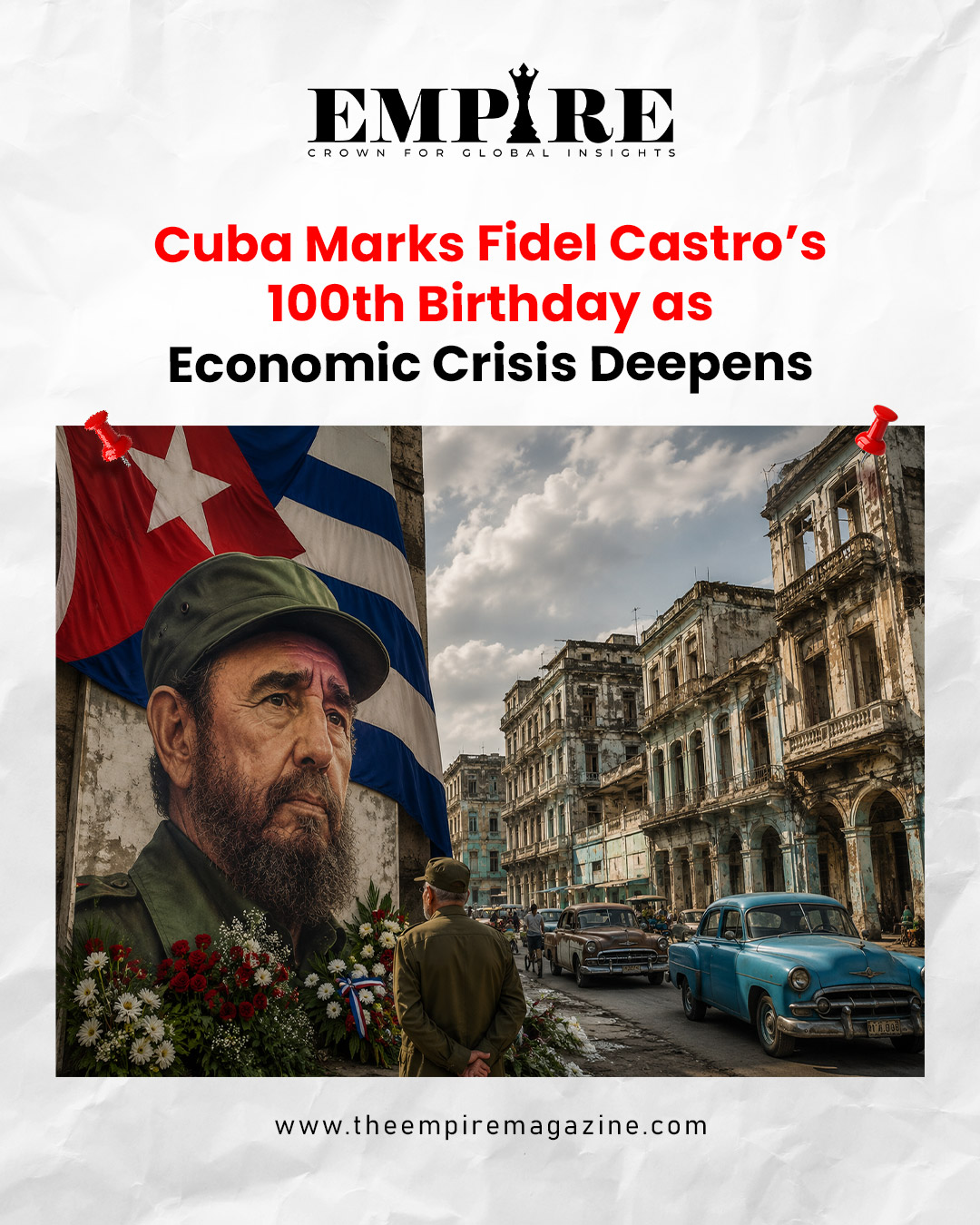
Cuba is marking the Fidel Castro 100th Birthday anniversary on August 13, 2026, but the centenary arrives at a difficult moment for the island nation. Across Havana and other Cuban cities, tributes to the revolutionary leader are taking place alongside a very different reality: prolonged blackouts, fuel shortages, rising prices, weakened public services and an economy struggling to regain stability.
Fidel Castro, who was born on August 13, 1926, dominated Cuban politics for decades after the 1959 revolution that overthrew Fulgencio Batista. He remained one of the most influential and controversial figures in modern Latin American history until his death in 2016. His supporters remember him as a symbol of national sovereignty and resistance to U.S. influence, while critics point to political repression, restrictions on dissent and the long-term weaknesses of Cuba’s economic model.
The Fidel Castro 100th Birthday celebrations therefore carry a deeper meaning than a traditional political anniversary. They have become an opportunity for Cuba to revisit the achievements, sacrifices and unresolved problems associated with the revolutionary project. In Havana, official commemorations and discussions about Castro’s legacy are taking place as citizens continue to deal with a severe economic and energy crisis.
Fidel Castro’s Revolutionary Legacy
Fidel Castro’s political journey changed Cuba permanently. After the 1959 revolution, his government nationalised major industries, expanded state control over the economy and built a socialist system closely aligned with the Soviet Union. The government also placed significant emphasis on universal healthcare and education, achievements that became central to Castro’s international image.
For decades, Cuba benefited from close economic ties with the Soviet Union, including access to subsidised energy and other resources. That support helped sustain the Cuban economic model, but the collapse of the Soviet Union in 1991 exposed serious structural weaknesses. Cuba entered the so-called “Special Period,” a period of extreme shortages, declining production and widespread power cuts.
Castro’s legacy has consequently always been complex. His government achieved significant social programmes while maintaining a highly centralised political system. Cuba also remained under a long-running U.S. embargo, which Havana has consistently blamed for restricting economic development. Critics, meanwhile, argue that domestic economic policies, state inefficiencies and limited market reforms also contributed heavily to the country’s long-term difficulties.
Today, the centenary forces Cuba to confront that complicated history. The question is no longer simply what Fidel Castro achieved, but whether the economic and political structures developed during his era can adapt to a dramatically different world.
Cuba Economic Crisis Deepens
The Cuba economic crisis in 2026 has become one of the most serious challenges facing the country in decades. An estimate from Cuba’s official Centre for the Study of the Cuban Economy put the country’s economic contraction at around 5% in 2025, following several years of decline. The estimate suggested that Cuba’s economy had contracted by more than 15% since 2020.
Cuba has struggled with weak domestic production
The crisis has several interconnected causes. Cuba has struggled with weak domestic production, limited foreign currency, shortages of imported goods, declining tourism and pressure on its energy supply. The situation has become even more difficult following disruptions to oil supplies from traditional partners and intensified U.S. economic pressure.
The government has attempted to introduce gradual economic reforms, including greater space for private businesses and foreign investment. Yet reforms have had to operate within a system where the state continues to control major parts of the economy.
For ordinary Cubans, macroeconomic statistics are experienced in much simpler ways: longer queues, higher prices, fewer buses, empty shelves and uncertainty about when electricity will return. That human dimension makes the current crisis particularly important as Cuba marks the Fidel Castro 100th Birthday anniversary.
Cuba Blackouts and Fuel Shortages
Energy has become one of the clearest symbols of Cuba’s current economic difficulties. The country’s ageing electricity infrastructure depends heavily on fuel-fired power generation, making reliable oil supplies essential to everyday life. In 2026, severe fuel shortages have repeatedly pushed the national grid toward collapse.
Cuba experienced major nationwide blackouts during the year, while some areas have faced electricity cuts lasting for many hours. In May, the country’s energy minister said Cuba had run out of diesel and fuel oil, while protests were reported in parts of Havana over prolonged power outages.
The impact extends far beyond electricity. Fuel shortages affect public transportation, food distribution, hospitals, businesses and tourism. When fuel becomes scarce, the entire economy slows down because goods cannot move easily and businesses cannot operate normally.
The crisis has also created a growing informal market for fuel. Reuters reported in August that U.S. fuel exports to private Cuban businesses had begun feeding a chaotic black market, with fuel being resold at high prices through social media and private networks.
This creates a painful contradiction for Cuba: even as the country experiments with greater private-sector participation, many citizens remain unable to afford the goods available outside the state system.
The Cost for Ordinary Cubans
Behind every discussion about the Cuba economic crisis are millions of people trying to manage everyday life. Extended blackouts mean families must reorganise meals, work, travel and household responsibilities around short and unpredictable periods of electricity.
The shortage of fuel has also weakened public transport, making it harder for workers and students to move around cities. Food and medicine shortages have placed additional pressure on households, while inflation and currency weakness have reduced the purchasing power of salaries and pensions.
The crisis has been particularly difficult for older Cubans. Reuters reported that more than a quarter of Cuba’s population is over 60, with many elderly people struggling with low pensions, food shortages and limited access to healthcare. The country’s health system has also faced shortages of medicines and personnel.
Remittances from relatives living abroad have become an important lifeline for many families. But not every household has access to that support, creating a growing divide between people who can receive money from overseas and those who depend almost entirely on domestic incomes.
The result is an increasingly unequal experience of the same crisis. For some, private markets provide alternatives. For others, the economic breakdown means simply waiting for electricity, food or transportation to become available.
Fidel Castro Legacy Faces New Questions
The Fidel Castro legacy is now being judged by a generation that largely did not experience the early years of the revolution. Younger Cubans have grown up amid economic restrictions, internet connectivity, migration and changing expectations about work and opportunity.
That generational shift matters. The revolutionary narrative once centred heavily on national independence, resistance to foreign influence and the achievements of the socialist state. Today, many younger Cubans are more focused on practical concerns such as employment, purchasing power, access to technology and the possibility of building a future at home.
At the same time, it would be too simple to attribute Cuba’s present crisis entirely to Castro-era policies. The U.S. embargo and sanctions have played a significant role in restricting trade and access to resources, while the tightening of U.S. pressure in 2026 has intensified fuel shortages and economic stress.
The more difficult question is how external pressure interacts with internal economic weaknesses. Cuba’s current predicament reflects decades of political decisions, international isolation, dependence on external energy supplies and limited economic flexibility.
That is why the Fidel Castro 100th Birthday anniversary is more than a celebration of one political figure. It is also a moment to examine whether the system built around his vision can survive without the economic conditions that once supported it.
What Lies Ahead for Cuba
Cuba’s future will depend heavily on whether the government can restore energy security while creating stronger incentives for domestic production and investment. The country has already begun experimenting with measures that provide greater room for private enterprise and foreign capital, but the scale and speed of these changes remain uncertain.
The energy crisis makes reform even more urgent. Without reliable electricity and transportation, businesses cannot grow, tourism cannot recover fully and essential services cannot function efficiently. The decline in tourism is particularly significant because international visitors have traditionally been an important source of foreign currency for Cuba.
Meanwhile, Washington’s continued economic pressure adds another layer of uncertainty. The United States announced additional Cuba-related sanctions in August 2026, demonstrating that political and economic tensions remain unresolved.
For Cuba, the challenge is therefore twofold: managing immediate humanitarian and economic pressures while deciding what kind of economic model can deliver sustainable growth. The answer may require more than simply defending or rejecting Castro’s legacy. It may require acknowledging what worked, confronting what failed and giving the next generation greater room to shape the country’s future.
The Fidel Castro 100th Birthday arrives at a defining moment for Cuba
The Fidel Castro 100th Birthday arrives at a defining moment for Cuba. A century after Castro’s birth, his image remains deeply connected to the country’s identity, history and political system. Yet the celebrations are unfolding against a backdrop of blackouts, fuel shortages, economic contraction and growing pressure on ordinary families.
Castro’s supporters continue to view him as the leader who defended Cuban sovereignty and transformed the country’s social structure. His critics see a political system that restricted freedoms and failed to build an economically sustainable future. Both perspectives remain part of the historical debate.
What cannot be ignored, however, is Cuba’s present reality. The island needs reliable energy, stronger production, functioning public services and economic opportunities for a younger generation. As Cuba remembers Fidel Castro at 100, the most important question may not be how history will remember him, but how Cuba will move forward from the system he helped create.
The centenary is therefore both a remembrance and a reckoning. Fidel Castro shaped modern Cuba for generations. The choices made by Cuba today will determine what comes after his legacy.
For more business and retail insights, read more on The Empire Magazine
Previous article: https://theempiremagazine.com/pulwama-almond/
Magazine Feautures | Podcasts: Empire Global Talks
Follow The Empire Magazine on Facebook | Instagram | LinkedIn | YouTube
The Empire Magazine | Crown for Global Insights