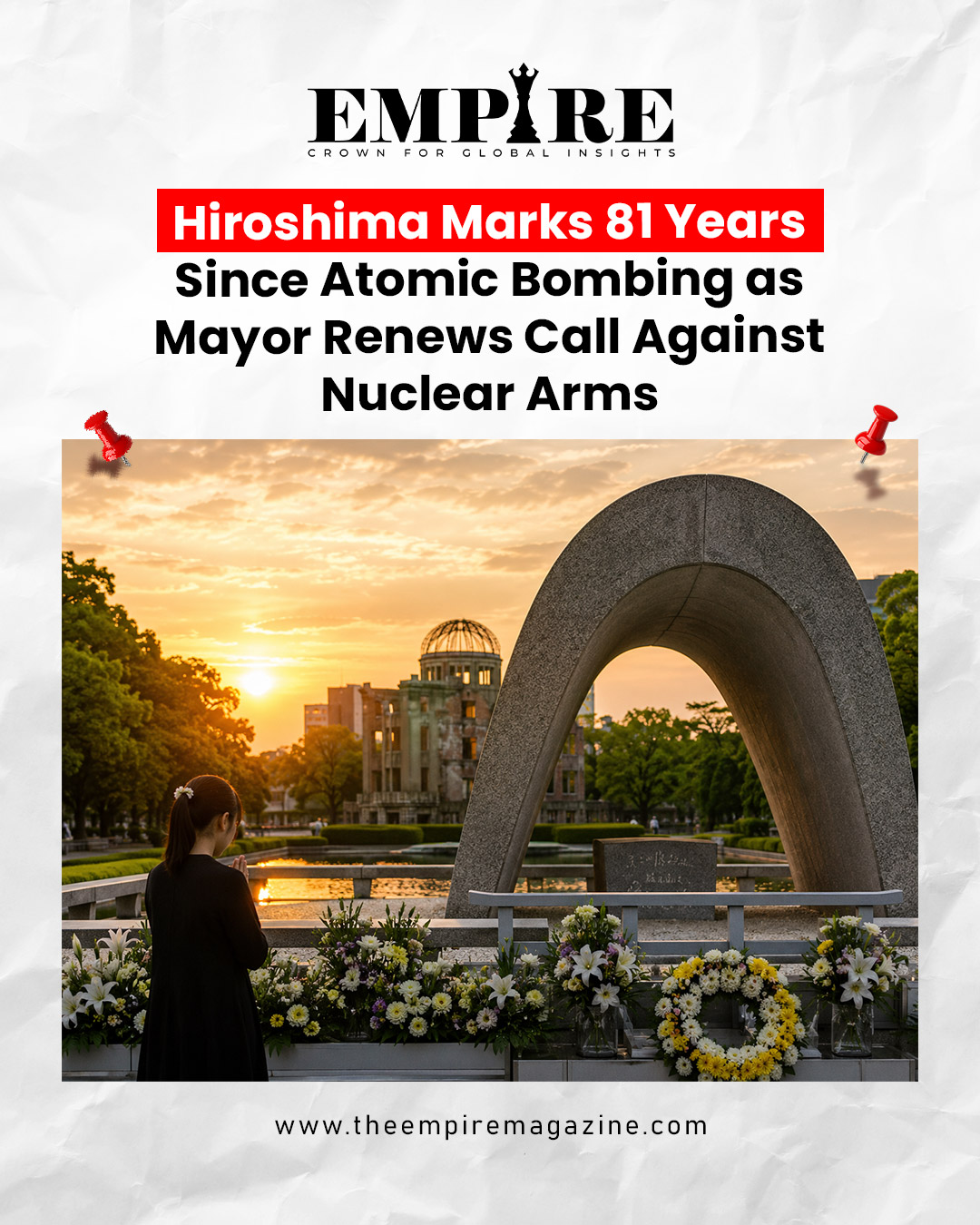
Hiroshima marks 81 years since the atomic bombing as Mayor Kazumi Matsui renews the call for nuclear disarmament and a world free of nuclear weapons. Hiroshima marked 81 years since the atomic bombing on August 6, 2026, with a Peace Memorial Ceremony where Mayor Kazumi Matsui urged world leaders to reject nuclear weapons and warned that treating nuclear deterrence as a permanent security solution could risk another Hiroshima or Nagasaki.
Hiroshima 81 Years Since Atomic Bombing
Hiroshima marked 81 years since the atomic bombing on August 6, 2026, with a solemn Peace Memorial Ceremony that once again placed the human cost of nuclear weapons at the centre of global attention. At 8:15 a.m., the city observed a moment of silence as a peace bell rang through Hiroshima Peace Memorial Park, marking the exact time a US B-29 bomber dropped an atomic bomb on the city on August 6, 1945. Around 50,000 people, including representatives from about 120 countries and regions, were expected to attend the ceremony.
For Hiroshima, the anniversary is not simply a historical commemoration. It is an annual reminder of what happens when nuclear weapons move from military strategy to human reality. The bombing destroyed much of the city and caused enormous loss of life, with the estimated number of people killed in Hiroshima reaching around 140,000 by the end of 1945. The tragedy was followed three days later by the atomic bombing of Nagasaki, where about 70,000 people were killed.
Eighty-one years later, Hiroshima continues to speak through remembrance, survivor testimony and its persistent demand for nuclear disarmament.
Hiroshima Remembers the Victims
The Hiroshima atomic bombing anniversary carries a deeply personal meaning for families who lost parents, children, relatives and friends in 1945. The city that once lay devastated has since rebuilt itself into a vibrant centre of life, commerce and culture, but the memory of August 6 remains embedded in its identity. The Peace Memorial Ceremony therefore serves two purposes: remembering those who died and asking whether humanity has learned enough from the destruction of Hiroshima.
The ceremony also reflects the passing of generations. Hiroshima’s surviving atomic bomb victims, known as hibakusha, are now elderly, with their average age exceeding 86. Their numbers are declining, making the preservation of first-hand memories increasingly urgent. Survivors have spent decades describing the devastation, radiation effects and long-term suffering caused by the bombing, often with one central message: no other generation should experience what they endured.
That message has become more significant as the world debates nuclear deterrence, military security and the future of international relations.
Hiroshima Mayor Kazumi Matsui Renews Nuclear Warning
Hiroshima Mayor Kazumi Matsui used the 81st anniversary Peace Declaration to deliver a direct warning about the continued reliance on nuclear weapons. He criticised major powers for pursuing wars and urged political leaders to stop presenting nuclear weapons as an acceptable or permanent method of deterrence. Matsui warned that downplaying the inhumanity of nuclear weapons and legitimising force could create cycles of retaliation that eventually produce another Hiroshima or Nagasaki.
The mayor’s message comes at a time when nuclear deterrence remains central to the security policies of several countries. His argument is rooted in Hiroshima’s experience: weapons that are discussed in strategic terms can have consequences that cannot be contained by political borders or military calculations. For Matsui, the lesson of Hiroshima is therefore not simply that nuclear war is dangerous, but that humanity must create security systems that do not depend on the threat of nuclear destruction.
His call places responsibility not only on governments but also on citizens to understand history and actively support peace.
Hiroshima Atomic Bombing Still Shapes Japan
The Hiroshima atomic bombing continues to influence Japan’s national identity and its difficult position within the global nuclear order. Japan is the only country to have experienced the wartime use of nuclear weapons, yet it also remains under the protection of the United States nuclear umbrella. This creates a complex security debate between Japan’s historic commitment to peace and the strategic realities of its regional environment.
Japan has long maintained its three non-nuclear principles of not possessing, not producing and not permitting the introduction of nuclear weapons. However, renewed security concerns have intensified discussion about the country’s future defence policy. Prime Minister Sanae Takaichi, attending the Hiroshima memorial for the first time as prime minister, said Japan would pursue a realistic approach toward a world in which nuclear weapons are never used while working within the international non-proliferation framework.
The contrast between strategic security considerations and Hiroshima’s moral appeal makes the country’s nuclear debate particularly important.
Hibakusha Voices Carry the Memory
The hibakusha remain among the most powerful voices in the global campaign against nuclear weapons. Their experiences transform an abstract discussion about deterrence into a human story of families separated, communities destroyed and lives permanently changed. As survivors become fewer each year, Hiroshima faces the challenge of ensuring that their experiences do not disappear with them.
Their testimony has helped turn Hiroshima into more than a memorial site. It has become a place where history, diplomacy and human conscience meet. Survivors have repeatedly argued that remembering the past is meaningful only when it changes decisions about the future. Their message also challenges younger generations to understand that nuclear weapons are not merely symbols of national power but instruments capable of causing catastrophic humanitarian consequences.
The responsibility of preserving this memory is therefore shifting gradually from survivors to educators, communities, governments and younger citizens who must carry the story forward.
Hiroshima Nuclear Deterrence Faces Fresh Debate
The debate over nuclear deterrence has become increasingly difficult in a world marked by geopolitical tensions, military conflicts and competing security interests. Supporters of nuclear deterrence argue that nuclear capabilities can prevent major wars by making the consequences of aggression unacceptable. Hiroshima’s leadership challenges this assumption by focusing on what happens if deterrence fails, whether through deliberate use, escalation, miscalculation or accident.
Mayor Matsui argued that political leaders who continue to treat nuclear deterrence as a realistic long-term solution risk moving the world further away from nuclear abolition. His warning reflects Hiroshima’s broader position that lasting international security should be built through dialogue, cooperation and mutual trust rather than permanent dependence on weapons of mass destruction.
This debate is particularly relevant as younger generations inherit a world where nuclear weapons remain part of national defence strategies despite the historical evidence of their devastating consequences.
Hiroshima Calls for Global Action
Hiroshima’s 81st anniversary message extends beyond Japan. The city has consistently sought to make nuclear disarmament an international priority and has worked through the Mayors for Peace network to promote peace among cities around the world. In its 2025 Peace Declaration, Hiroshima said its network included more than 8,500 member cities, reflecting the city’s effort to build support for a culture of peace at the local level.
The 2026 Peace Declaration again placed responsibility on political leaders and civil society. Matsui called on citizens to learn from the past, participate in their communities and help make the abolition of nuclear weapons a widely accepted principle. The declaration also came after the latest Nuclear Non-Proliferation Treaty review conference failed for a third consecutive time to adopt a final document, according to the published text of the Hiroshima Peace Declaration.
For Hiroshima, global action begins with recognising that nuclear security cannot be separated from human security.
Why Hiroshima Still Matters Today
The importance of Hiroshima has not diminished with time. If anything, its relevance has become sharper as the number of people who personally remember the bombing continues to fall. History can become distant when it is reduced to dates and statistics, but Hiroshima keeps the human dimension alive through memorials, survivor testimony and annual ceremonies.
United Nations Secretary-General António Guterres said on the 81st anniversary that Hiroshima represents more than the horror of nuclear weapons, describing it as an example of resilience, renewal and hope. He urged the world to choose dialogue over division, cooperation over confrontation and common security over narrow national advantage.
That message captures why Hiroshima remains central to conversations about nuclear disarmament. The city’s story is not only about destruction in 1945; it is also about rebuilding, reconciliation and the possibility of choosing a different future.
A Message for Future Generations surrounding Hiroshima
One of the most important questions surrounding the Hiroshima 81 years since atomic bombing anniversary is how its lessons will be communicated to people who have no living memory of World War II. Younger generations know the event through history books, photographs, museums and survivor accounts, but preserving its emotional meaning requires more than remembering a date.
Children’s representatives at the 2026 ceremony reflected on the loss of ordinary life caused by the bombing, emphasising how everyday objects and family memories became reminders of destruction. Their participation demonstrates how Hiroshima is attempting to transfer its message from one generation to another.
The challenge is not simply to teach young people what happened, but to encourage them to question how societies can prevent such devastation from happening again. In that sense, remembrance becomes an active responsibility rather than a passive act.
The Enduring Legacy of Hiroshima
Hiroshima’s 81st anniversary closes another chapter in the lives of the hibakusha while opening another chapter in the world’s continuing debate over nuclear weapons. The city’s message remains remarkably consistent: the memory of Hiroshima should not become a museum piece disconnected from contemporary policy. It should influence how governments think about security, how citizens understand war and how future generations imagine peace.
The atomic bombing of Hiroshima changed world history in a matter of seconds. Eighty-one years later, the city continues to transform that painful history into a call for responsibility. Mayor Kazumi Matsui’s renewed appeal against nuclear arms reflects a belief that the ultimate lesson of Hiroshima is not simply that nuclear weapons are destructive, but that humanity must work toward a world where their use is unthinkable.
As the number of hibakusha continues to decline, the responsibility to remember is becoming a responsibility to act. Hiroshima’s enduring message is therefore both simple and profound: peace cannot be guaranteed by forgetting the past. It must be built by learning from it.
For more business and retail insights, read more on The Empire Magazine
Previous article: https://theempiremagazine.com/swaminathan-award/
Magazine Feautures | Podcasts: Empire Global Talks
Follow The Empire Magazine on Facebook | Instagram | LinkedIn | YouTube
The Empire Magazine | Crown for Global Insights