
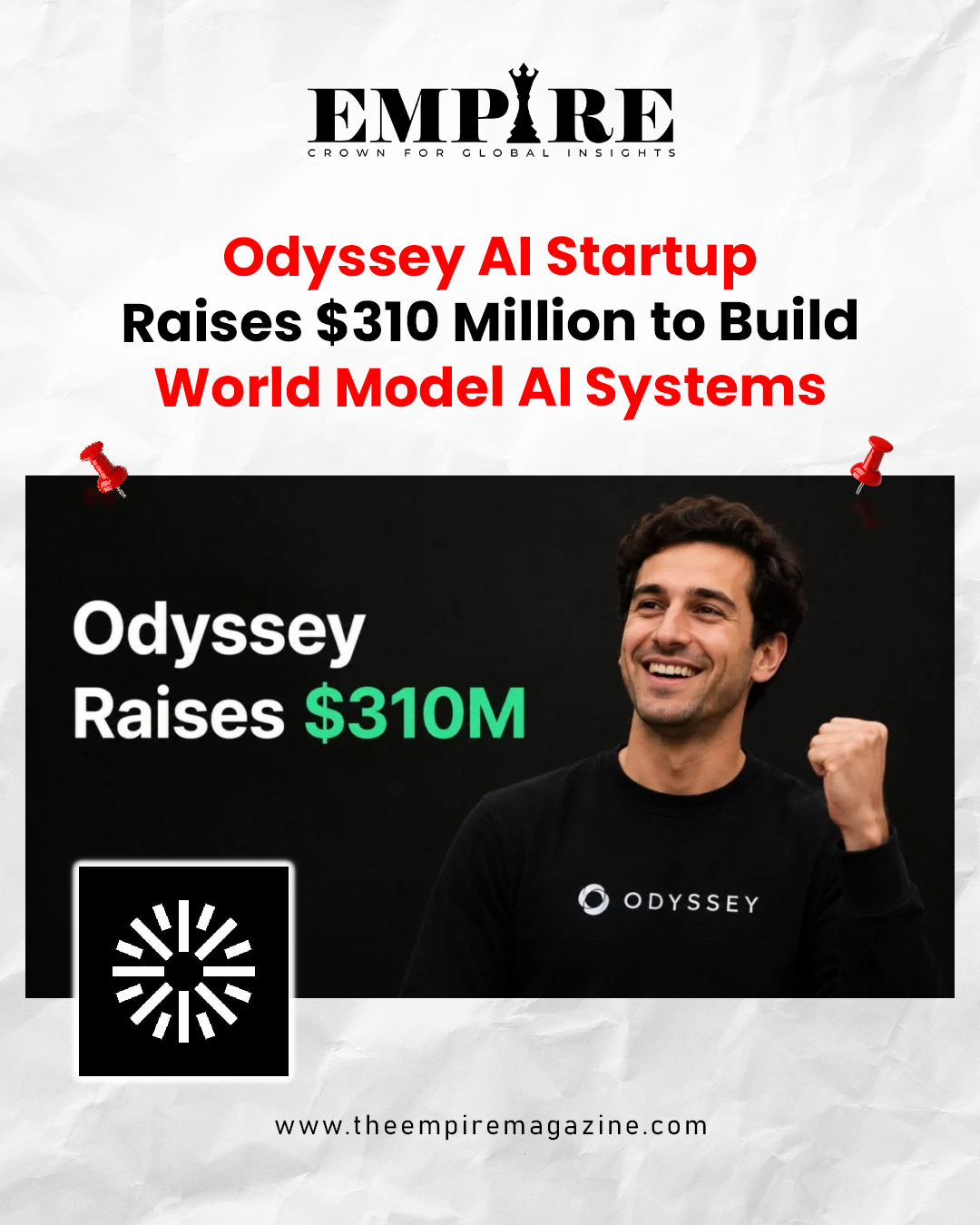
Odyssey AI Startup raises $310 million in fresh funding to develop world-model AI systems. Discover how the company plans to reshape robotics, autonomous vehicles, and physical AI.
Odyssey AI Startup Raises $310 Million
The Odyssey AI Startup has emerged as one of the fastest-growing companies in the artificial intelligence sector after securing $310 million in Series B funding, pushing its valuation to approximately $1.45 billion. The investment marks one of the largest AI funding rounds of the year and reflects growing confidence in a new generation of AI systems capable of understanding and predicting the physical world.
Unlike conventional generative AI models that primarily create text, images, or code, the Odyssey AI Startup is developing world-model AI systems technology designed to perceive, understand, and simulate real-world environments. Industry experts believe these systems could become the foundation for autonomous vehicles, robotics, industrial automation, and intelligent digital assistants capable of interacting naturally with physical surroundings.
The funding round attracted leading technology investors, including Natural Capital, while existing backers such as Amazon, GV (Google Ventures), AMD Ventures, EQT Ventures, and IQT also participated. The strong investor confidence demonstrates the market’s belief that AI is moving beyond language models into systems capable of reasoning about the real world.
As artificial intelligence rapidly evolves, companies developing “physical AI” have become increasingly attractive to investors. The latest investment positions the Odyssey AI Startup among an elite group of AI unicorns focused on solving one of the industry’s biggest technical challenges creating machines that understand how the physical world works rather than simply processing digital information.
For businesses, governments, and technology leaders, this investment represents more than another startup success story. It signals a broader shift toward AI systems that may redefine industries ranging from manufacturing and logistics to healthcare and transportation.
Odyssey AI Startup Focuses on Building World-Model AI
The rapid rise of the Odyssey AI Startup reflects an important shift in artificial intelligence research. While companies such as OpenAI, Anthropic, and Google have popularized large language models capable of generating human-like responses, Odyssey is taking a fundamentally different path.
Its technology centers on world-model AI, a concept that enables machines to predict how objects, people, and environments behave over time. Rather than simply responding to prompts, these AI systems learn the laws of the physical world by processing enormous volumes of real-world video and sensor data.
The startup was founded by former autonomous driving experts Oliver Cameron and Jeff Hawke, both of whom recognized that future AI systems would need a deeper understanding of physical environments. Their experience in self-driving technology highlighted a critical limitation of today’s AI models: they excel at processing digital information but struggle to reason about real-world movement, spatial awareness, and cause-and-effect relationships.
This is precisely the challenge the Odyssey AI Startup aims to solve. Its AI models are designed to simulate future events, anticipate movement, and understand changing environments in real time. Such capabilities could dramatically improve robotic navigation, warehouse automation, industrial inspection systems, autonomous drones, and next-generation transportation technologies.
The company’s approach has attracted widespread attention because many researchers now believe world-model AI represents the next major milestone after large language models. By giving AI systems an internal representation of how the world behaves, developers hope to create machines that can make safer, more accurate decisions in dynamic environments.
The latest funding provides Odyssey with significant resources to expand its research infrastructure, recruit leading AI scientists, and accelerate development of increasingly sophisticated world models. Industry observers believe this strategy could position the Odyssey AI Startup at the forefront of what many describe as the next wave of artificial intelligence innovation.
Growing Investor Confidence Highlights the Expanding AI Infrastructure Market
The successful funding round also illustrates how investor priorities are evolving across the AI ecosystem. While consumer-facing AI applications continue attracting attention, venture capital firms are increasingly investing in foundational AI technologies capable of supporting future generations of intelligent systems.
For the Odyssey AI Startup, this trend has translated into strong financial backing from some of the world’s most influential technology investors. Beyond capital, these strategic partnerships provide access to advanced computing resources, semiconductor expertise, and cloud infrastructure essential for training increasingly complex AI models.
A significant milestone accompanying the funding announcement is Odyssey’s strategic collaboration with Amazon Web Services (AWS). Under the partnership, AWS will become Odyssey’s preferred cloud provider, supplying large-scale computing capacity through its AI infrastructure, including Trainium chips designed specifically for machine learning workloads.
This collaboration is particularly important because world-model AI systems require immense computational resources. Unlike traditional language models that process text, Odyssey’s technology must analyze massive datasets consisting of videos, images, sensor information, and environmental interactions. Training these sophisticated models demands high-performance computing infrastructure that only a handful of cloud providers can currently deliver.
The investment also reflects growing recognition that the future of AI extends beyond chatbots and virtual assistants. Businesses across manufacturing, logistics, healthcare, defense, and autonomous mobility are seeking AI systems capable of understanding physical environments, making real-time decisions, and interacting safely with the world around them.
As demand for intelligent automation accelerates, companies building foundational AI infrastructure are expected to become central players in the global technology landscape. The Odyssey AI Startup is positioning itself at the heart of this transformation, aiming to provide the underlying intelligence that powers the next generation of autonomous systems.
Odyssey AI Startup Could Transform Robotics, Autonomous Mobility, and Industrial Automation
The ambitions of the Odyssey AI Startup extend far beyond building another artificial intelligence platform. The company is developing foundational AI systems that could become the operating intelligence behind autonomous machines capable of understanding, predicting, and interacting with the physical world.
One of the most promising applications lies in robotics. Today’s robots are often limited to structured environments where every movement is carefully programmed. However, real-world settings such as warehouses, hospitals, factories, construction sites, and public spaces are constantly changing. This unpredictability requires machines that can reason, adapt, and anticipate what may happen next.
The Odyssey AI Startup believes world-model AI can bridge this gap. By learning from vast amounts of real-world visual data, these models can develop an internal understanding of how environments function, enabling robots to make informed decisions without relying solely on predefined instructions.
The autonomous vehicle industry also stands to benefit significantly. Self-driving cars must continuously interpret traffic conditions, predict pedestrian behavior, anticipate road hazards, and react within milliseconds. While current autonomous systems rely heavily on sensors and mapping technologies, world-model AI introduces an additional layer of intelligence by enabling vehicles to simulate possible future scenarios before taking action.
Manufacturing is another sector where the Odyssey AI Startup could have a profound impact. Smart factories increasingly depend on AI-driven automation to improve efficiency, reduce operational costs, and enhance workplace safety. AI systems capable of understanding physical environments could help manufacturers optimize production lines, predict equipment failures, and improve quality control through real-time analysis.
Healthcare is also emerging as a potential area of application. Hospitals and medical facilities are exploring AI-powered robotic assistants for logistics, patient support, and surgical assistance. World-model AI could help these systems navigate complex environments more safely while adapting to constantly changing conditions.
Industry analysts believe these developments represent the next evolution of artificial intelligence, where AI moves beyond generating digital content and begins actively interacting with the physical world. If successful, the Odyssey AI Startup could play a central role in shaping this transition.
Odyssey AI Startup Enters an Increasingly Competitive AI Race
Although the Odyssey AI Startup has attracted considerable attention following its $310 million funding round, it enters a highly competitive market where several leading technology companies are investing heavily in physical AI and world-model research.
Major AI developers, including OpenAI, Google DeepMind, Meta, NVIDIA, and Tesla, are all pursuing technologies that combine advanced reasoning with an understanding of the real world. These companies recognize that the next generation of artificial intelligence will require much more than language processing it will need spatial awareness, long-term planning, and an ability to predict physical outcomes.
What differentiates the Odyssey AI Startup is its specialized focus. Rather than building a broad consumer-facing AI assistant, the company is concentrating on developing foundational world models that can power a wide range of industries and applications. This focused strategy allows Odyssey to dedicate its resources to solving one of the most technically demanding problems in AI research.
However, the journey will not be without challenges. Training world-model AI systems requires enormous computing resources, access to diverse real-world datasets, and sophisticated machine learning architectures capable of processing visual, spatial, and temporal information simultaneously. These requirements make development both technically complex and financially expensive.
Another challenge involves ensuring safety and reliability. AI systems operating in physical environments must consistently make accurate decisions because errors could have real-world consequences, particularly in autonomous vehicles, industrial robotics, or healthcare settings. As regulators worldwide introduce stricter AI governance frameworks, companies like Odyssey will also need to demonstrate transparency, accountability, and robust safety standards.
Despite these hurdles, investors remain optimistic. The strong backing received by the Odyssey AI Startup reflects confidence that solving these challenges could unlock one of the largest commercial opportunities in the AI industry over the coming decade.
What the Future Holds for Odyssey AI Startup and the Evolution of World-Model AI
The latest funding round represents more than a financial milestone—it signals growing industry belief that world-model AI could define the next phase of artificial intelligence innovation. As businesses increasingly seek AI systems capable of operating in real-world environments, companies building foundational intelligence platforms are expected to become key players in the global technology ecosystem.
For the Odyssey AI Startup, the $310 million investment provides the resources needed to accelerate research, expand engineering teams, strengthen computing infrastructure, and deepen strategic partnerships. Its collaboration with Amazon Web Services, including access to advanced AI infrastructure and Trainium chips, will be instrumental in training increasingly sophisticated world models capable of handling complex physical interactions.
Industry experts believe the commercialization of world-model AI could reshape multiple sectors over the next decade. From autonomous transportation and warehouse automation to smart cities, industrial robotics, agriculture, healthcare, and defense, AI systems that understand and predict the physical world could significantly improve productivity, safety, and operational efficiency.
At the same time, success will depend on responsible innovation. Developers must ensure that these systems are reliable, transparent, and aligned with evolving regulatory standards. Ethical deployment, data privacy, and rigorous testing will remain essential as world-model AI transitions from research laboratories into real-world applications.
The rapid rise of the Odyssey AI Startup highlights how quickly the AI landscape is evolving. Just a few years ago, generative AI dominated industry conversations. Today, investors and researchers are increasingly looking beyond text generation toward intelligent systems capable of reasoning about the physical world. This shift reflects a broader vision for artificial intelligence one in which machines not only understand language but also comprehend how the real world functions.
Whether Odyssey ultimately becomes a dominant force in AI infrastructure remains to be seen. However, its latest funding round has firmly established the Odyssey AI Startup as one of the most closely watched companies in the emerging world-model AI sector. As competition intensifies and innovation accelerates, the company’s progress will likely influence the future direction of robotics, autonomous systems, and physical AI on a global scale.
Odyssey AI Startup has captured global attention
The Odyssey AI Startup has captured global attention by securing $310 million in Series B funding, reinforcing investor confidence in the future of world-model AI systems. Rather than competing solely in the crowded generative AI space, Odyssey is pursuing a vision of artificial intelligence that can perceive, predict, and interact with the physical world an advancement that could redefine industries ranging from robotics and autonomous vehicles to healthcare and manufacturing.
As AI development shifts toward physical intelligence, Odyssey’s combination of experienced leadership, strategic partnerships, and significant financial backing positions it as one of the most promising innovators in the next wave of artificial intelligence. While technical, regulatory, and ethical challenges remain, the company’s progress will be closely watched by investors, enterprises, and policymakers alike.
If world-model AI delivers on its promise, the Odyssey AI Startup may not simply become another successful AI company it could help lay the technological foundation for a future where intelligent machines seamlessly understand and navigate the world around us.
For more business and retail insights, read more on The Empire Magazine
Previous article: https://theempiremagazine.com/un-climate/
Magazine Feautures | Podcasts: Empire Global Talks
Follow The Empire Magazine on Facebook | Instagram | LinkedIn | YouTube
The Empire Magazine | Crown for Global Insights