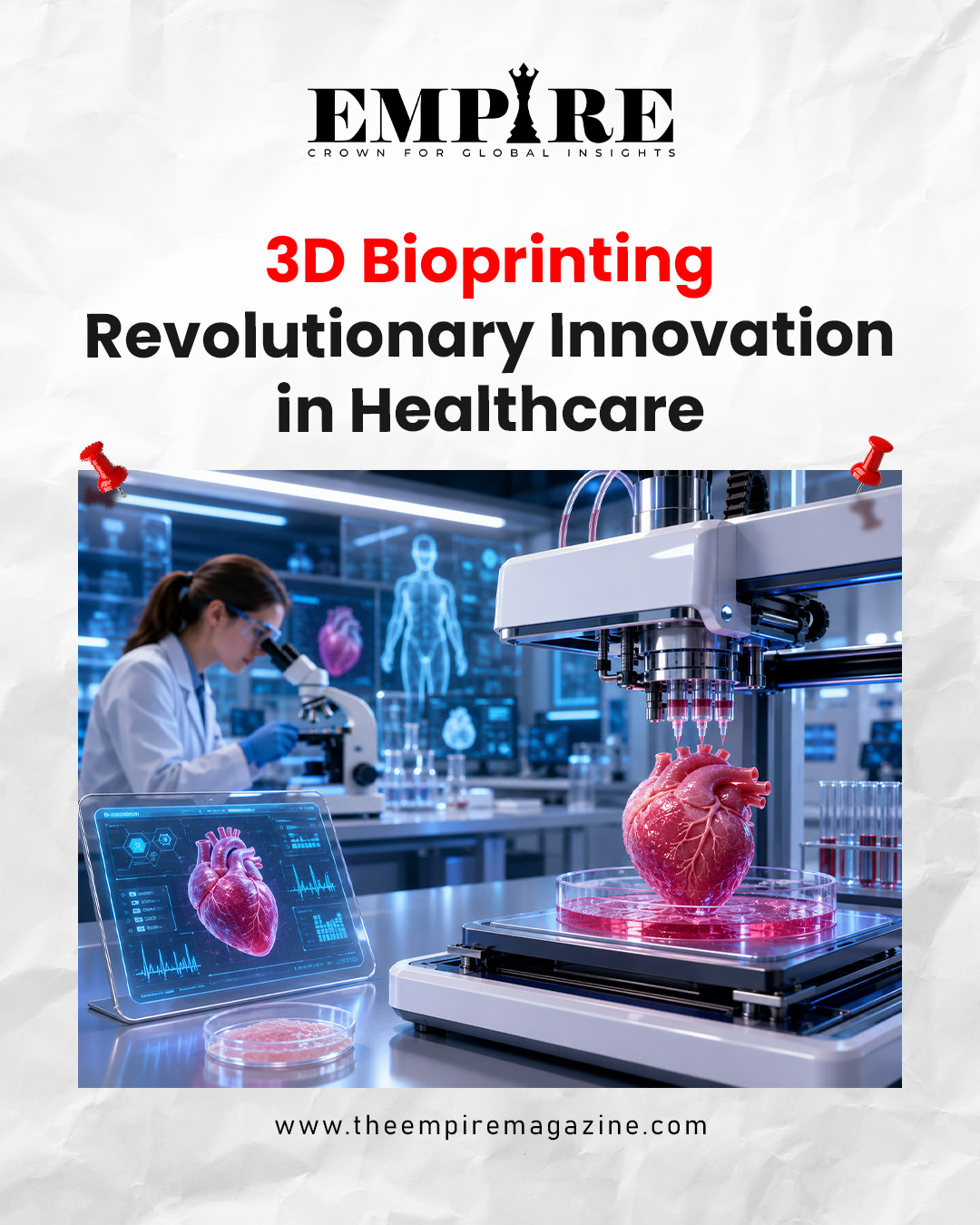
3D bioprinting is revolutionising healthcare by enabling scientists to print living tissues using bio-inks made of human cells. The technology has the potential to transform organ transplantation, regenerative medicine, drug development, and personalised treatment, making healthcare more precise and accessible in the future.
A New Era of Healthcare Is Being Built Layer by Layer
Imagine a future where patients no longer spend years waiting for an organ transplant. Instead, doctors could create a living organ using the patient’s own cells, significantly reducing the risk of rejection and saving countless lives. While this may sound like science fiction, it is becoming an increasingly realistic possibility through 3D bioprinting.
Over the past decade, healthcare has witnessed remarkable technological advancements, from robotic surgeries and artificial intelligence to precision medicine. Among these innovations, 3D bioprinting has emerged as one of the most promising breakthroughs because it combines engineering, biology, medicine, and advanced manufacturing to create living tissues.
Although the technology is still evolving, researchers around the world are making significant progress in printing skin, cartilage, blood vessels, bone tissue, heart tissue, and miniature organs for research purposes. These developments are not only changing how scientists study diseases but are also laying the foundation for a future where personalised healthcare becomes a reality.
As global demand for organ transplants continues to rise and healthcare systems search for more effective treatment options, 3D bioprinting is increasingly being viewed as one of the most transformative medical technologies of the 21st century.
What Is 3D Bioprinting and Why Is It Different from Traditional 3D Printing?
Most people are familiar with traditional 3D printing, where machines build objects layer by layer using materials such as plastic, metal, or resin. 3D bioprinting follows a similar principle, but instead of printing inanimate objects, it prints living biological structures.
The process uses specialised bio-inks, which are made from living human cells, biomaterials, growth factors, and supportive substances. These bio-inks are carefully deposited layer by layer to create tissues that closely resemble those found inside the human body.
Unlike conventional manufacturing, the goal is not simply to reproduce the shape of an organ but to replicate its biological function. Scientists must ensure that printed tissues remain alive, receive nutrients, develop blood vessels, and function as naturally as possible after printing.
This makes bioprinting one of the most complex and interdisciplinary fields in modern medicine, requiring expertise in biology, engineering, materials science, and clinical research.
How 3D Bioprinting Is Transforming Modern Healthcare
The healthcare industry is embracing 3D bioprinting because of its potential to address some of medicine’s most pressing challenges.
One of its greatest strengths lies in personalised medicine. Every patient’s body is unique, which means treatments that work for one individual may not always be effective for another. Bioprinting allows researchers to use a patient’s own cells to create customised tissues that closely match their biological profile.
This approach could reduce complications, improve treatment success rates, and minimise the risk of immune rejection during transplantation. The technology is also helping surgeons prepare for complex procedures. Instead of relying solely on scans, doctors can use patient-specific printed anatomical models to better understand difficult cases before entering the operating room.
As healthcare continues moving toward personalised care, 3D bioprinting is expected to become an increasingly valuable clinical tool.
3D Bioprinting Could Solve the Global Organ Shortage
Perhaps the most exciting application of 3D bioprinting is its potential to address the worldwide shortage of donor organs.
Every year, thousands of patients die while waiting for compatible organs because demand far exceeds supply. Even when donor organs become available, patients often face long waiting periods, complex matching procedures, and the lifelong need for immunosuppressive drugs.
Researchers hope that one day, organs such as kidneys, livers, hearts, and lungs could be bioprinted using a patient’s own cells. Since these organs would be biologically compatible, the likelihood of rejection could be significantly reduced.
Although fully functional transplantable organs are still under development, scientists have already succeeded in creating small tissue models, miniature organs known as organoids, and experimental biological structures that are advancing medical research.
Each breakthrough brings researchers one step closer to making organ bioprinting a clinical reality.
Regenerative Medicine Is Becoming More Advanced Through Bioprinting
Another area benefiting enormously from bioprinting is regenerative medicine, which focuses on repairing or replacing damaged tissues rather than simply treating symptoms.
Scientists have already developed promising approaches involving bioprinted:
- Skin for severe burn victims
- Bone tissue for complex fractures
- Cartilage for joint repair
- Blood vessels for laboratory research
- Heart tissue for studying cardiovascular diseases
- Corneal tissue for future eye treatments
Instead of relying entirely on donor tissues, future treatments may involve creating patient-specific biological implants that integrate naturally into the body.
This could significantly improve recovery times while reducing surgical complications. Regenerative medicine also offers hope for patients suffering from degenerative diseases, traumatic injuries, and congenital disorders that currently have limited treatment options.
Drug Development Is Becoming Faster and Safer
One of the less publicised but highly important applications of 3D bioprinting in healthcare is pharmaceutical research. Developing a new medicine often requires years of laboratory testing followed by extensive clinical trials. Traditional testing methods frequently rely on animal models, which do not always accurately predict how humans will respond.
Bioprinted human tissues provide researchers with more realistic biological models for studying diseases and evaluating new drugs.
Scientists can test potential medicines on printed liver tissue, heart tissue, or tumour models before beginning human clinical trials. This approach improves research accuracy while reducing costs and potentially decreasing the need for animal testing.
For pharmaceutical companies, this means safer medicines, shorter development timelines, and more personalised treatment strategies.
Artificial Intelligence Is Making 3D Bioprinting Smarter and More Precise
The rapid growth of artificial intelligence (AI) is accelerating the development of 3D bioprinting. While bioprinting relies on advanced hardware and biological materials, AI helps researchers design tissues more accurately, predict how cells will behave, and optimise the printing process.
Machine learning algorithms can analyse vast amounts of biological data to determine the best cell arrangements, identify potential printing errors, and improve the structural stability of printed tissues. This reduces trial-and-error experimentation and speeds up research.
Robotics is also playing a vital role. Automated bioprinters can precisely deposit living cells layer by layer, ensuring greater consistency and reducing the chances of human error. As AI and robotics continue to evolve, the future of 3D bioprinting is expected to become faster, more efficient, and increasingly reliable.
Together, these technologies are helping researchers move closer to producing complex biological structures that closely mimic natural human tissues.
How 3D Bioprinting Is Already Making a Difference in Healthcare
Although fully functional printed organs are still under development, 3D bioprinting is already being used in several areas of healthcare and medical research.
Scientists have successfully developed bioprinted skin models that help researchers study burns, wounds, and skin diseases. Researchers are also printing cartilage, bone tissue, and blood vessel structures for experimental treatments and regenerative medicine.
In cancer research, bioprinted tumour models are enabling scientists to better understand how cancers grow and respond to different medicines. Instead of relying solely on conventional laboratory methods, researchers can now study diseases using tissues that more closely resemble the human body.
Medical institutions are also exploring bioprinted tissues for testing new drugs before they reach human clinical trials. This approach could improve patient safety, reduce research costs, and shorten the time required to develop new medicines.
While these applications are still evolving, they demonstrate that bioprinting is already contributing to healthcare long before fully printed organs become a reality.
The Biggest Challenges Facing 3D Bioprinting
Despite its enormous promise, 3D bioprinting is not without challenges.One of the greatest scientific hurdles is creating fully functional organs with complex networks of blood vessels. Human organs require a continuous supply of oxygen and nutrients, making vascularisation one of the most difficult aspects of bioprinting.
Another challenge is ensuring that printed tissues behave exactly like natural tissues after implantation. Scientists must carefully study how printed cells grow, communicate, and integrate with the patient’s body over time.
Cost is another significant barrier. Advanced bioprinters, specialised biomaterials, and research facilities require substantial investment. As a result, the technology is currently limited to research institutions, universities, and specialised biotechnology companies. Standardisation also remains an issue. Different laboratories use varying printing methods, bio-inks, and quality control processes. Establishing global standards will be essential before bioprinted tissues become widely available in clinical practice.
Although progress has been remarkable, experts agree that overcoming these scientific and technical challenges will require continued collaboration between researchers, healthcare providers, biotechnology companies, and regulatory authorities.
Ethical and Regulatory Questions Cannot Be Ignored
Like many breakthrough technologies, 3D bioprinting raises important ethical and regulatory questions. One key concern is ensuring patient safety. Before bioprinted tissues or organs can be used routinely, they must undergo extensive testing to demonstrate their long-term effectiveness and safety.
Regulators must also develop clear approval pathways for these innovative therapies. Since bioprinted organs combine living cells, medical devices, and advanced manufacturing techniques, they do not always fit neatly within existing healthcare regulations.
There are also broader ethical discussions surrounding equitable access. If bioprinted organs become available in the future, ensuring they remain affordable and accessible not just to wealthy patients will be a major challenge for healthcare systems worldwide.
Data privacy, informed consent for cell donation, and responsible use of genetic information are additional issues that researchers and policymakers continue to address.
Carefully balancing innovation with patient safety and ethical responsibility will be essential as the technology progresses.
The Business of 3D Bioprinting Is Growing Rapidly
Beyond its medical potential, 3D bioprinting is creating new opportunities for the global healthcare and biotechnology industries.
Biotechnology companies, pharmaceutical firms, medical device manufacturers, and research organisations are investing heavily in developing new bio-inks, advanced bioprinters, tissue engineering techniques, and regenerative therapies.
As demand for personalised medicine grows, healthcare providers are expected to increasingly collaborate with technology companies to develop customised treatment solutions.
The technology is also creating opportunities for startups working in areas such as biomaterials, tissue engineering, AI-driven healthcare, and regenerative medicine.
While commercial adoption will take time, many industry experts believe bioprinting could become one of the fastest-growing segments of healthcare innovation over the next decade.
What the Future of 3D Bioprinting Could Look Like
The future of 3D bioprinting extends far beyond printing replacement organs. Researchers are exploring the possibility of creating personalised tissues for reconstructive surgery, repairing damaged nerves, developing more accurate disease models, and advancing precision medicine.
In the years ahead, hospitals may establish specialised bioprinting laboratories capable of producing patient-specific tissues for surgeries and regenerative treatments. Pharmaceutical companies could routinely use bioprinted organs to test medicines before clinical trials, reducing costs and improving patient safety.
Scientists are also investigating the use of stem cells and advanced biomaterials to produce increasingly sophisticated biological structures that more closely replicate natural human organs.
Although these goals may still be years away, the pace of innovation suggests that bioprinting will continue to reshape healthcare in ways that were once considered impossible.
3D Bioprinting Is Redefining the Future of Healthcare
The rise of 3D bioprinting marks a significant shift in how medicine approaches disease treatment, tissue repair, and organ replacement. Rather than relying solely on traditional therapies, healthcare is moving toward solutions that are more personalised, regenerative, and technologically advanced.
While challenges such as cost, regulation, and scientific complexity remain, the progress achieved over the past decade demonstrates that bioprinting is no longer a distant concept. It is an active area of research with real-world applications that are already improving medical science and patient care.
As artificial intelligence, tissue engineering, and regenerative medicine continue to evolve, 3D bioprinting is expected to play an increasingly important role in addressing some of healthcare’s biggest challenges from reducing organ shortages to accelerating drug discovery and enabling personalised treatments.
The journey from laboratory innovation to routine clinical practice may take time, but the direction is clear.3D bioprinting has the potential to transform healthcare as profoundly as antibiotics, medical imaging, and minimally invasive surgery once did.
For patients, it offers hope for more effective treatments and improved quality of life. For researchers, it opens new possibilities for understanding diseases. And for the global healthcare industry, it represents one of the most exciting frontiers in modern medicine one that could redefine how future generations receive care.
For more insights, navigate on The Empire Magazine
Previous article: Key Investment and Business Trends 2026
Magazine Feautures | Podcasts: Empire Global Talks
Follow The Empire Magazine on Facebook | Instagram | LinkedIn
The Empire Magazine | Crown for Global Insights