South Korea’s Historic Leap in Global Markets
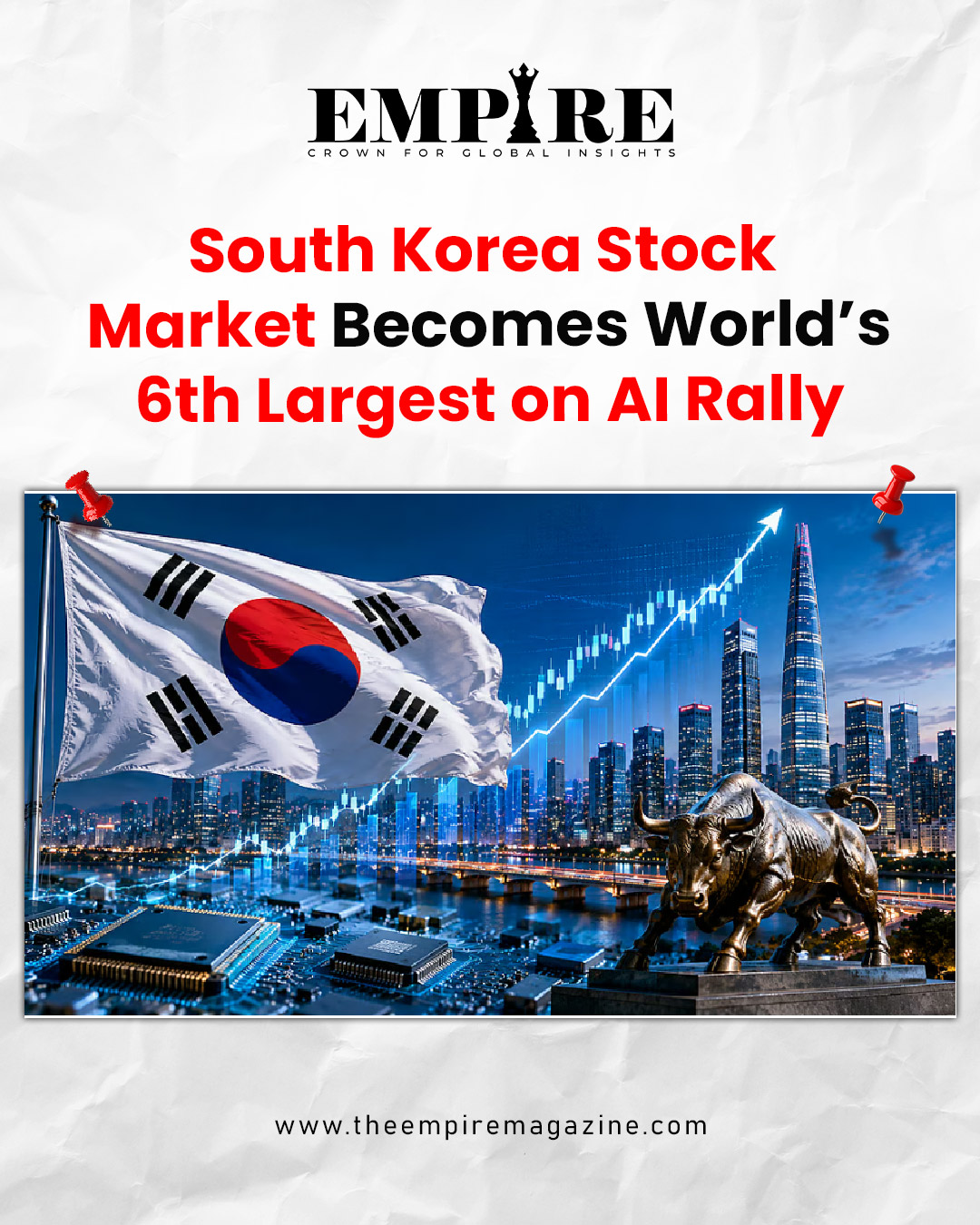
South Korea has entered a defining moment in its financial history as its stock market rises to become the world’s sixth-largest equity market, overtaking India in total market capitalization amid a powerful artificial intelligence-driven rally. The benchmark KOSPI index has surged to record highs, reflecting a dramatic shift in investor sentiment toward semiconductor-heavy economies that sit at the heart of the global AI supply chain. This transformation is not merely a short-term market movement but a structural re-rating of South Korea’s position in global finance, where technology infrastructure has become the dominant driver of equity valuations. The country now stands alongside financial giants such as the United States, China, Japan, and leading European markets, marking a significant evolution from its historical identity as an export-driven manufacturing economy to a global leader in advanced digital infrastructure and AI hardware ecosystems.
South Korea’s AI Revolution Sparks Semiconductor Supercycle
At the core of South Korea’s market ascent lies the unprecedented artificial intelligence revolution that has triggered a global semiconductor supercycle, reshaping demand for memory chips, high-performance processors, and advanced data infrastructure. AI models require vast computational power, and this has created an explosive need for high-bandwidth memory (HBM), DRAM, and next-generation chips that enable large-scale machine learning systems. As global technology firms expand AI data centers across the United States, Europe, and Asia, South Korean chipmakers have become essential suppliers in this rapidly growing ecosystem. The resulting demand surge has pushed semiconductor stocks into a prolonged bull run, driving not only corporate earnings but also investor expectations for sustained structural growth. Unlike previous tech cycles, this AI-driven expansion is deeply tied to physical infrastructure, making semiconductor producers the foundational layer of the global AI economy and positioning South Korea at its center.
Samsung and SK Hynix Power the KOSPI Surge
The extraordinary rise of South Korea’s stock market is largely anchored by two industrial giants, Samsung Electronics and SK Hynix, which together form the backbone of the nation’s semiconductor dominance. These companies have benefited directly from soaring global demand for AI-optimized memory chips, particularly high-bandwidth memory used in advanced AI training systems and data center operations. SK Hynix, in particular, has emerged as one of the biggest winners of this cycle, at times surpassing Samsung in market valuation due to its early and aggressive investments in AI-specific chip technologies. Samsung, meanwhile, continues to maintain its global leadership in diversified electronics and semiconductor production, reinforcing the sector’s dominance within the KOSPI index. Their combined performance has been so significant that they now account for a disproportionately large share of index movements, creating both unprecedented wealth creation and heightened concentration risk within the broader South Korean equity market.
Global Capital Flows Into AI Infrastructure
The global investment landscape is undergoing a fundamental realignment as institutional investors increasingly redirect capital from traditional sectors into AI infrastructure and semiconductor manufacturing. This shift reflects a growing recognition that the true value chain of artificial intelligence lies not only in software development but in the physical hardware that enables computational scale. As a result, South Korea, Taiwan, and select U.S. semiconductor firms have become primary beneficiaries of this capital rotation. While software-centric AI companies continue to attract attention, rising costs and valuation pressures have prompted investors to seek exposure in more tangible, supply-constrained segments of the AI economy. South Korea’s dominance in memory chip production has placed it in a uniquely advantageous position, allowing it to capture disproportionate value from the global AI boom and cement its role as a critical node in the evolving architecture of digital transformation.
South Korea’s Government Strategy and the $576 Billion AI Vision
Supporting this market surge is South Korea’s ambitious national strategy aimed at securing long-term leadership in artificial intelligence and semiconductor production through a massive $576 billion investment roadmap. The government has aligned closely with major conglomerates to expand chip fabrication facilities, strengthen supply chain resilience, and accelerate innovation in next-generation memory technologies. This strategic push includes plans to significantly increase DRAM production capacity and enhance high-bandwidth memory output, ensuring that South Korea remains ahead in the global semiconductor race. In addition, the initiative focuses on building AI data center infrastructure and fostering innovation clusters that integrate research, manufacturing, and global distribution networks. This coordinated effort between state policy and private industry has reinforced investor confidence, as markets increasingly view South Korea not just as a participant in the AI boom but as one of its principal architects.
Market Risks, Concentration, and Investor Caution
Despite the remarkable rally, South Korea’s financial ascent is accompanied by growing concerns around market concentration, valuation pressures, and cyclical dependency on semiconductor demand. The heavy weighting of Samsung Electronics and SK Hynix within the KOSPI index has created an environment where a small number of stocks disproportionately influence overall market performance, increasing vulnerability to sector-specific downturns. Analysts caution that any slowdown in global AI investment or correction in semiconductor pricing could trigger significant volatility across the broader market. Furthermore, the rapid pace of gains has raised questions about whether certain segments of the AI-driven rally are entering overheated territory, drawing comparisons with past technology bubbles. However, proponents argue that unlike speculative cycles of the past, today’s growth is underpinned by tangible infrastructure demand, suggesting a more durable foundation despite short-term volatility risks.
South Korea’s Rise as a Financial Powerhouse
South Korea’s emergence as the world’s sixth-largest stock market represents a defining shift in global financial power structures, driven almost entirely by the transformative impact of artificial intelligence and semiconductor innovation. The country’s deep integration into the global AI supply chain, combined with strong government backing and the dominance of world-leading technology firms, has repositioned it as a critical pillar of the new digital economy. While challenges related to market concentration and cyclical volatility remain, the long-term trajectory points toward sustained influence in global capital markets. As AI continues to reshape industries, South Korea stands at the intersection of technology and finance, evolving from a regional manufacturing powerhouse into a central force shaping the future of global investment flows and technological progress.
For more business and retail insights, read more on The Empire Magazine
Previous article: Airtrunk to invest $30b in India AI & Cloud Infra
Magazine Feautures | Podcasts: Empire Global Talks
Follow The Empire Magazine on Facebook | Instagram | LinkedIn
The Empire Magazine | Crown for Global Insights