AI CEOs Enter the Global Policy Stage
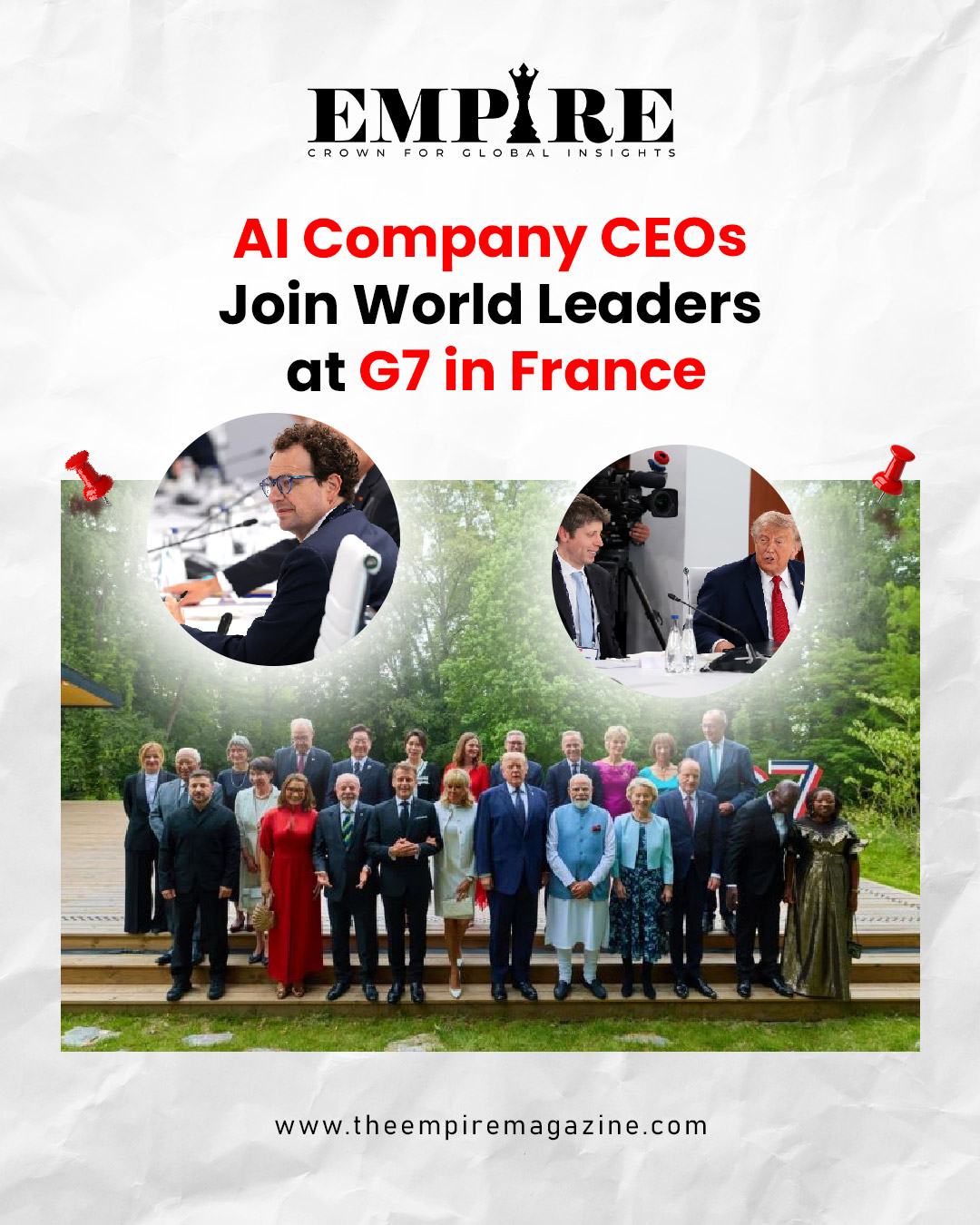
The presence of artificial intelligence company CEOs alongside heads of state at the G7 Summit in France marks a defining moment in global governance, where technology leadership is no longer confined to corporate boardrooms but has firmly entered the realm of international diplomacy. As the G7 nations, comprising some of the world’s most advanced economies, grapple with rapid advancements in AI, the participation of leaders from firms such as OpenAI, Microsoft, Google, Amazon, and Anthropic signals a shift in how policy is being shaped in real time by those building the technologies that will define the next century. The G7 Summit in France itself, a high-level platform where economic, security, and technological priorities are set, has increasingly become a focal point for AI governance discussions, especially as governments attempt to balance innovation with regulation. This convergence of political power and technological influence reflects a broader recognition that artificial intelligence is not just a tool of economic productivity but a foundational force reshaping national security, labor markets, education systems, and even democratic processes. The symbolism of AI CEOs sitting at the same table as world leaders underscores how deeply embedded these companies have become in global infrastructure and decision-making ecosystems.
Why G7 Leaders Are Turning to AI Companies
The inclusion of AI company executives at the G7 Summit is not merely ceremonial but reflects urgent strategic necessities faced by governments attempting to keep pace with exponential technological advancement. Artificial intelligence is evolving faster than most regulatory systems can adapt, creating a governance gap that world leaders are increasingly dependent on private sector expertise to fill. Governments are now confronted with issues such as generative AI misuse, deepfake-driven misinformation, cybersecurity vulnerabilities, and the economic disruption of labor markets, all of which require technical insight that traditionally lies within companies like OpenAI and Google. At the same time, countries within the G7 are competing to secure leadership in AI innovation, particularly against rising technological powers in Asia, making collaboration with industry leaders not just advisory but strategic. AI CEOs bring critical insights into frontier model development, compute infrastructure scaling, and safety alignment challenges that governments alone cannot fully evaluate. Moreover, regulatory frameworks such as the EU AI Act and emerging U.S. executive guidelines are increasingly shaped through consultation with companies like Microsoft and Anthropic, which are actively involved in responsible AI research. This dependency highlights a new model of governance where policy is co-created between state institutions and private technology firms, signaling a departure from traditional regulatory independence toward a hybrid system of techno-diplomacy.
The Big Tech Presence at the G7 Summit
The presence of leading AI companies at the G7 Summit in France illustrates how concentrated technological influence has become within a small group of global corporations shaping the future of intelligence systems. Executives from OpenAI, Google, Microsoft, Amazon, and Anthropic represent not only commercial enterprises but also key architects of foundational AI models that underpin everything from enterprise productivity tools to national defense simulations. Their participation reflects how AI development has moved beyond experimental research into large-scale infrastructure deployment, requiring coordination with governments on compute regulation, data governance, and cross-border AI safety standards. At the G7 table, discussions are increasingly focused on how to ensure that frontier models remain aligned with democratic values while still allowing for competitive innovation among member states. This dynamic creates a delicate balance where CEOs are simultaneously partners and subjects of regulation, offering technical expertise while also navigating scrutiny over market dominance and ethical concerns. The summit becomes a convergence point where policy agendas intersect with product roadmaps, and where decisions about global AI safety frameworks may directly influence the next generation of model releases. The visibility of these CEOs alongside world leaders also underscores the symbolic elevation of tech companies to quasi-institutional status within global governance structures.
AI Governance, Regulation, and Geopolitical Stakes
As artificial intelligence becomes a defining force in global economics and security, the G7 Summit in France has emerged as a critical arena for shaping the rules that will govern its development and deployment. The involvement of AI CEOs highlights the increasing urgency of establishing international standards for safety, transparency, and accountability in systems developed by companies such as OpenAI and Anthropic, especially as models grow more capable and autonomous. Governments are particularly concerned with risks such as AI-enabled cyber warfare, election interference, and the concentration of computational power in a handful of corporations predominantly based in the United States. At the same time, there is growing geopolitical competition around AI leadership, with G7 nations aiming to maintain strategic advantage against non-G7 technological ecosystems. This has led to discussions not only about regulation but also about public-private partnerships to accelerate safe innovation. Companies like Microsoft and Google are increasingly positioned as intermediaries between national policy objectives and global technology deployment, contributing to frameworks that attempt to ensure alignment between AI systems and human oversight. However, tensions remain between regulatory ambition and innovation speed, as overly restrictive policies risk slowing competitiveness, while insufficient oversight could amplify systemic risks. The G7 thus becomes a stage where geopolitical strategy, technological capability, and ethical responsibility converge in real time, shaping the foundational architecture of global AI governance.
What This Means for the Future of Global Power
The integration of AI company CEOs into high-level diplomatic forums like the G7 Summit in France signals a long-term transformation in how global power is structured, distributed, and exercised in the 21st century. No longer confined to nation-states alone, influence is increasingly shared with technology companies such as OpenAI, Microsoft, Google, Amazon, and Anthropic, which control critical infrastructure powering global communication, commerce, and intelligence systems. This shift raises fundamental questions about accountability, sovereignty, and the future of democratic governance in an era where algorithmic systems can influence information flows at scale. As AI becomes more deeply embedded in military systems, financial markets, healthcare, and education, the decisions made at summits like the G7 will have far-reaching consequences beyond traditional policy cycles. The presence of tech CEOs at these meetings reflects a recognition that technological capability is now inseparable from national strength, and that collaboration between governments and private innovators is essential to maintaining stability in an increasingly complex world. However, it also introduces new challenges around power concentration and ethical oversight, as the companies driving AI innovation gain unprecedented influence over global policy directions. Ultimately, this moment represents the early formation of a new kind of global order, one where artificial intelligence is not just a tool of governance but a central actor in shaping it, redefining the balance between state authority and technological power in ways that are still unfolding.
For more business and retail insights, read more on The Empire Magazine
Previous article: Luxury Experiences
Magazine Feautures | Podcasts: Empire Global Talks
Follow The Empire Magazine on Facebook | Instagram | LinkedIn
The Empire Magazine | Crown for Global Insights