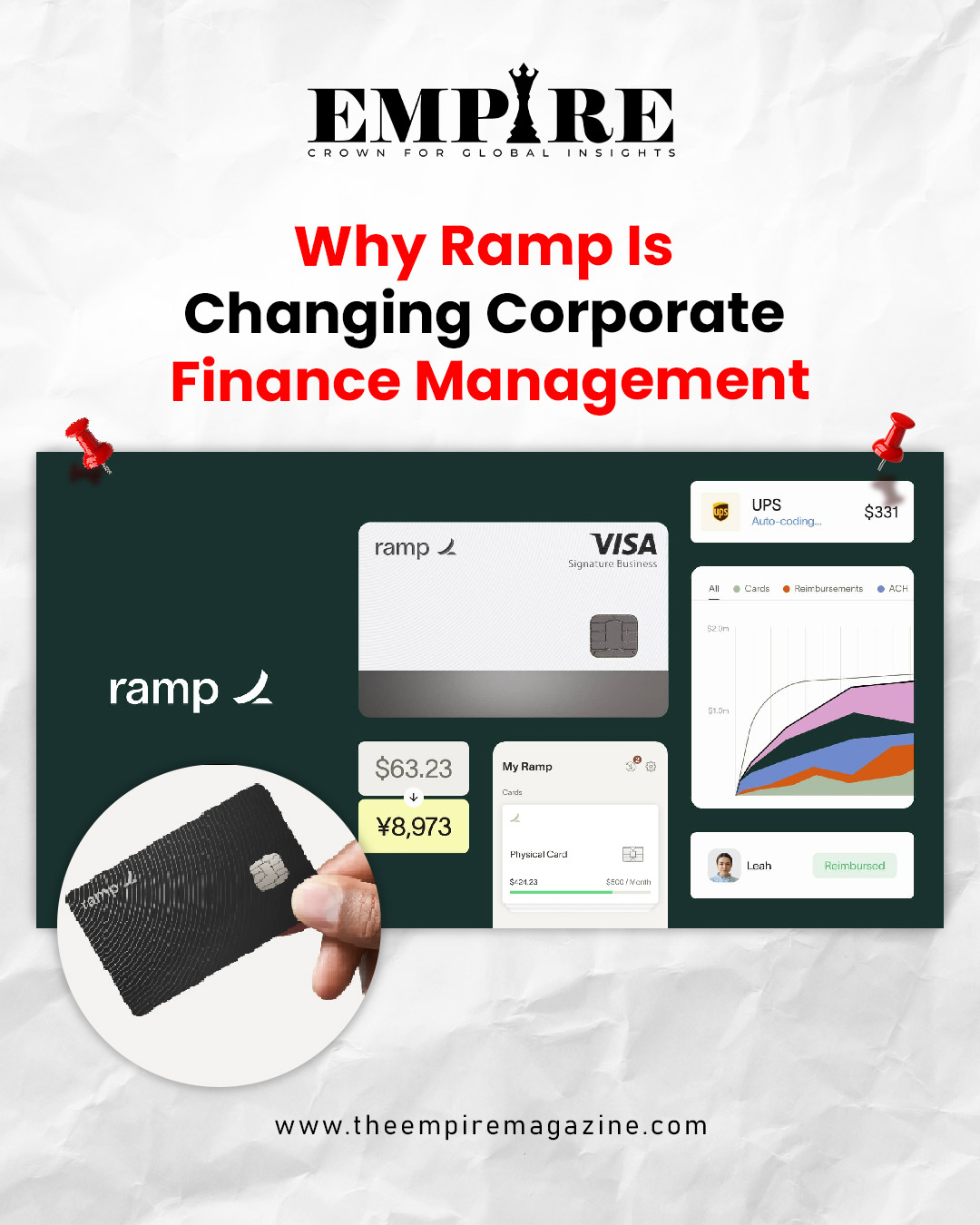
Ramp is redefining corporate finance by embedding AI-driven automation, real-time spending controls, and integrated corporate cards into a single platform. It eliminates manual expense workflows and gives finance teams continuous visibility into company-wide spending decisions.
When Finance Becomes a Real-Time System
Corporate finance has long been defined by fragmentation. Expense reports move through layers of approval, reconciliation happens after delays, and financial visibility often arrives too late to influence decisions. In this environment, control is reactive rather than strategic. Ramp has emerged as one of the clearest attempts to reverse that model. Instead of treating finance as a reporting function, it reframes it as a real-time operating system where every transaction is immediately visible, categorized, and governed. The shift is subtle but structurally important. Finance is no longer something that closes the books. It is something that never stops updating.
The Collapse of Fragmented Finance Tools
For decades, corporate finance has relied on a patchwork of tools, corporate cards from one provider, expense tracking software from another, procurement systems layered on top, and accounting platforms sitting at the core. Each system solved a narrow problem but created operational friction between them.
Ramp’s approach is to compress these layers into a single workflow. A transaction on a corporate card is not just a payment event; it becomes a policy check, a budget update, a reconciliation entry, and a data point for forecasting.
This redesign removes the traditional lag between spending and reporting. For fast-scaling companies, that lag has always been a hidden cost, one that shows up in delayed decisions, overspending, or inefficient vendor contracts.
Intelligence Embedded at the Point of Spend
What differentiates Ramp in the crowded fintech landscape is not simply automation, but where that automation sits. Instead of processing data after the fact, intelligence is embedded at the moment of transaction.
When an employee makes a purchase, the system immediately applies policy rules, categorizes the expense, and flags anomalies. Over time, it learns patterns across departments and vendors, allowing finance teams to identify inefficiencies that would otherwise remain hidden in aggregated reports.This shift from post-event analysis to real-time governance is where AI begins to reshape corporate finance in a meaningful way. It reduces dependency on manual reconciliation cycles and compresses what used to be weeks of finance work into continuous processing.
Why Legacy Systems Are Losing Structural Relevance
Traditional enterprise finance systems were designed for stability, compliance, and audit readiness. They were never built for dynamic decision-making. As companies have shifted toward faster operating models, this rigidity has become a constraint. Finance teams still spend disproportionate time closing books, reconciling mismatched entries, and chasing approvals. The result is a system where financial truth always arrives late.
Ramp’s model challenges that architecture directly. Instead of treating reconciliation as a periodic task, it removes much of the need for it by ensuring transactions are correct, categorized, and policy-compliant at the point of entry. This is not an incremental improvement. It is a structural redesign of financial workflow logic.
The Competitive Pressure Inside Fintech
The corporate spend management space has become one of fintech’s most contested arenas. Players like Brex, Divvy (Bill.com), and legacy incumbents such as SAP Concur all compete for the same operational layer inside businesses. Yet the competitive axis is shifting. The question is no longer who issues corporate cards or tracks expenses better. It is who owns the financial workflow itself.
Ramp’s positioning reflects this change. Rather than building isolated financial tools, it aims to become the system through which all spending decisions are made and executed. That ambition places it closer to a finance infrastructure layer than a traditional SaaS product.
The CFO’s Role Is Being Rewritten
As automation becomes more embedded in finance operations, the role of the CFO is undergoing a quiet transformation. The function is moving away from transactional oversight and toward strategic capital orchestration. With platforms like Ramp providing continuous visibility into spending, CFOs are no longer waiting for month-end reports to understand financial health. They are operating in real time, adjusting budgets, reallocating resources, and identifying inefficiencies as they occur.
This changes the cadence of decision-making inside organizations. Budget cycles compress. Approvals accelerate. Financial planning becomes iterative rather than static. In many ways, the CFO is becoming closer to a systems operator than a historical accountant.
The Broader Shift Toward Unified Financial Infrastructure
The most important trend underlying Ramp’s rise is not competition, it is consolidation. Across enterprise software, fragmented tools are being replaced by unified platforms that centralize workflows and data.
Finance is the next frontier of that consolidation cycle. Companies are increasingly unwilling to maintain separate systems for cards, expenses, procurement, and accounting when a single platform can manage all four.
This shift mirrors earlier transitions in CRM, HR, and customer support software, where point solutions gradually gave way to integrated ecosystems. But finance carries higher stakes. Errors are not just operational inefficiencies, they directly impact liquidity, compliance, and survival.
Why This Shift Matters Now
The timing of Ramp’s rise is not accidental. Businesses are operating in an environment where cost efficiency and financial discipline are under sharper scrutiny than ever before. Capital is no longer abundant, and visibility into spending has become a board-level concern.
In that context, automation is not just a productivity tool. It is a governance mechanism. By reducing manual processes and increasing transparency, platforms like Ramp allow companies to operate with tighter financial control without increasing headcount. That efficiency becomes particularly valuable in uncertain macroeconomic conditions.
Finance Moving Toward Continuous Intelligence
The long-term trajectory of platforms like Ramp points toward a more fundamental transformation: finance systems that do not simply record activity but interpret and anticipate it. The next evolution is likely to move beyond automation into prediction, systems that forecast budget overruns before they happen, suggest procurement adjustments dynamically, and optimize cash flow in real time. At that stage, corporate finance stops being a periodic discipline entirely. It becomes a continuous intelligence layer embedded into every business decision.
For more business and retail insights, read more on The Empire Magazine
Refer to our previous article:
Follow The Empire Magazine on Facebook | Instagram | LinkedIn
For Inspiring Podcasts: Empire Global Talks
Our Magazine Edits: Pranav Swaroop Naidu | Influential Voice
The Empire Magazine | Crown For Global Insights