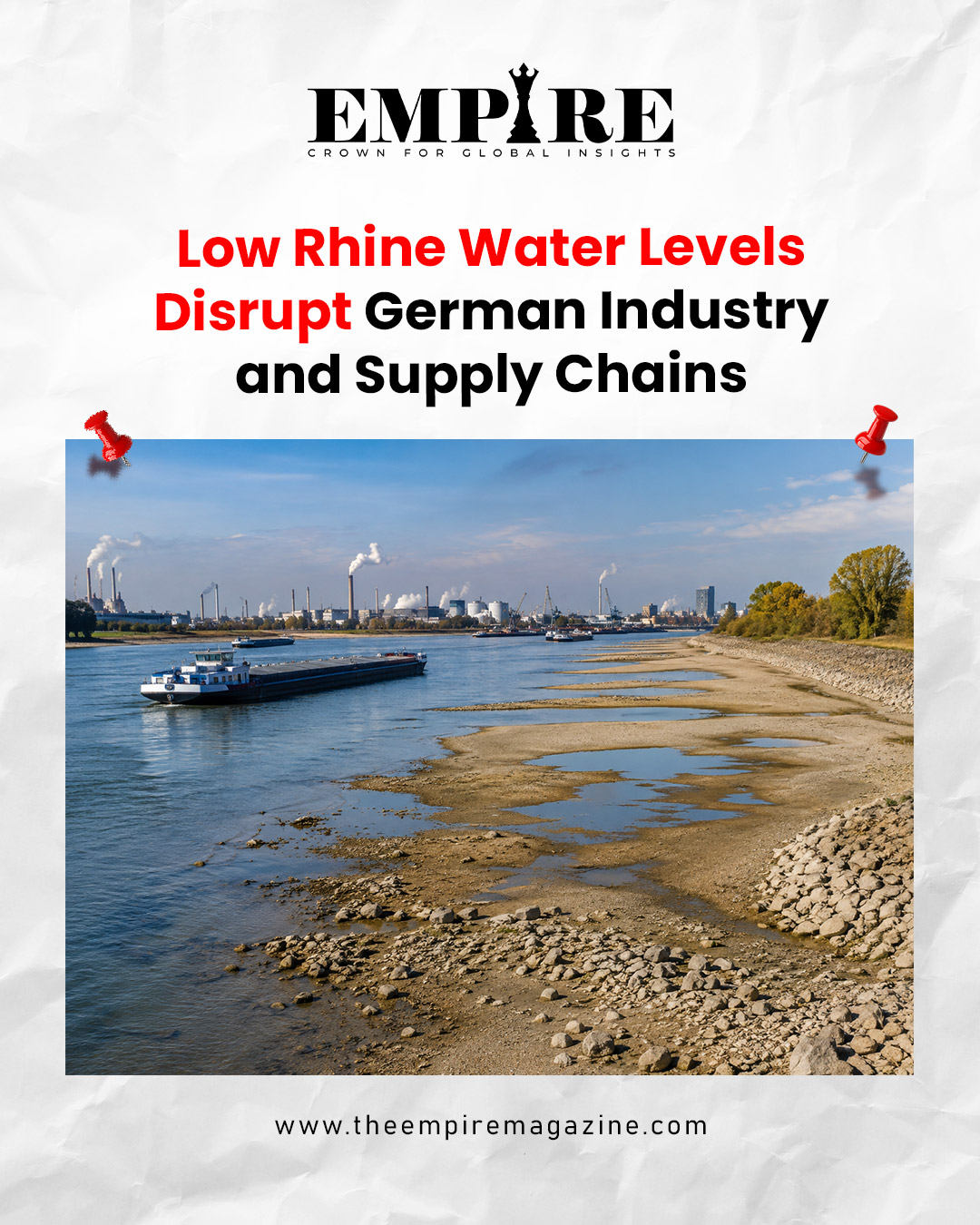
Low Rhine water levels are disrupting German industry, raising freight costs, delaying supplies and putting pressure on critical supply chains. Low Rhine water levels are disrupting German industry by restricting cargo movement along one of Europe’s most important waterways. Chemical, steel, energy and agricultural companies are facing higher freight costs, limited shipping capacity and supply-chain delays as prolonged drought leaves vessels unable to carry normal loads.
Low Rhine Water Levels Hit German Industry
Low Rhine water levels are creating a fresh disruption for German industry, with cargo vessels struggling to move normal loads along one of Europe’s most important commercial waterways. Prolonged dry weather and a lack of rainfall have pushed the Rhine to exceptionally low levels, reducing shipping capacity and increasing pressure on companies that depend on the river for essential deliveries. Reuters reported on August 11 that chemical producers, utilities, steelmakers and agricultural traders were already experiencing higher freight costs and fewer shipping options.
The situation became even more serious on August 12, when Reuters reported that water levels had fallen further and cargo vessels were stranded at a critical section of the river.
For German manufacturers, the problem is not simply that ships are moving more slowly. When vessels cannot carry full loads, companies need more shipments to move the same amount of material. That pushes transportation costs higher and creates uncertainty for factories that depend on regular deliveries.
The Rhine is therefore becoming an economic pressure point, turning an environmental problem into a major German industry supply chain challenge.
Why the Rhine Is Vital to Germany
The Rhine River in Germany is central to European trade and industrial logistics. It connects major industrial regions with ports such as Rotterdam and carries commodities including chemicals, coal, minerals, grains, oil products and other raw materials. Its importance becomes particularly clear when water levels fall and the movement of heavy cargo is restricted.
For decades, companies have relied on Rhine shipping because barges can transport large quantities of goods more efficiently than road vehicles. But this advantage depends on adequate water depth. At low levels, vessels must reduce their cargo to avoid running aground.
The Kaub section is particularly important because it is a known bottleneck for Rhine navigation. Earlier in July, Argus reported that water levels at Kaub had fallen sharply and that some vessels could carry only around 40% of their normal capacity.
This means that even when the Rhine remains technically navigable, its economic value can fall rapidly. Low Rhine water levels in Germany can therefore disrupt supply chains long before shipping stops completely.
Low Rhine Water Levels Raise Freight Costs
One of the clearest effects of low Rhine water levels is the increase in freight costs. A barge carrying less cargo generates less revenue per journey, while operators still face many of the same operating expenses. Freight rates therefore rise as shipping capacity becomes scarce.
The steel supply chain provides a clear example. Argus reported that falling water levels were already slowing steel feedstock movements across central and northwestern Europe and pushing shipping costs higher. Market participants indicated that vessels were being restricted to roughly 40% of normal capacity in some conditions.
For manufacturers, that extra cost does not disappear. It can eventually affect production expenses, procurement budgets and final product prices.
Companies also face difficult decisions about inventory. Holding more raw materials can protect factories from delays, but it ties up working capital. Ordering more frequently through alternative transport can keep production moving, but at a considerably higher cost.
The result is a supply-chain environment where every shipment becomes more expensive and every delay carries greater financial risk.
Rhine Shipping Disruption Hits Chemicals
The Rhine shipping disruption is particularly damaging for Germany’s chemical and petrochemical industries. These sectors rely on the river to transport feedstocks to large production sites, making them highly sensitive to changes in navigability.
S&P Global reported in July that low Rhine water levels were restricting the movement of naphtha and LPG to inland German steam crackers. The company noted that reduced barge loading capacity was contributing to production disruptions across the petrochemical sector.
The pressure is now visible at major businesses. Reuters reported that Covestro declared force majeure for certain products produced at its Dormagen site after transport difficulties limited its ability to operate normally. Evonik also reported production pressure at its Marl chemical park.
This shows how quickly a logistics problem can become a manufacturing problem. A factory does not necessarily stop because it lacks machinery or workers. Sometimes production is affected because a critical ingredient cannot arrive on time.
For Germany’s chemical sector, the Rhine is therefore much more than a transport route. It is a key part of the production system itself.
German Steel Supply Chains Face Pressure
Germany’s steel industry supply chain is another major casualty of the low-water crisis. Steel production depends on steady access to large quantities of raw materials, including coal and other industrial inputs that are difficult and expensive to replace with smaller road shipments.
Reuters reported that Salzgitter, Germany’s second-largest steelmaker, had shifted some coal transportation from Rotterdam to rail because low Rhine levels were making river transport more difficult.
That adjustment illustrates the wider problem facing manufacturers. Alternative transport can keep supplies moving, but the infrastructure is not designed to replace the Rhine overnight.
A vessel can move a huge quantity of industrial material in a single journey. Replacing that capacity with trucks requires far more vehicles, drivers and road capacity.
For steelmakers operating in a highly competitive global market, additional logistics expenses can quickly become another challenge on top of energy prices, weak demand and international competition.
The Rhine water level crisis is therefore putting pressure on one of Germany’s most important industrial sectors.
Low Rhine Water Levels Disrupt Energy Supplies
The effects of low Rhine water levels are also being felt in Germany’s energy and utilities sectors. Fuel, industrial materials and other essential commodities depend on reliable transportation, while some riverside power and industrial facilities face broader operational challenges.
Reuters reported that utilities including Uniper and EnBW had pointed to lower output from German hydroelectric facilities as water conditions deteriorated.
Agricultural businesses are also facing serious disruption. Reuters reported that agricultural trader RWZ had moved less than 10% of the volume it normally sends through its Rhine terminals during the comparable July-August period, with more cargo being shifted to trucks.
These developments reveal the interconnected nature of the crisis. A low river affects shipping companies first, but the consequences can quickly spread to fuel suppliers, manufacturers, agricultural traders, utilities and consumers.
When a major logistics route becomes unreliable, the entire economic network feels the pressure.
Road and Rail Face Heavy Pressure
Germany is trying to compensate for the Rhine shipping disruption by shifting cargo to road and rail, but those alternatives have clear limits.
Road transport provides flexibility, yet replacing large barges with trucks requires a massive increase in vehicle capacity. Reuters reported that certain materials could require as many as 150 trucks to replace the volume carried by a single barge.
Rail can handle large cargo volumes, but railway capacity is already under pressure. Sudden demand from companies trying to bypass the Rhine can make available slots more expensive and difficult to secure.
This creates a difficult balance for German businesses. Moving goods by truck or rail can prevent production stoppages, but the additional expense can significantly reduce operating margins.
It also shifts the problem elsewhere. More trucks mean more road congestion and emissions, while additional rail demand creates competition for limited infrastructure.
The lesson is clear: Germany has alternatives to Rhine shipping, but it does not have an easy one-for-one replacement for the river.
Rhine Drought Raises Climate Risk
The current Rhine drought is also forcing businesses to rethink how they manage climate-related supply-chain risks. Low water is a recurring problem, but the economic damage becomes much greater when companies operate with limited logistics alternatives.
Germany experienced serious Rhine disruption during previous drought periods, demonstrating how low water can affect industrial output and trade. The Kiel Institute has highlighted the wider economic effects of such supply-chain interruptions, particularly for businesses heavily dependent on inland waterways.
The growing concern is that extreme weather events could become a recurring business risk rather than an occasional disruption.
Companies may increasingly need higher safety stocks, multiple transportation routes and better real-time monitoring of water levels. Procurement teams may also have to identify which materials are most exposed to Rhine shipping and develop alternative suppliers or routes before a crisis develops.
Climate resilience is therefore becoming part of supply-chain management.
For Germany, the question is no longer whether low-water events can happen. It is how prepared businesses and infrastructure are when they do.
What Germany Can Do Next
The immediate priority is to keep German industry supply chains functioning, but the long-term response will require more than emergency trucking and rail diversions.
German industry groups are increasingly emphasizing the importance of maintaining waterways as critical infrastructure. The current crisis has demonstrated how quickly the economic value of the Rhine can fall when water levels become too low for efficient navigation.
Businesses can respond by diversifying logistics, improving inventory planning and investing in systems that monitor river conditions in real time. Government policy will also have an important role in improving inland-waterway infrastructure and strengthening the resilience of alternative transport networks.
The objective should not be to replace the Rhine. The Rhine will remain essential to European trade.
The goal should be to ensure that one difficult season on the river does not become a major industrial crisis.
The Bigger Supply Chain Warning
The low Rhine water levels crisis is ultimately a warning about how vulnerable modern supply chains can become when they depend too heavily on a single transport corridor.
Germany has built one of the world’s strongest industrial economies around highly connected logistics networks. The Rhine is at the heart of that system, linking ports, factories, warehouses and international markets. But when drought pushes water levels to extreme lows, the same interconnected system can quickly become a source of vulnerability.
Recent developments have already affected chemical production, steel logistics, agricultural shipments and energy-related operations.
For businesses, the message is becoming difficult to ignore. Supply-chain efficiency cannot come at the expense of resilience.
The Rhine will continue to carry Europe’s industrial trade, but companies and policymakers may need to prepare for a future in which the river is not always available at full capacity.
Low Rhine water levels are not just a shipping story. They are becoming a German industry story, a logistics story and increasingly a supply-chain resilience story.
Previous article: https://theempiremagazine.com/norway/
Magazine Feautures | Podcasts: Empire Global Talks
Follow The Empire Magazine on Facebook | Instagram | LinkedIn | YouTube
The Empire Magazine | Crown for Global Insights