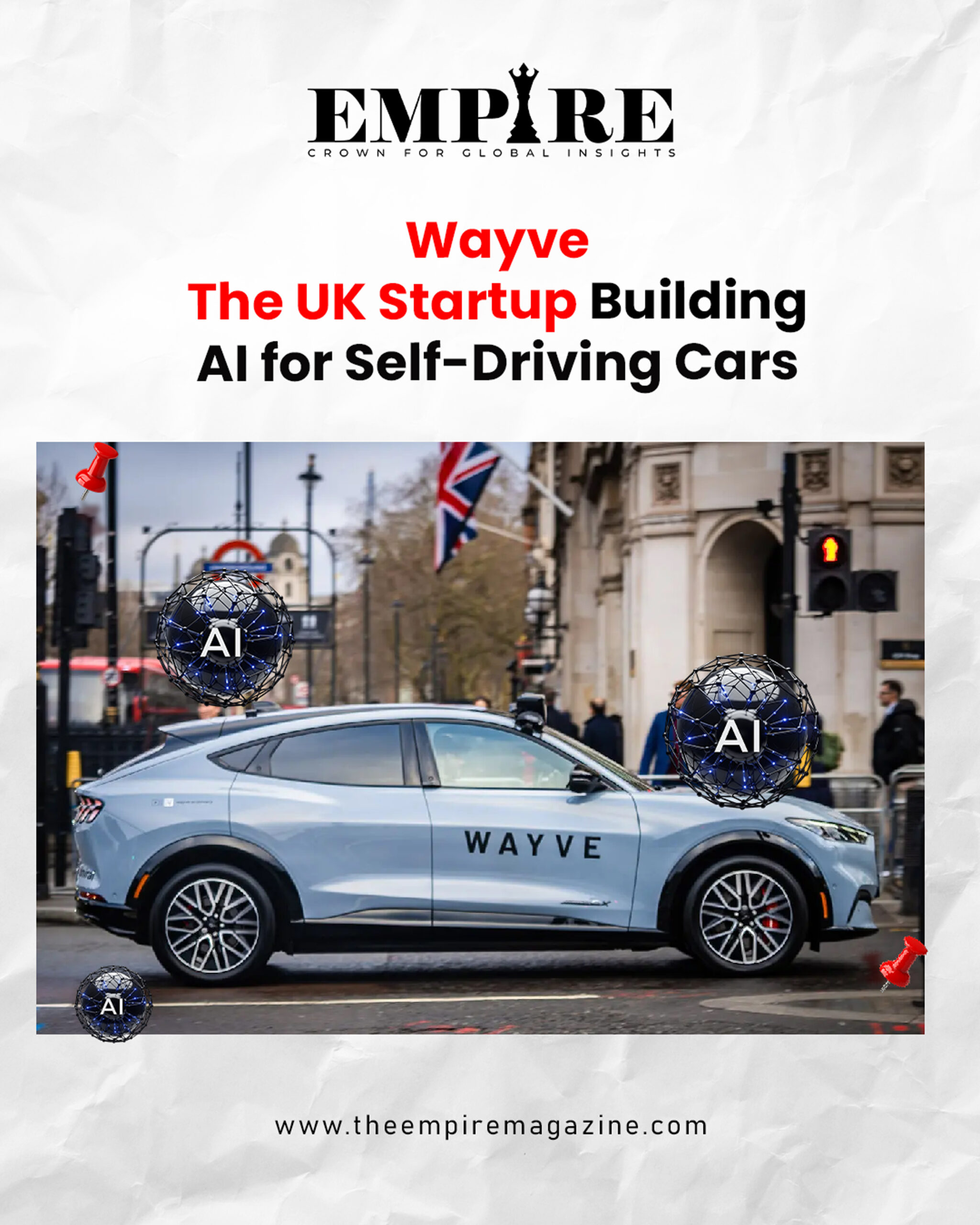
Wayve Is Building AI for Self-Driving Cars
Wayve is a UK-based artificial intelligence startup developing self-driving technology through a learning-based approach called embodied AI. Founded in 2017 by Alex Kendall and Amar Shah, the company was created to build autonomous driving systems that can learn from real-world driving data instead of depending only on hand-coded rules and highly detailed maps.
Wayve is headquartered in London and has become one of Europe’s most important autonomous vehicle companies. Its technology focuses on creating AI systems that can understand roads, traffic, pedestrians, vehicles, movement, and real-world driving conditions. The company’s goal is to build autonomy that can work across different vehicles and cities, not only in limited test zones.
In 2026, Wayve raised a major Series D funding round backed by global automakers and technology companies. Reuters reported that the UK self-driving startup raised $1.2 billion from investors including Mercedes-Benz, Stellantis, Nissan, and Uber, while additional milestone-based investment brought the round to $1.5 billion. Reuters also reported that the funding lifted Wayve’s valuation to $8.6 billion and brought total funding raised to $2.8 billion.
What Wayve Does in Autonomous Driving
Wayve develops AI software for assisted and automated driving. The company describes its platform as end-to-end embodied AI that can scale across any vehicle and anywhere. Unlike many traditional autonomous driving systems, Wayve’s approach uses machine learning to help vehicles learn from driving experience.
Self-driving cars need to understand complex road environments. They must recognize traffic signals, lane markings, pedestrians, cyclists, parked vehicles, roadworks, weather conditions, and unpredictable human behavior. Wayve’s system is designed to learn these patterns from data and improve its ability to drive safely and efficiently.
End-to-End AI Approach
An end-to-end AI system means the model learns to connect sensor input with driving decisions. Instead of separating every task into many manually programmed modules, the AI system learns driving behavior through large-scale data and model training.
This approach is important because real-world roads are complex. Hand-coded systems can struggle when they meet unusual situations. Wayve’s model aims to generalize across different environments by learning from varied driving data.
Wayve’s Funding Growth
Wayve has attracted major investors because autonomous driving is a difficult but high-value technology market. In 2024, Wayve raised a $1.05 billion Series C round led by SoftBank, with participation from Nvidia and existing investor Microsoft. Reuters reported that the funding was intended to accelerate Wayve’s embodied AI technology for production-model vehicles.
In 2026, Wayve followed this with a larger commercial deployment round. The company’s official announcement said it secured $1.5 billion to deploy its global autonomy platform, marking industry support for its end-to-end embodied AI approach.
Why Investors Are Backing Wayve
Investors are backing Wayve because autonomous driving technology could transform mobility, logistics, ride-hailing, delivery, private vehicles, and public transport. Self-driving systems can support safer roads, lower operating costs, improved mobility access, and new vehicle business models if deployed successfully.
Wayve’s investor group also matters. Backing from SoftBank, Microsoft, Nvidia, Uber, Mercedes-Benz, Stellantis, and Nissan shows interest from AI infrastructure companies, mobility platforms, and global automakers. This gives Wayve access to capital, data, automotive expertise, and commercial deployment opportunities.
Partnerships With Automakers and Mobility Platforms
Wayve’s 2026 funding round included major automakers such as Mercedes-Benz, Stellantis, and Nissan. These companies are important because self-driving software needs vehicle integration, testing, safety validation, production systems, and customer deployment.
Uber’s involvement is also significant. Reuters reported that Wayve is working with global automakers on driver assistance technology and scaling robotaxi deployments.
Automaker Partnerships Matter
Automakers need autonomous driving software that can work in real production vehicles. A startup may build strong AI models, but large-scale deployment requires hardware integration, sensors, safety systems, manufacturing standards, and regulatory approval.
By working with global automakers, Wayve can move closer to commercial use. These partnerships can help the company test its software in different vehicles and prepare for wider deployment.
Why Wayve Is Important for the UK AI Sector
Wayve is one of the most visible examples of the UK’s artificial intelligence strength. The company was founded by researchers from the University of Cambridge, and its growth reflects the UK’s talent base in machine learning, robotics, computer vision, and autonomous systems.
The British Business Bank invested £25 million into Wayve as part of its 2026 Series D round, showing public-sector support for the company’s role in the UK technology ecosystem.
Europe’s Autonomous AI Champion
Europe has many strong research institutions, but it has often produced fewer large AI companies than the United States or China. Wayve’s rise gives the UK and Europe a major autonomous AI company with global ambition.
Its funding rounds are among the largest for a European AI startup, and its work connects AI research with one of the world’s biggest industrial markets: transportation.
How Embodied AI Changes Self-Driving Technology
Embodied AI refers to artificial intelligence that learns by interacting with the physical world. In self-driving cars, this means the AI system must understand motion, space, risk, timing, road behavior, and cause and effect.
Wayve’s approach is based on the idea that autonomy should not be limited to one city, one vehicle type, or one fixed map. The company wants to build AI that can adapt to real-world driving conditions and generalize across locations.
Learning From Real Driving Data
Driving is full of rare and unusual situations. A pedestrian may step onto the road unexpectedly. A cyclist may change direction. A delivery van may block a lane. Weather may reduce visibility. Road signs may be unclear.
Learning from real driving data allows AI systems to experience many different road situations. The more diverse the training data, the better the system may become at handling new environments.
Competition in the Self-Driving Market
Wayve operates in a competitive autonomous driving market. Competitors include Waymo, Tesla, Baidu Apollo, Pony.ai, Mobileye, Zoox, and other companies working on robotaxis, driver assistance, and automated mobility.
Different companies use different strategies. Some depend on detailed maps and sensor-heavy vehicles. Others focus on camera-based systems or advanced driver assistance. Wayve’s strategy is to build a generalizable AI driver that can work across vehicle platforms.
Why Scalability Matters
Scalability is one of the biggest challenges in autonomous driving. A system that works in one city may not work in another. Road signs, driving styles, regulations, weather, traffic density, and road layouts can vary widely.
Wayve’s business case depends on proving that its AI can scale beyond limited test zones. If successful, this could make deployment faster and more flexible than systems requiring extensive mapping and local customization.
Safety and Regulation
Self-driving technology must meet strict safety standards before it can be widely deployed. Regulators, automakers, insurers, and the public need evidence that autonomous systems can operate safely in real conditions.
Human Supervision and Testing
Autonomous driving systems often go through stages, from driver assistance to supervised autonomy and then higher levels of automation. Testing includes simulation, closed-track trials, public road tests, safety drivers, regulatory review, and continuous monitoring.
Wayve’s technology must prove reliability across weather, traffic, road types, and rare events. Safety validation remains one of the most important challenges for every autonomous vehicle company.
Wayve Labs and the Broader AI Vision
In 2026, Wayve launched Wayve Labs, a research unit focused on embodied intelligence beyond self-driving cars. Business Insider reported that the lab is led by chief scientist Jamie Shotton and focuses on broader physical-world AI and robotics research.
This shows that Wayve’s technology may eventually support more than cars. Embodied AI could have applications in robotics, logistics, warehouses, industrial automation, and machines that need to understand and act in physical environments.
Wayve’s Business Opportunity
Wayve’s opportunity is connected to the future of mobility. Automakers want smarter vehicles. Ride-hailing platforms want robotaxi networks. Cities want safer and more efficient transport. Logistics companies want automation. Consumers want advanced driver assistance and safer driving features.
For more startup and technology insights, read this feature on The Empire Magazine.
Follow The Empire Magazine on Instagram and Facebook.
– The Empire Magazine
Crown For Global Insights