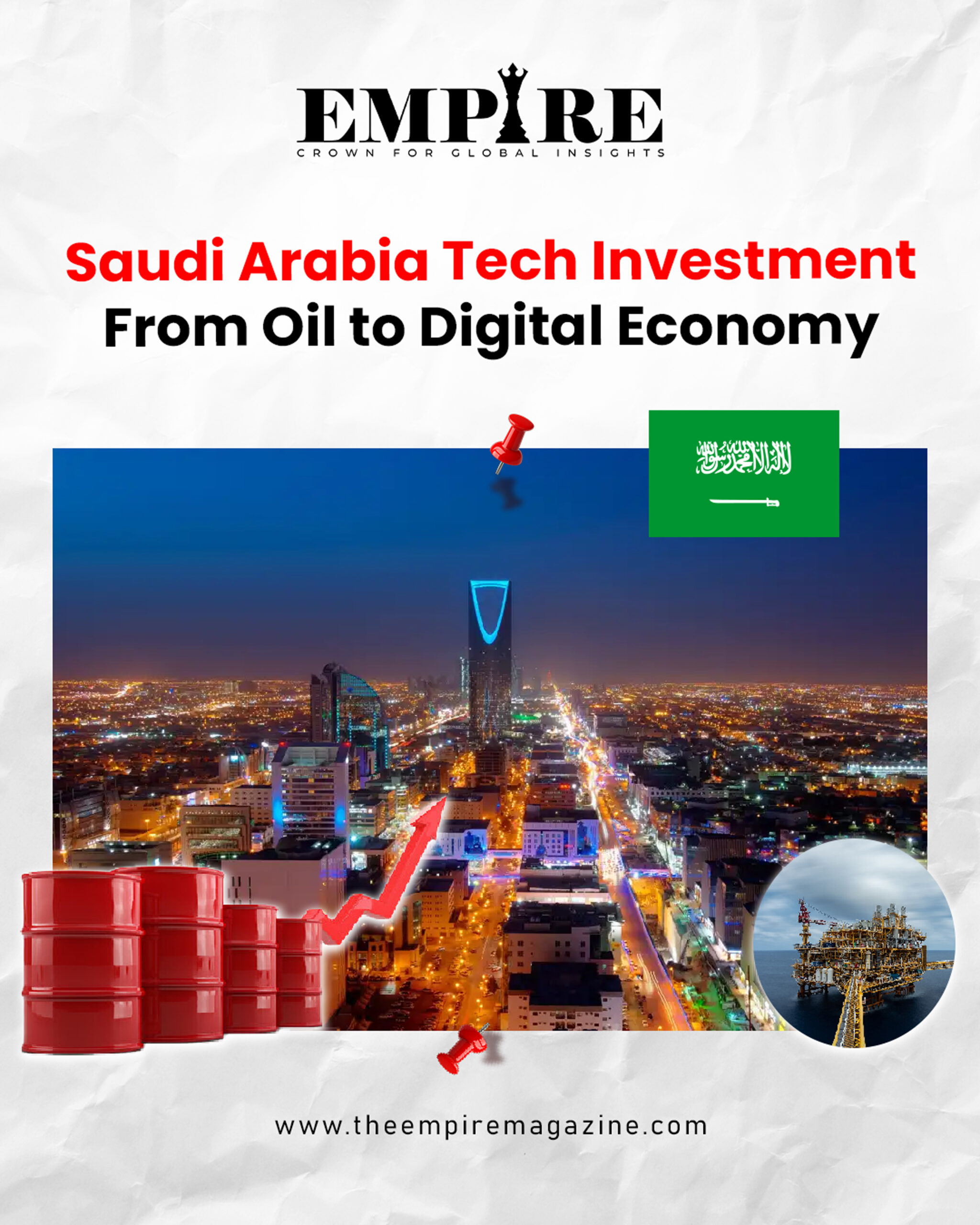
Saudi Arabia Tech Investment Is Reshaping the Kingdom’s Economy
Saudi Arabia Tech Investment is becoming one of the most important parts of the Kingdom’s economic transformation. For decades, Saudi Arabia was mainly known for oil, energy exports, and petroleum wealth. Today, the country is using that financial strength to build a digital economy focused on artificial intelligence, cloud computing, data centers, smart cities, fintech, cybersecurity, gaming, and advanced technology infrastructure.
This shift is closely connected to Vision 2030, Saudi Arabia’s national strategy to diversify the economy, reduce long-term dependence on oil revenue, grow private sector participation, and create new industries. Technology is now central to that strategy because digital systems support government services, business growth, education, healthcare, tourism, finance, logistics, and entertainment.
Saudi Arabia’s technology push is not only about buying foreign technology. The Kingdom is working to build local capabilities, attract global companies, support startups, train digital talent, and become a regional hub for innovation.
From Oil Wealth to Digital Diversification
Saudi Arabia’s oil wealth has given the country major investment capacity. Through institutions such as the Public Investment Fund, known as PIF, the Kingdom has invested in domestic projects and international companies. In the current phase, more focus is being placed on building technology capacity inside Saudi Arabia.
Vision 2030 and Economic Change
Vision 2030 was launched to create a broader economic base beyond hydrocarbons. The strategy includes targets around investment, private sector growth, tourism, entertainment, digital government, logistics, and quality of life. Technology supports many of these goals because digital infrastructure can improve productivity and service delivery across the economy.
Saudi Arabia’s investment minister stated in 2025 that most Vision 2030 initiatives were either completed or on track by the end of 2024. This shows the scale of the transformation already underway.
The Rise of Saudi Arabia’s Digital Economy
Saudi Arabia’s digital economy has grown rapidly. The Communications, Space and Technology Commission reported that the Kingdom’s digital economy reached SAR 495 billion in 2024 and contributed around 15% to GDP. The country also has one of the largest ICT markets in the Middle East and North Africa region.
This growth is supported by high mobile usage, strong internet penetration, government digitization, cloud adoption, and rising demand for online services. Saudi Arabia has also ranked strongly in global ICT development measures, reflecting improvements in infrastructure and digital readiness.
Why ICT Growth Matters
Information and communications technology is the foundation of a digital economy. It supports cloud computing, online payments, e-commerce, remote work, digital public services, data analytics, cybersecurity, and artificial intelligence.
A strong ICT sector helps businesses operate faster and allows government institutions to provide better digital services. It also supports startups by giving them access to infrastructure, platforms, and customer markets.
PIF and the Role of Strategic Capital
The Public Investment Fund is one of the main drivers of Saudi Arabia’s economic transformation. PIF invests across sectors such as technology, tourism, entertainment, real estate, sports, gaming, electric vehicles, renewable energy, and infrastructure.
In 2026, Reuters reported that PIF’s new 2026–2030 strategy is expected to place stronger focus on the domestic economy. This matters because Saudi Arabia is using sovereign capital not only for global investment returns but also to build national industries.
Building Local Technology Champions
Saudi Arabia is working to create local technology champions that can operate at regional and global levels. These companies can help develop domestic skills, create jobs, support innovation, and reduce dependence on foreign platforms.
This approach is visible in AI, cloud infrastructure, gaming, fintech, and digital services. The goal is to turn Saudi Arabia from a technology consumer into a technology producer and exporter.
HUMAIN and Saudi Arabia’s AI Ambition
One of the most important recent developments in Saudi technology is HUMAIN, an artificial intelligence company launched under PIF in 2025. HUMAIN was created to develop AI infrastructure, cloud technologies, data centers, AI models, and AI solutions.
The company is part of Saudi Arabia’s plan to become a global AI hub. Reuters reported that HUMAIN has been working on large data center financing and partnerships to expand Saudi Arabia’s AI capacity.
AI Infrastructure and Data Centers
AI requires massive computing power. Data centers, chips, cloud platforms, energy supply, networking, and cooling systems are all essential parts of AI infrastructure. Saudi Arabia is investing in these areas because AI leadership depends on more than software.
Large-scale data centers can support Arabic language AI models, enterprise AI tools, government AI services, healthcare innovation, education platforms, and business automation. Saudi Arabia’s focus on AI infrastructure also supports digital sovereignty because countries increasingly want control over data, computing, and local AI systems.
Cloud Computing and Global Technology Partnerships
Saudi Arabia has attracted major technology companies and cloud providers as part of its digital push. Global firms are interested in the Saudi market because of its investment capacity, young population, public-sector digitization, and regional growth potential.
Why Cloud Investment Is Important
Cloud computing allows companies and government institutions to store data, run applications, scale digital services, and use AI tools without building every system internally. For startups, cloud access reduces infrastructure costs and helps them grow faster.
Cloud investment also supports cybersecurity, data analytics, e-commerce, digital banking, smart cities, and enterprise software. As Saudi Arabia expands its digital economy, cloud infrastructure becomes a critical foundation.
Fintech, Startups, and Digital Services
Saudi Arabia’s tech investment push also includes fintech and startups. Digital payments, open banking, lending platforms, insurance technology, and online financial services are growing as the Kingdom modernizes its financial sector.
The startup ecosystem is also expanding through accelerators, venture capital, government programs, and private investment. Entrepreneurs are building companies in e-commerce, logistics, healthtech, edtech, gaming, and enterprise software.
A Young Digital Consumer Market
Saudi Arabia has a young, digitally active population. This creates strong demand for mobile apps, online shopping, digital entertainment, fintech services, gaming, and social platforms. For investors and startups, this consumer base makes the country an attractive market for digital products.
Smart Cities and Future Infrastructure
Saudi Arabia’s technology investments are also connected to large development projects and smart city plans. Projects such as NEOM, The Line, Diriyah, Qiddiya, and Red Sea developments include digital systems, data platforms, smart mobility, sustainability technologies, and advanced infrastructure.
Technology in Urban Development
Smart city technology can support transport systems, energy management, building efficiency, security, healthcare, tourism, and public services. These projects show how Saudi Arabia is using technology not only for software businesses but also for physical infrastructure and future urban planning.
Challenges in the Digital Economy Shift
Saudi Arabia’s technology transformation also faces challenges. Building a digital economy requires skilled talent, strong regulations, cybersecurity systems, private sector growth, global partnerships, and long-term execution.
AI and data center development require large energy resources, advanced chips, cloud expertise, and technical talent. Startups need access to funding, customers, experienced mentors, and competitive markets. Regulations must also keep pace with fintech, AI, data privacy, and digital platforms.
Talent and Skills Development
Digital transformation depends on people. Saudi Arabia is investing in education, technical training, coding programs, AI skills, cybersecurity capabilities, and entrepreneurship. This is important because long-term technology leadership cannot depend only on imported systems or foreign expertise.
A strong local talent base can help the Kingdom build companies, manage infrastructure, and develop technologies that serve local and international markets.
Saudi Arabia’s Position in the Global Tech Race
Saudi Arabia’s tech investment push reflects a wider global trend where countries are competing to lead in AI, digital infrastructure, semiconductors, cloud computing, and data-driven industries. The Kingdom is using its capital, policy direction, energy resources, and strategic location to become a serious player in this competition.
For more business and technology insights, read this feature on The Empire Magazine.
Conclusion
Saudi Arabia Tech Investment shows how the Kingdom is moving from an oil-centered economy toward a more diversified digital economy. Vision 2030, PIF-backed companies, AI infrastructure, cloud computing, fintech, smart cities, and startup development are all part of this transformation.
The shift does not mean oil is no longer important. It means Saudi Arabia is using oil wealth to build new economic engines for the future. As investment continues, the Kingdom’s digital economy is becoming a major part of its national growth story.
The Empire Magazine
Crown For Global Insights