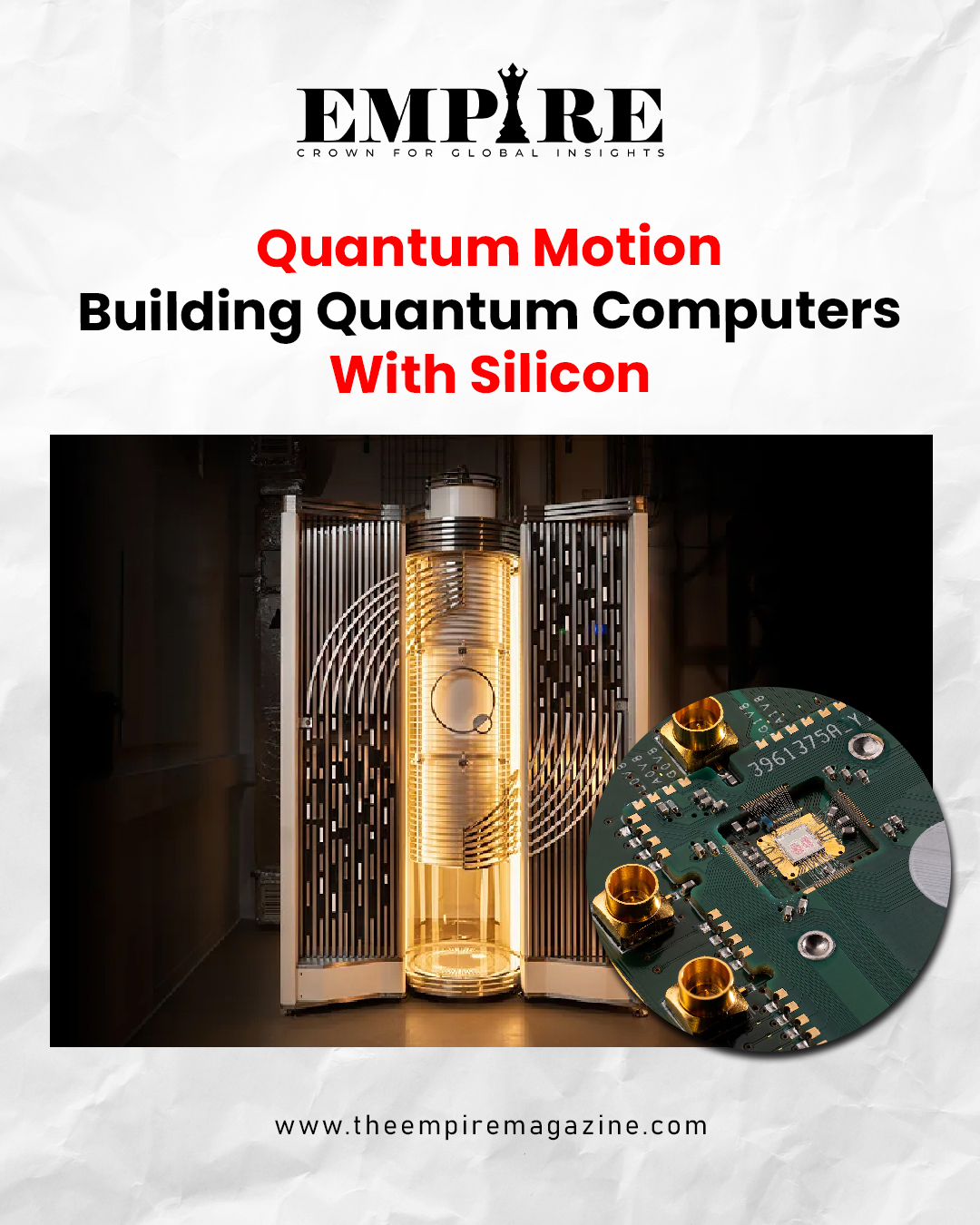
Quantum Motion Is Building Quantum Computers With Standard Silicon
Quantum Motion is a London-based quantum computing startup focused on building quantum computers using standard silicon technology. The company’s approach is important because silicon is already the foundation of the global semiconductor industry. It is used in smartphones, laptops, servers, and conventional computer chips.
Instead of building quantum computers through entirely separate manufacturing systems, Quantum Motion is working with silicon-based technology that can be produced using commercial chip fabrication processes. This strategy could make quantum computers easier to scale, manufacture, and integrate with existing computing infrastructure.
Quantum Motion was founded in 2017 by Professor John Morton from University College London and Professor Simon Benjamin from the University of Oxford. The company brings together academic quantum research and semiconductor engineering to develop scalable quantum computing systems.
Why Silicon Matters in Quantum Computing
Quantum computing is based on qubits, which are different from classical bits. A normal computer bit represents either 0 or 1. A qubit can represent quantum states that allow a quantum computer to process certain types of complex problems differently from classical machines.
The challenge is that qubits are difficult to build, control, scale, and protect from errors. Different companies are using different methods, including superconducting circuits, trapped ions, photonics, neutral atoms, and silicon spin qubits.
Silicon Offers a Manufacturing Advantage
Quantum Motion’s focus on silicon is important because the world already has a mature silicon manufacturing ecosystem. Semiconductor foundries are capable of producing extremely complex chips at scale. If quantum devices can be built using similar processes, the path to large-scale production may become more practical.
The company says it is developing quantum computing architectures compatible with standard silicon processing. Its platform is based on silicon transistor technology, which is closely linked to the technology used in everyday electronic devices.
Quantum Motion’s Full-Stack Silicon CMOS Quantum Computer
In September 2025, Quantum Motion announced that it had delivered a full-stack quantum computer built using a standard silicon CMOS chip fabrication process. The system was installed at the UK’s National Quantum Computing Centre as part of its quantum testbed programme.
This was a significant milestone because the system used mass-manufacturable 300mm silicon CMOS wafer technology. CMOS, or complementary metal-oxide-semiconductor, is the standard technology used in many modern chips.
What Full-Stack Means
A full-stack quantum computer includes more than a quantum processor. It includes the hardware, control systems, cryogenic systems, software interface, and user access layer needed to operate the machine. Quantum Motion’s system includes a silicon spin-qubit quantum processing unit, control electronics, and compatibility with software frameworks such as Qiskit and Cirq.
The system’s data-centre-friendly design is also important. Reports about the machine describe a three-rack footprint, which shows the company’s goal of making quantum systems more practical for real computing environments.
The $160 Million Series C Funding Round
In May 2026, Quantum Motion raised $160 million in Series C funding to advance its silicon-based quantum computing platform. The round was co-led by DCVC and Kembara. Investors included the British Business Bank, Firgun, Oxford Science Enterprises, Inkef, Bosch Ventures, Porsche Automobil Holding, and Parkwalk Advisors.
The funding is intended to support the company’s work toward commercial deployment of silicon transistor-based quantum computers. The round also reflects growing investor interest in quantum computing companies that can connect advanced science with semiconductor manufacturing.
Why Investors Are Backing Silicon Quantum Startups
Investors are interested in quantum computing because the technology may eventually support major advances in materials science, drug discovery, cryptography, optimization, finance, and artificial intelligence. However, the industry still faces major engineering challenges.
Quantum Motion’s silicon-based strategy appeals to investors because it uses a familiar manufacturing foundation. If silicon quantum processors can scale successfully, they may offer cost, size, and manufacturing advantages compared with some other quantum approaches.
How Quantum Motion’s Technology Works
Quantum Motion’s approach is based on silicon spin qubits. In simplified terms, the company uses the spin of an electron as the basis for a qubit. The electron can be controlled using techniques linked to transistor structures and magnetic fields.
According to Reuters reporting, Quantum Motion’s leadership has described the approach as using standard transistors with minimal adaptation to turn them into qubits. The company has also worked with GlobalFoundries, a major semiconductor manufacturer, to support its manufacturing strategy.
Why Electron Spin Is Important
Electron spin is a quantum property that can be used to store and process quantum information. In silicon spin-qubit systems, electrons are confined in tiny structures known as quantum dots. These quantum dots can be formed using semiconductor manufacturing techniques.
This approach is attractive because it may allow many qubits to be placed close together on a silicon chip. Dense qubit placement is important for building larger quantum processors.
Europe’s Role in the Quantum Technology Race
Quantum Motion is part of Europe’s growing quantum technology ecosystem. The United Kingdom has invested in quantum research through national programmes, universities, and public-private partnerships. The UK National Quantum Computing Centre is one of the important institutions supporting development and testing of quantum systems.
Europe’s quantum sector includes startups, research laboratories, semiconductor partners, universities, and government-backed innovation programmes. Quantum Motion’s work connects academic research from UCL and Oxford with commercial chip manufacturing and venture capital funding.
The UK’s National Quantum Computing Centre
The UK National Quantum Computing Centre provides infrastructure for testing and developing quantum computing technologies. Quantum Motion’s system at the NQCC gives researchers and users an opportunity to evaluate silicon-based quantum hardware in a structured environment.
This type of public-private collaboration is important because quantum computing is still an emerging field. Startups need access to research ecosystems, manufacturing partners, technical validation, and long-term funding.
Quantum Motion and the Standard Silicon Strategy
The phrase “standard silicon” is central to Quantum Motion’s business story. The company is not only trying to build a quantum computer. It is trying to build quantum systems using the manufacturing logic that made classical computing scalable.
If successful, this strategy could reduce the cost and complexity of building large quantum systems. Reuters reported that Quantum Motion’s approach could potentially reduce production costs, with high-performance quantum computers targeted in the $10 million to $20 million range.
Data Centre Integration
Quantum Motion’s product strategy also focuses on data-centre-ready systems. This matters because commercial quantum computers will likely need to work alongside classical computers, cloud infrastructure, and enterprise systems.
A quantum computer does not replace every type of classical computing. Instead, it may work as a specialized processor for certain complex workloads. This is similar to how GPUs support artificial intelligence workloads in modern data centers.
Challenges Facing Quantum Motion
Quantum Motion still faces the same broad challenges as the wider quantum computing industry. These include qubit quality, error correction, scaling, cooling, control electronics, manufacturing consistency, and real-world application development.
Quantum computers usually need extremely cold operating conditions to protect delicate quantum states. Building systems that are reliable, scalable, and useful for commercial workloads remains a major technical task.
Scaling From Milestone to Market
Delivering a full-stack silicon CMOS quantum computer is an important milestone, but commercial success depends on continued progress. Customers will need evidence of performance, reliability, qubit scaling, useful applications, and integration with existing software and hardware environments.
Quantum Motion’s funding, semiconductor partnerships, and public testbed deployment give the company resources to continue development, but the quantum computing market remains early and highly competitive.
Why Quantum Motion Is Important for the Future of Computing
Quantum Motion represents a practical engineering approach to one of technology’s most difficult challenges. By using standard silicon processes, the company is trying to connect quantum computing with the manufacturing strength of the semiconductor industry.
The company’s work also shows how startups can transform deep scientific research into commercial technology platforms. Its development path includes university research, venture capital, chip manufacturing, national research infrastructure, and global interest in quantum computing.
For more technology and startup insights, read this feature on The Empire Magazine.
Follow The Empire Magazine on Instagram and Facebook.
– The Empire Magazine
Crown For Global Insights