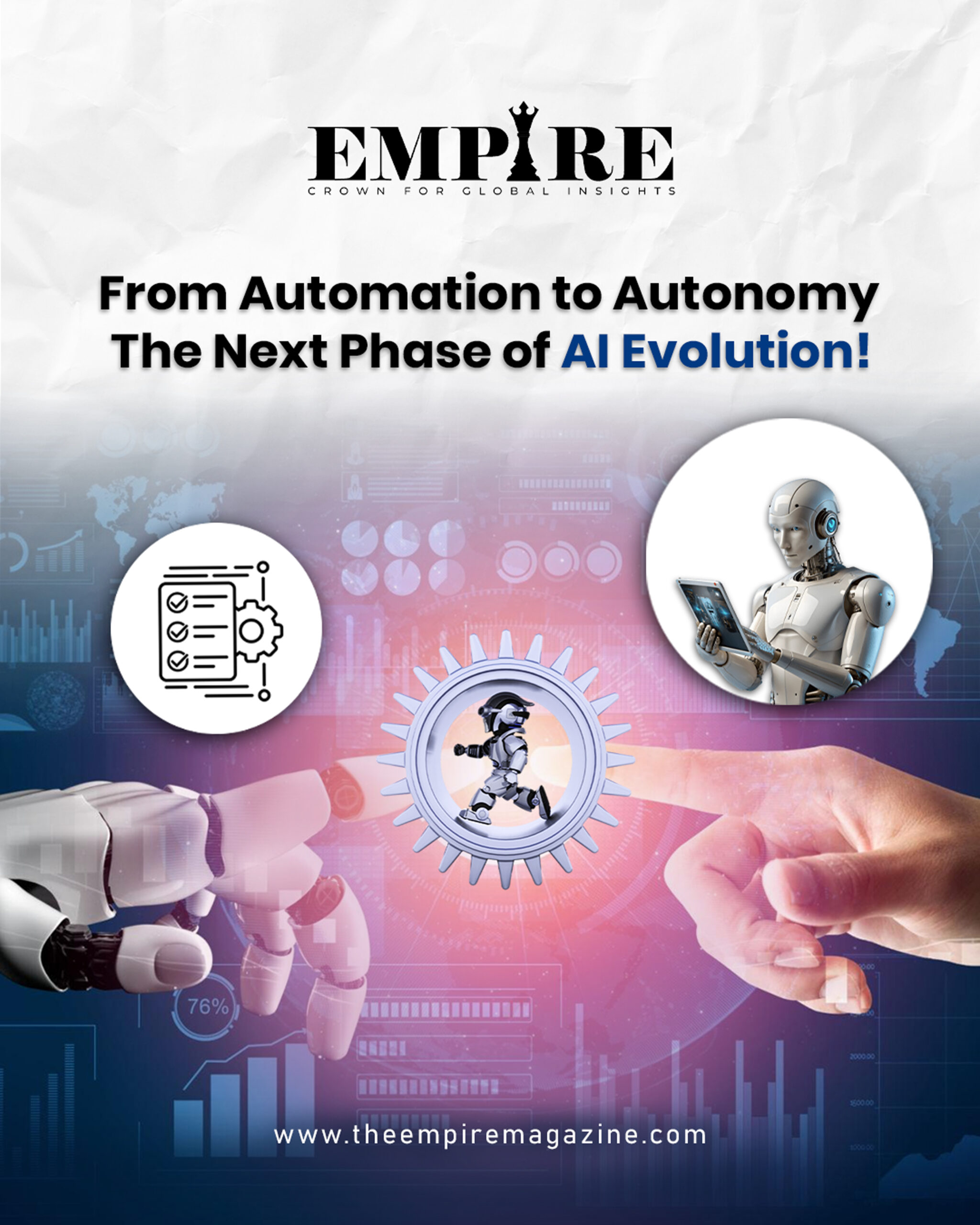
The shift from automation to autonomy marks one of the most important turning points in the evolution of artificial intelligence. For years, businesses used AI mainly to automate repetitive tasks, reduce manual effort, and improve speed. That phase changed industries, but it was only the beginning. Today, AI is entering a more advanced stage where systems are no longer just following instructions. They are beginning to plan, coordinate, and act with far less human input than before. This transition is changing how companies operate, how work gets done, and how value is created in the digital economy.
At a basic level, automation is about executing tasks faster and more consistently. Autonomy goes much further. It is about systems that can interpret goals, evaluate options, and carry out multi-step actions with limited supervision. A simple comparison makes the idea clear: automation is like cruise control, while autonomy is like a self-driving vehicle. One assists a task. The other can manage a wider journey. That distinction is what makes this next phase of AI evolution so powerful.
The movement from automation to autonomy is not just a technical upgrade. It represents a major business shift. It means organizations are moving from using AI as a support tool to using AI as an active operational layer. Systems are becoming capable of coordinating meetings, drafting responses, managing workflows, generating content, handling customer interactions, and supporting complex decisions in real time. As AI becomes more context-aware and capable of orchestration, businesses are rethinking roles, processes, and strategies.
Understanding the Difference Between Automation and Autonomy
To fully understand the movement from automation to autonomy, it is important to separate the two ideas clearly. Automation is designed to perform predefined tasks according to set rules. It works well when the process is repetitive, structured, and predictable. This includes things like sending invoices, processing forms, scheduling posts, or triggering standard alerts.
Autonomy, however, works at a higher level. Autonomous systems do not just complete isolated tasks. They can manage sequences of tasks, respond to changing conditions, and make context-based adjustments. They are closer to digital operators than digital assistants. Instead of waiting for each instruction, they can take a broader goal and decide how to move toward it. This is why autonomy is becoming so relevant in industries that need speed, adaptability, and scale.
The evolution from automation to autonomy is possible because AI capabilities have improved significantly in language understanding, reasoning, context handling, and workflow coordination. AI is no longer being viewed only as a chatbot or an efficiency tool. It is becoming an intelligent layer within business ecosystems.
Why This Shift Matters for Business
The transition from automation to autonomy matters because it creates a different level of leverage. Automation saves time. Autonomy has the potential to redesign how companies function. When AI can execute connected workflows rather than isolated tasks, businesses gain more than efficiency. They gain responsiveness, scalability, and the ability to move faster in increasingly complex environments.
This matters especially in a world where the pace of change is accelerating. Organizations are dealing with more data, more channels, more customer expectations, and more operational complexity than ever before. Autonomous AI systems can help manage this by handling decision support, cross-functional coordination, and exception-based workflows with much less friction.
The value of this shift is also tied to talent. As AI handles more structured digital work, human workers can spend more time on judgment, creativity, empathy, leadership, and strategy. This is one reason the future of work is becoming more about collaboration with AI than competition against it. Workers who understand how to guide, supervise, and improve autonomous systems will be far more valuable in the next phase of business growth.
Where Autonomy Is Already Appearing
The shift from automation to autonomy is already visible in several areas of business and digital work. AI assistants are moving beyond answering questions and now helping users manage calendars, summarize meetings, draft follow-ups, and coordinate tasks across tools. Content systems are evolving from simple generation tools into intelligent production partners that can help plan campaigns, repurpose assets, and adapt content for multiple formats.
In entrepreneurship, solo founders are using AI tools to launch and operate businesses with remarkable speed. This includes building landing pages, generating messaging, automating customer communication, and creating lightweight operational systems without large teams. In this environment, AI is not just saving time. It is enabling one person to operate with the power of a much larger business structure.
Another major area is the rise of small, highly focused AI applications. These micro-AI tools are designed to do one thing extremely well. While large AI platforms get most of the attention, these focused tools are quietly producing strong results by solving specific workflow problems with speed and precision. This shows that the movement from automation to autonomy does not always require giant platforms. Sometimes it happens through compact, purpose-built systems that become deeply embedded in daily work.
The Rise of Agentic AI
One of the clearest signs of the transition from automation to autonomy is the rise of agentic AI. Agentic systems are designed to take action toward a goal rather than simply respond to prompts. Instead of only answering a request, they can break a larger objective into smaller tasks, coordinate information, and complete structured workflows. This changes the way businesses think about AI implementation.
The importance of this shift is reflected in the growing need for AI orchestration, governance, and human-AI collaboration skills. New roles are emerging around designing workflows for AI agents, managing ethical compliance, and handling the uncertain edge cases that AI still cannot resolve on its own. In this model, humans are not removed from the system. They become supervisors, strategists, and decision-makers working alongside increasingly capable AI systems.
This is why the move from automation to autonomy should not be misunderstood as full replacement. It is better understood as augmentation. The systems become more capable, but the highest-value human contributions become even more important. Critical thinking, emotional intelligence, and strategic judgment are not weakened by autonomy. In many cases, they become more essential.
Challenges in the Move Toward Autonomy
Even though the transition from automation to autonomy is promising, it also comes with real challenges. Autonomous systems require trust, oversight, and clear governance. When AI begins to act more independently, organizations need to ensure that outputs remain accurate, ethical, secure, and aligned with business values.
This means companies must invest not only in tools but also in policies, training, and decision frameworks. Questions around data privacy, bias, accountability, and human review become more important as autonomy grows. Businesses that ignore these issues may move quickly in the short term but face bigger problems later.
There is also a skills challenge. As AI takes on more operational work, the workforce needs to evolve. Companies must help teams build digital fluency, adaptability, and the ability to work effectively with AI-driven systems. The organizations that succeed in the era from automation to autonomy will be those that balance innovation with responsibility.
What the Future Looks Like
Looking ahead, the transition from automation to autonomy will likely define the next major phase of AI adoption. Businesses will increasingly shift from one-off AI tools to connected AI ecosystems. Instead of buying a single productivity tool, they will look for integrated systems that support end-to-end workflows. This is already visible in the way major AI platforms are expanding from standalone features into broader ecosystems of content, reasoning, design, voice, and workflow tools.
At the same time, individuals will need to become more intentional about how they use AI. The future will reward those who can identify where autonomy creates practical value and where human insight must remain central. This is not about chasing trends. It is about understanding how intelligent systems can solve real problems, improve operations, and support better outcomes.
The transition from automation to autonomy also points toward a larger truth about the future of work and business. Technology is not simply replacing effort. It is changing the shape of effort. Routine digital work will continue to shrink as a source of advantage. Human strengths such as imagination, empathy, ethical reasoning, and adaptive thinking will become more powerful when paired with autonomous systems that handle scale and speed.
For more insights, visit:
https://theempiremagazine.com/?p=5961
Stay connected with us:
Instagram: https://www.instagram.com/the_empire_magazine/
Facebook: https://www.facebook.com/profile.php?id=61573749076160
– The Empire Magazine
Crown For Global Insights