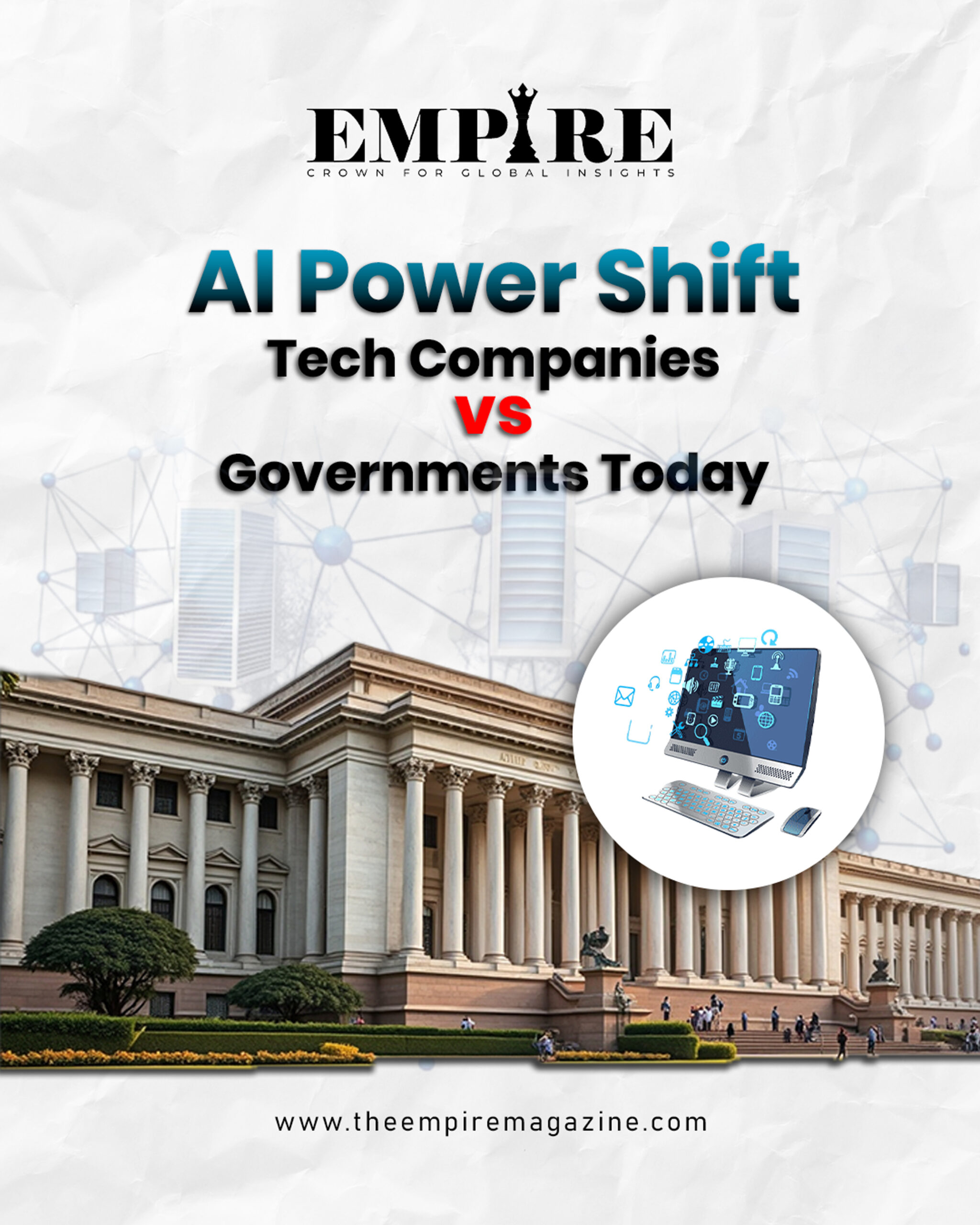
AI Power Shift is no longer a distant possibility. It is already changing the modern world in ways that affect politics, economics, culture, and daily life. Artificial intelligence is often discussed as a tool for efficiency, automation, and innovation, but its deeper impact goes far beyond technology. A larger shift is taking place beneath the surface: power is moving away from traditional public institutions and increasingly concentrating in the hands of private technology companies.
For decades, governments were seen as the main centers of authority. They created laws, regulated markets, protected public interests, and shaped national priorities. Today, however, some of the most powerful decisions affecting society are no longer made only by elected institutions. They are influenced by digital platforms, AI systems, and the companies that design, control, and deploy them at scale.
This growing AI Power Shift is one of the defining transformations of our time. It raises an urgent question for the future: who really governs the systems that now shape how people work, communicate, consume information, and make decisions?
The Rise of New Digital Power Centers
Artificial intelligence has become the foundation of many modern digital systems. Search engines, recommendation algorithms, cloud platforms, automated moderation tools, digital assistants, and predictive analytics all rely on AI in one form or another. The companies behind these systems do more than offer services. They influence behavior, shape access to information, and determine how digital life is organized.
This gives them a level of power that looks increasingly institutional. They set standards, create rules, and control the digital spaces where billions of people interact. In many cases, these platforms are no longer just private products. They function more like infrastructure.
That is what makes the AI Power Shift so important. This is not only about successful businesses becoming larger. It is about private corporations gaining influence once associated mainly with governments and public systems.
Why Technology Companies Hold So Much Influence
The reason technology firms have become so powerful is simple: AI thrives on scale. The more data, computing power, users, and infrastructure a company controls, the stronger its position becomes. This creates a cycle where larger firms keep becoming more influential because they already own the resources needed to improve their systems faster than others.
Their influence also crosses borders with ease. Unlike traditional industries that are more tied to national laws or physical limitations, AI-driven platforms can operate globally with very little friction. A single company can affect communication, commerce, labor markets, and cultural visibility across multiple countries at the same time.
Because of this, some tech firms now play roles that resemble governance:
- they moderate speech
- they rank and filter information
- they define access to digital tools
- they influence political visibility
- they shape economic opportunity for workers and businesses
These powers were once more clearly tied to public institutions. Now they increasingly sit inside private systems.
Why Governments Are Struggling to Respond
One of the biggest reasons the AI Power Shift continues is that governments often move more slowly than technology. Policymaking takes time, regulation requires coordination, and democratic systems usually involve debate, review, and compromise. Technology companies, by contrast, can develop, test, and deploy new systems at extraordinary speed.
This creates a serious gap. By the time governments begin discussing how to regulate an AI tool or platform, that system may already be deeply embedded in everyday life.
There is also another problem: many governments are hesitant to act too aggressively. AI is now closely linked to national competitiveness, economic growth, and strategic influence. Leaders often worry that strict regulation could discourage investment, slow innovation, or push major companies to more favorable environments.
As a result, public institutions sometimes adopt a cautious approach. Instead of setting strong boundaries early, they allow technology companies to expand first and regulate later. That delay gives private firms even more room to define the rules.
The Economic Consequences of the AI Power Shift
The AI Power Shift has major economic implications. As AI changes industries, the benefits often flow most strongly to those who own the technology, the data, and the distribution systems. This can lead to a concentration of wealth and market power in a small number of companies.
At the same time, automation and AI-driven efficiency are changing employment patterns. Some jobs are being redefined, some are being replaced, and others are being created in highly specialized areas. This means the gains from AI are not evenly distributed. People and regions with access to digital infrastructure, technical training, and investment are better positioned to benefit, while others risk falling behind.
This uneven distribution can deepen inequality. It may separate not only rich and poor individuals, but also stronger and weaker economies. Countries with less digital capacity may become dependent on external platforms and systems rather than building their own.
That makes the AI question more than a business issue. It becomes a matter of global economic balance.
The Social Impact on Everyday Life
The AI Power Shift also affects how society functions on a daily level. AI systems influence what people read, what they buy, what content they encounter, and which voices become visible. Recommendation engines and ranking systems do not simply organize information. They shape attention.
This matters because attention influences belief, behavior, and public culture. When algorithms decide what is amplified and what is hidden, they gain soft power over society. They help define which issues appear urgent, which trends become dominant, and which narratives reach the public.
This type of influence was once associated more clearly with political or media institutions. Today, it is often embedded inside private technology systems that are optimized for growth, engagement, and efficiency rather than public accountability.
That is why the current shift feels so significant. It is not only changing markets. It is changing the structure of social influence itself.
Public Authority vs Private Control
A central tension in the AI Power Shift is the growing divide between public authority and private control. Governments are still expected to protect fairness, ensure stability, and defend public interests. But in the digital world, many practical decisions are being made somewhere else.
Technology companies increasingly:
- define platform rules
- control digital access
- influence economic participation
- determine visibility and reach
- shape how people interact with information
Yet unlike governments, they are not elected by the public. Their leadership is not chosen through democratic processes, and their internal decisions are often not transparent. This creates a legitimacy problem. If private platforms now influence public life at scale, what kind of accountability should they face?
That question is becoming harder to ignore.
Can Citizens Push Back?
In theory, users can influence the system through choice. People can support ethical platforms, demand greater transparency, and raise concerns about misuse. Digital advocacy, consumer pressure, and public debate all matter.
But in reality, this power is limited. A small number of major platforms dominate digital life, and many people rely on them daily for work, communication, information, and services. Leaving them entirely is often unrealistic.
This is why individual choice alone may not be enough. Broader pressure may need to come from collective action, stronger rights frameworks, public-interest technology models, and rules that make AI systems more transparent and accountable.
Awareness is growing, and that matters. The more people understand the stakes of the AI Power Shift, the more likely it becomes that societies will demand a healthier balance between innovation and oversight.
The Future of AI Governance
The future of the AI Power Shift will depend on how governments, companies, and citizens respond. There are several possible paths forward.
Governments can develop clearer regulation, stronger digital rights protections, and better enforcement mechanisms. Companies can adopt more transparent and responsible AI practices. Public institutions can invest in their own technical capacity instead of always reacting from behind. International cooperation can also help, especially since AI systems operate across borders.
None of these solutions are easy. But ignoring the issue would allow the shift to continue by default.
The most important challenge is not whether AI will grow. It will. The real challenge is whether the systems built around it will remain aligned with public values, human rights, and democratic accountability.
Final Thoughts
AI Power Shift describes one of the most important transformations of the digital age. Artificial intelligence is not only changing how technology works. It is changing how power works. Tech companies now influence communication, markets, labor, and public life in ways once dominated by states and public institutions.
The danger is not simply that machines will become too powerful. The deeper concern is that those who control these systems may quietly set the rules for society without meaningful oversight. If governments continue to fall behind, and if global coordination remains weak, the balance of authority may keep moving away from the public sphere.
The future of AI is not only about innovation. It is about governance, accountability, and who gets to shape the systems that increasingly shape us.
Read more here:
https://theempiremagazine.com/?p=5660
Follow us on social media:
Instagram: https://www.instagram.com/the_empire_magazine/
Facebook: https://www.facebook.com/profile.php?id=61573749076160
– The Empire Magazine
Crown For Global Insights