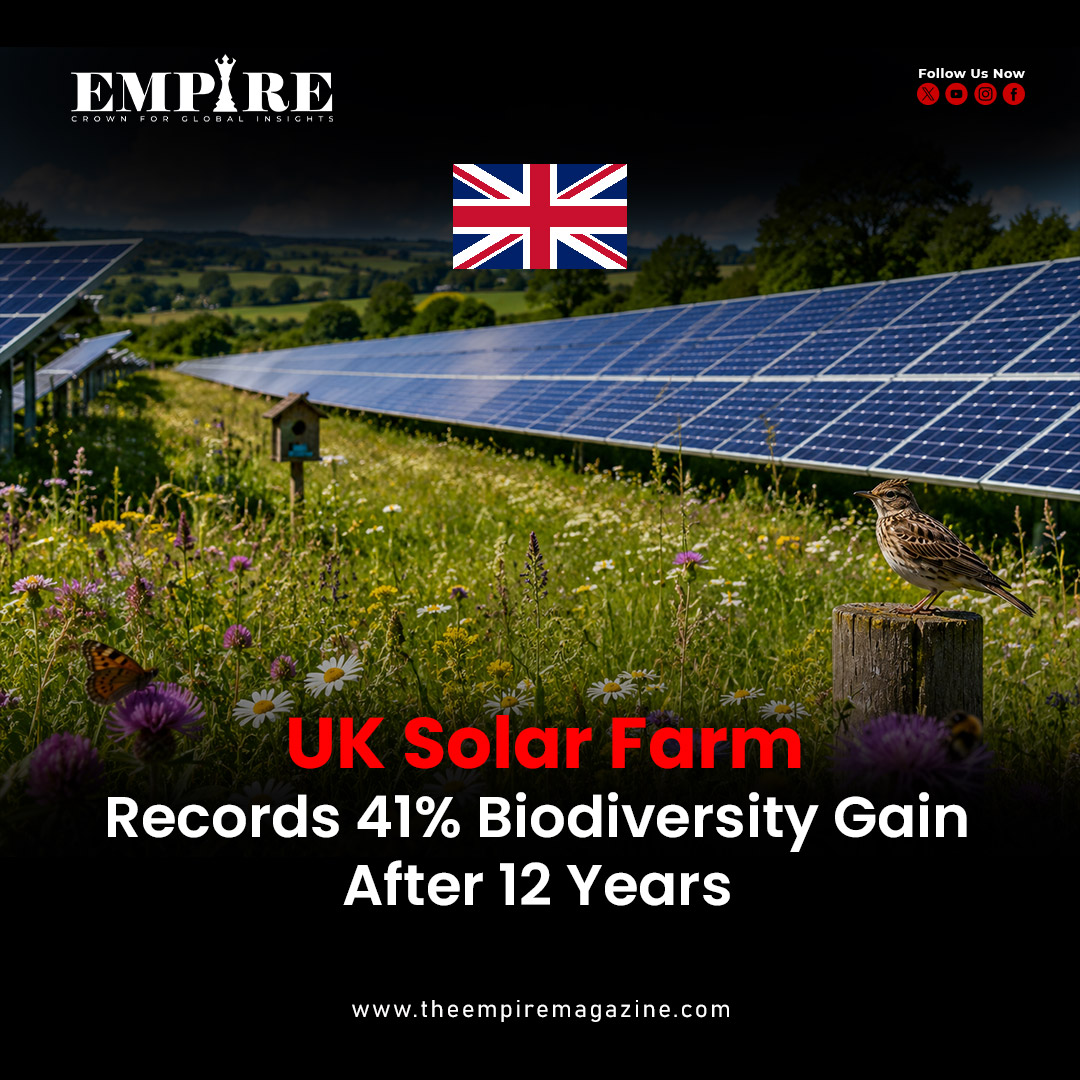
The Broxted Solar Farm in Suffolk recorded a 41% biodiversity increase across the estate after more than 12 years of monitoring. Since 2013, the UK solar farm has generated over 350 GWh of clean electricity while supporting wildlife habitats, sheep grazing and conservation initiatives. The project demonstrates how renewable energy and biodiversity recovery can work together.
The UK solar farm biodiversity story is gaining fresh attention
The UK solar farm biodiversity story is gaining fresh attention after Broxted Estate and Solar Farm in Suffolk recorded a 41% increase in biodiversity following more than a decade of ecological monitoring. The findings offer a striking example of how solar energy, wildlife conservation, farming and community interests can coexist when renewable energy projects are designed with nature in mind.
A new report produced by Suffolk Wildlife Trust’s Wilder Ecology, alongside the Broxted Estate and Cubico, examines more than 12 years of ecological monitoring at the site. The solar farm began generating electricity in December 2013, while systematic ecological surveys have been continuing since the project’s early development.
The results are significant because the debate around large-scale solar farms often focuses on land use and their possible effects on wildlife. Broxted presents a different picture: with early ecological planning, active habitat management and long-term monitoring, renewable energy infrastructure can become part of a wider landscape strategy that supports nature recovery.
UK Solar Farm Biodiversity Gain at Broxted
The Broxted Estate and Solar Farm in Suffolk provides one of the clearest long-term examples of a UK solar farm delivering measurable biodiversity benefits. According to a retrospective Biodiversity Net Gain assessment, biodiversity across the Broxted Estate increased by 41% compared with the 2011 baseline. The assessment forms part of a wider ecological study examining habitats and species across the solar farm and surrounding estate.
Planning for the solar development began in 2011, and electricity generation started in December 2013. Rather than treating the solar farm as an isolated energy project, the estate incorporated it into a broader land-management strategy involving wildlife conservation, farming, woodland restoration, habitat creation and community engagement.
That approach has become central to the project’s environmental performance. The latest report describes the monitoring programme as one of the earliest of its scope and size in Europe, with systematic ecological surveys continuing since 2013. The report also stresses that its findings represent progress to date rather than a final assessment of the site’s long-term ecological journey.
The 41% biodiversity gain therefore matters not simply because of the headline figure, but because it is backed by years of monitoring and active management.
How the UK Solar Farm Improved Biodiversity
The biodiversity increase at the UK solar farm did not happen automatically. The Broxted model relied on an integrated management strategy that considered the solar installation alongside the wider estate. Habitat creation and management were carried out across grassland, woodland, scrub and ponds, creating a mosaic of environments capable of supporting different species.
Sheep grazing has also played an important role. Grazing helps manage vegetation beneath and around the solar panels while allowing the land to continue supporting agricultural activity. This combination of renewable energy production and farming demonstrates how solar infrastructure can coexist with productive rural land management when the landscape is carefully planned.
The project also benefited from collaboration between the landowner, solar operator and conservation specialists. Suffolk Wildlife Trust has provided ecological expertise, while Cubico has operated the solar project and worked with the estate on its long-term environmental objectives.
This integrated approach is particularly important because biodiversity does not respond to solar panels alone. It depends on what happens around them: how grassland is managed, whether hedgerows are maintained, whether ponds are protected and whether wildlife corridors remain available.
Wildlife Benefits From the Solar Farm
The UK solar farm has produced notable results for birds and other wildlife. Monitoring at Broxted recorded six Red List and 13 Amber List Birds of Conservation Concern in 2025 across restored habitats surrounding the solar farm. The species recorded include the internationally threatened turtle dove, as well as yellowhammer and linnet.
One of the most striking results concerns meadow pipits. Their numbers have more than doubled at the site, making Broxted a significant location for the species at county level and placing the site against the wider national decline experienced by meadow pipits.
The estate has also recorded eight bat species, while habitats support common lizards, common toads, water shrews and pollinator-friendly wildflowers. These findings demonstrate that biodiversity outcomes can extend beyond headline bird numbers and include a broader range of species.
However, the report also provides an important reminder that renewable energy projects can create trade-offs. Skylarks were present on the site before construction but have not been observed nesting within the solar farm since 2024. They continue to nest in nearby grassland, which highlights the importance of retaining suitable open habitats alongside solar developments.
Solar Energy and Farming Together
One of the strongest lessons from the Broxted solar farm is that renewable energy does not necessarily have to eliminate agricultural use. Sheep grazing continues across the solar farm, helping maintain grassland while keeping the land connected to farming activity.
This model is increasingly relevant as countries search for more renewable electricity without ignoring food production and rural landscapes. Solar farms can occupy substantial areas, making land management an important part of their environmental and social acceptance.
At Broxted, solar generation became one component of a broader estate strategy. The land continues to support energy production, agriculture, wildlife habitats and community interests.
The approach also reflects the growing importance of landscape-scale thinking. A solar farm should not always be assessed only within the boundaries of its panels and fencing. Wildlife moves across landscapes, while habitats such as grassland, woodland, ponds and hedgerows can influence ecological outcomes well beyond the solar installation itself.
The Broxted experience suggests that the strongest projects may be those that recognise these connections from the beginning rather than attempting to add biodiversity measures after construction.
The Role of Long-Term Biodiversity Monitoring
Long-term monitoring is perhaps the most important feature of the Broxted study. The report draws on more than 12 years of habitat and species monitoring, creating an unusually detailed dataset for an operational solar site.
That evidence helps distinguish genuine ecological change from assumptions made during planning. Biodiversity assessments can sometimes depend heavily on predictions about what might happen after a development is completed. Broxted provides an opportunity to compare those expectations with observations collected over many years.
The monitoring programme included botanical surveys, breeding bird surveys, wintering bird surveys, reptile monitoring and bat surveys. The report also documents habitat management, fixed-point photography and other ecological information gathered during the project’s operation.
This matters for the future of the solar industry. As solar capacity expands, developers and policymakers will need stronger evidence about how renewable infrastructure affects land and wildlife over decades, not simply during construction.
Broxted’s long-term dataset can therefore serve as a valuable reference point for future solar projects seeking to balance energy generation with biodiversity protection.
UK Solar Farm Produces Clean Energy
The environmental story at Broxted is not limited to biodiversity. Since beginning operation in 2013, the UK solar farm has generated more than 350 GWh of clean electricity. Suffolk Wildlife Trust says this is equivalent to the annual consumption of around 100,000 UK homes.
The report also states that the solar farm has avoided many tens of thousands of tonnes of carbon dioxide emissions through its electricity generation.
This combination of clean energy production and ecological management is what makes the project particularly relevant to Britain’s wider energy transition. The UK is seeking to increase renewable generation while strengthening energy security and reducing greenhouse gas emissions.
Solar power is expected to remain an important part of that transition. Yet the expansion of solar infrastructure will increasingly be judged not only by how much electricity it produces, but also by how responsibly it uses land.
Broxted demonstrates that these objectives can be considered together. Energy generation can continue while habitats are restored, farming remains active and communities participate in the wider project.
Why Early Ecological Planning Matters
The 41% biodiversity gain at Broxted offers another clear lesson: environmental planning works best when it begins before construction.
Suffolk Wildlife Trust’s Wilder Ecology Manager Jo Green said early engagement with ecologists during planning and design was instrumental in achieving the project’s biodiversity outcomes. The organisation also highlighted the importance of combining long-term monitoring with collaborative environmental management.
This principle could become increasingly important as the UK develops larger solar installations. Ecologists can identify sensitive habitats, important species and opportunities for habitat creation before project layouts are finalised. Developers can then design around those considerations rather than trying to correct problems later.
At Broxted, an Environmental Management Group involving key partners has helped guide conservation strategy. The partnership includes the estate, Cubico and Suffolk Wildlife Trust, alongside wider community involvement.
The lesson is straightforward: biodiversity should be part of solar farm design, not simply an environmental condition attached to it.
Lessons for Future Solar Farms
The Broxted solar farm provides several lessons for future renewable energy developments. First, solar projects can be planned as part of wider landscapes rather than treated as standalone infrastructure. Second, habitat management requires continuous attention after construction. Third, farming and renewable energy can sometimes operate together through approaches such as grazing.
Perhaps most importantly, the project shows why measurement matters. The 41% biodiversity increase is supported by a retrospective Biodiversity Net Gain assessment and more than a decade of monitoring, giving the findings a stronger evidence base than short-term observations.
The results should not be interpreted to mean that every solar farm will automatically increase biodiversity. Outcomes depend heavily on the original land use, site design, management practices and surrounding landscape. Broxted itself shows both positive results and species-specific challenges, particularly in relation to skylarks.
That nuance makes the case study more useful. It presents solar energy not as universally beneficial or harmful to biodiversity, but as an infrastructure choice whose ecological impact can be shaped by responsible planning and management.
The Future of Solar Energy and Biodiversity
The UK solar farm biodiversity results at Broxted arrive at an important moment for renewable energy. The country needs more clean electricity, but it also faces the challenge of restoring nature and protecting increasingly pressured wildlife populations.
Broxted shows that these priorities do not always have to compete. More than 350 GWh of clean electricity has been generated since 2013 while the wider estate has recorded a 41% biodiversity increase, continued agricultural activity and a diverse range of wildlife.
The project’s greatest contribution may therefore be the example it provides for future development. Renewable energy can be integrated with farming, conservation and communities when the right partnerships are established early and maintained over the long term.
As solar power expands across the UK and other countries, the question will increasingly move beyond how many panels can be installed. The bigger question will be how renewable infrastructure can become part of healthier, more resilient landscapes.
Broxted offers one possible answer: build clean energy infrastructure, monitor its ecological impact, manage the surrounding land carefully and make biodiversity part of the project from the start.
For a technology designed to harness the sun, the Broxted experience suggests that the most successful solar farms may ultimately be measured not only by the electricity they generate, but also by the life they help sustain.
Previous article: https://theempiremagazine.com/carpl-ai/
Magazine Feautures | Podcasts: Empire Global Talks
Follow The Empire Magazine on Facebook | Instagram | LinkedIn | YouTube
The Empire Magazine | Crown for Global Insights