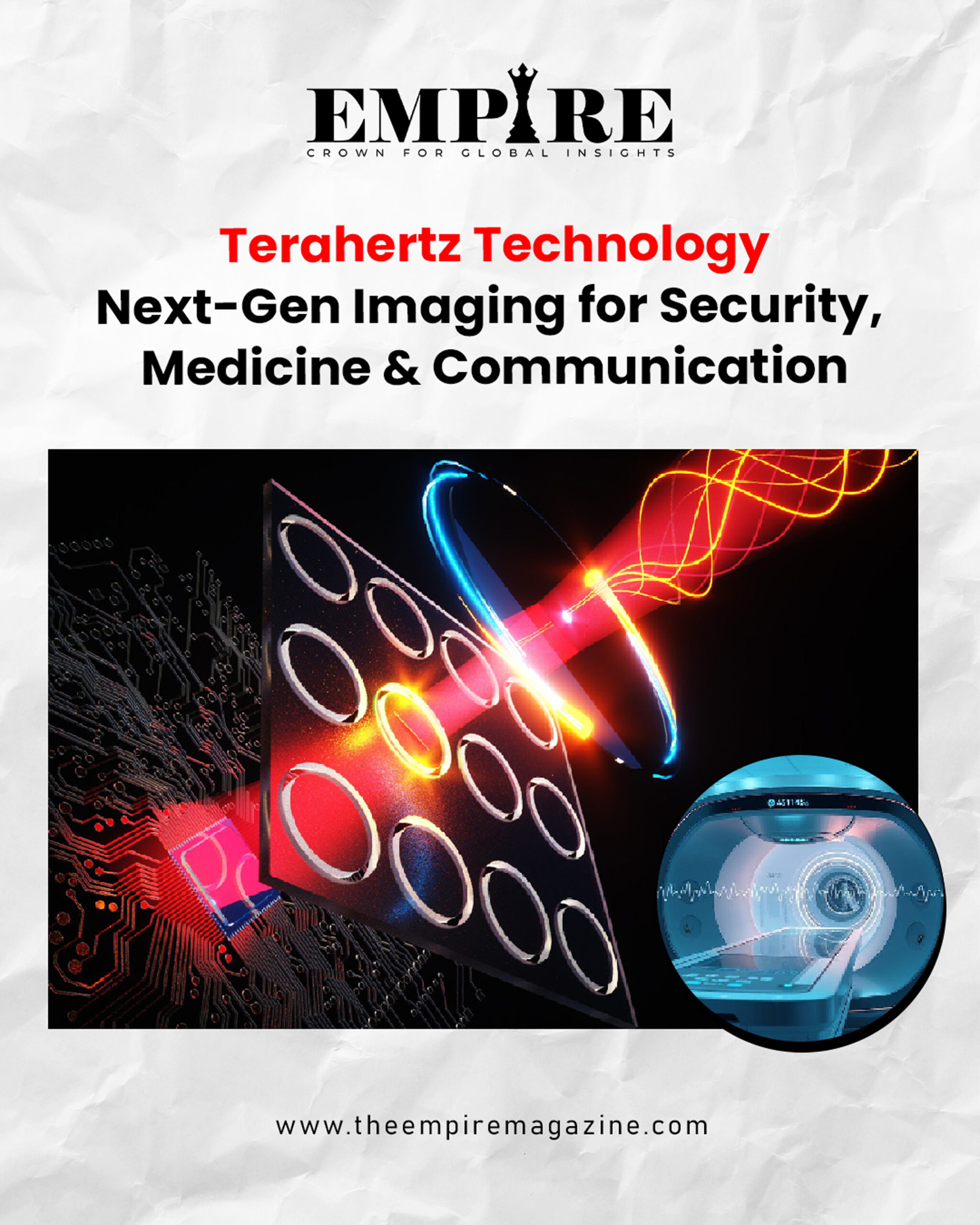
Terahertz Technology is emerging as one of the most promising next-generation innovations in 2026. Lying between microwave and infrared frequencies on the electromagnetic spectrum, terahertz waves (THz) offer unique capabilities that are transforming security screening, medical diagnostics, and high-speed communication.
What is Terahertz Technology?
Terahertz radiation operates at frequencies between 0.1 and 10 THz. These waves can penetrate many non-conducting materials such as clothing, paper, plastics, and ceramics, while remaining non-ionizing (unlike X-rays). This makes terahertz imaging safe for humans while still providing detailed internal views.
Key Applications of Terahertz Technology
1. Security and Airport Screening Terahertz scanners are revolutionizing security checkpoints. Unlike traditional X-ray machines, THz systems can detect concealed weapons, explosives, and narcotics hidden under clothing without physical contact or radiation risks. Major airports and high-security facilities are increasingly adopting terahertz-based full-body scanners for faster and safer screening.
2. Medical Imaging and Diagnostics In healthcare, terahertz technology offers exciting possibilities:
- Early detection of skin cancer and breast cancer
- Non-invasive imaging of dental cavities and gum disease
- Real-time monitoring of burn depth and wound healing
- High-resolution imaging of pharmaceutical tablets for quality control
Because terahertz waves are non-ionizing, they are safer for repeated use compared to X-rays or CT scans.
3. High-Speed Wireless Communication Terahertz waves can carry enormous amounts of data, making them ideal for future 6G networks. THz communication can deliver ultra-high-speed wireless links with low latency, perfect for smart cities, industrial automation, and immersive AR/VR experiences.
4. Industrial and Quality Control Manufacturers are using terahertz systems for non-destructive testing of materials, detecting defects in semiconductors, plastics, and composite materials used in aerospace and automotive industries.
Recent Breakthroughs in 2026
Significant advancements have made terahertz technology more practical:
- Miniaturization of THz devices, making them more portable and cost-effective
- Improved signal processing and AI integration for clearer imaging
- Development of room-temperature THz detectors (previously required expensive cooling systems)
- Better penetration and resolution capabilities
These improvements have accelerated commercial adoption across multiple sectors.
Advantages of Terahertz Technology
- Safe for Humans: Non-ionizing radiation, unlike X-rays
- High Resolution: Can detect objects and substances at microscopic levels
- Material Penetration: Sees through clothing, packaging, and many composites
- Spectroscopic Fingerprinting: Can identify specific chemicals and substances
- Real-time Imaging: Fast enough for security and medical applications
Challenges Remaining
Despite its potential, terahertz technology still faces hurdles:
- Limited range due to high atmospheric absorption
- High cost of equipment (though rapidly decreasing)
- Need for more compact and energy-efficient systems
- Regulatory approvals for widespread medical and security use
Future Outlook
Experts predict that by 2030, terahertz technology will become mainstream in several fields. The global market for THz systems is expected to grow exponentially as costs decline and applications expand.
In security, we may soon see contactless, high-speed screening at airports and events. In medicine, non-invasive THz scanners could become standard diagnostic tools. In communication, terahertz waves will play a key role in enabling ultra-fast 6G networks.
Terahertz Technology stands at the intersection of security, healthcare, and communication — three critical pillars of modern society. As research continues and commercialization accelerates, this invisible part of the electromagnetic spectrum is set to become highly visible in our daily lives.
For more science and technology insights, explore related coverage here: https://theempiremagazine.com/?p=6595
Follow The Empire Magazine on Instagram and Facebook for the latest updates.
– The Empire Magazine
Crown For Global Insights