United States | Biotechnology & Innovation
Information checked on 3 October 2026.
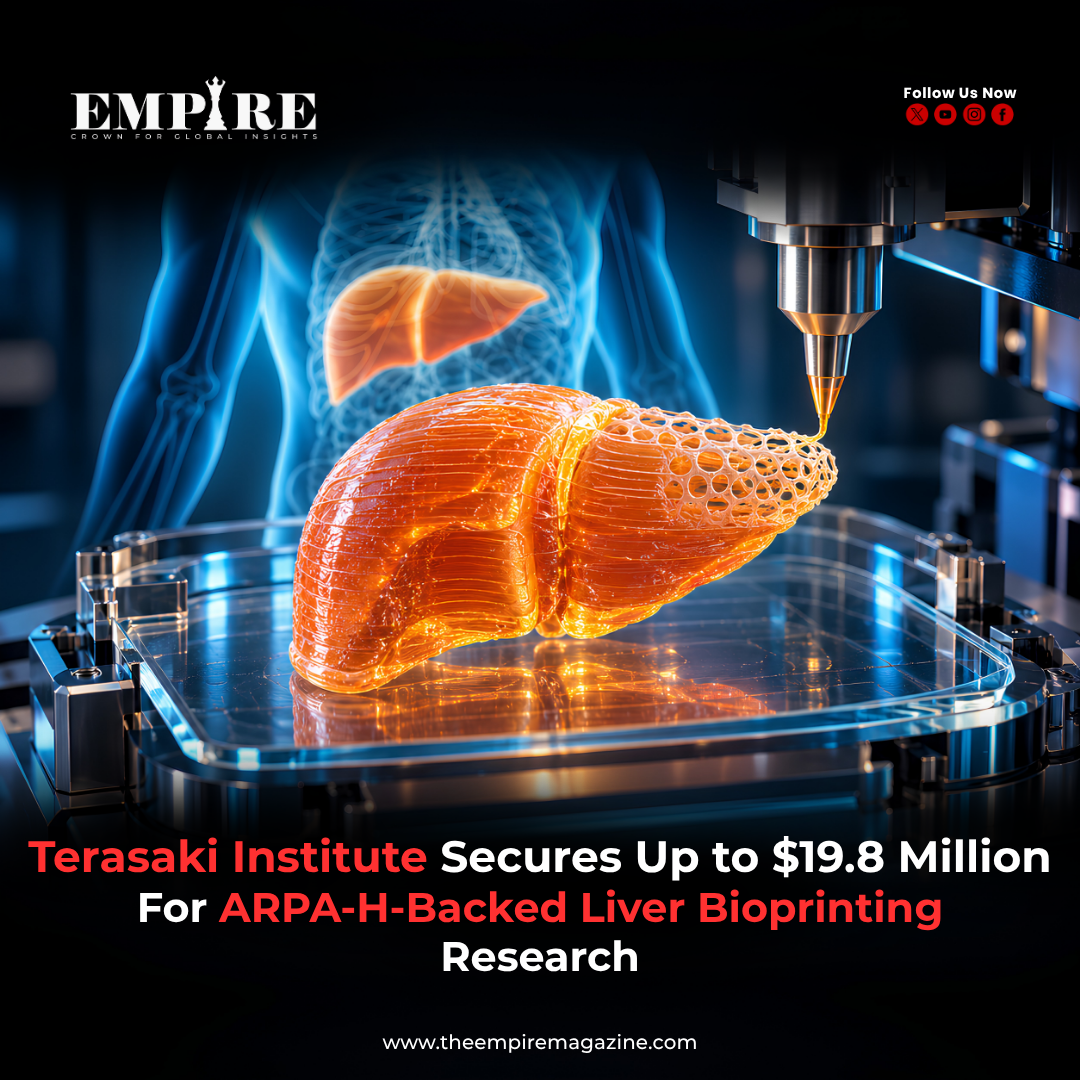
Terasaki liver bioprinting research has received new backing as the Terasaki Institute for Biomedical Innovation announces an award worth up to $19.8 million for its Prometheus project. The institute announced the funding on 2 October 2026, naming Dr. Xiling Shen as principal investigator.
Backed by the Advanced Research Projects Agency for Health, or ARPA-H, Prometheus aims to produce transplantable liver tissue with broad immune compatibility. The announcement describes research objectives, without establishing a treatment ready for patients.
What the ARPA-H Award Supports
ARPA-H lists 31 July 2026 as the award’s start date, preceding the public announcement. Its record identifies Terasaki as the lead recipient and gives a maximum funding value.
The funding sits within PRINT, ARPA-H’s Personalized Regenerative Immunocompetent Nanotechnology Tissue programme. PRINT brings together cell sourcing, large-scale cell manufacturing and organ fabrication, followed by safety and efficacy testing. Its broader goal is to make compatible replacement organs available on demand.
Why Liver Replacement Research Matters
Liver transplantation can save the lives of people whose liver has failed because of disease or injury. Current procedures rely on donor organs: a whole liver or part of one may come from a deceased donor, while a living donor can provide a portion of their liver. The donated portion can grow after transplantation.
Access involves more than finding available tissue. ARPA-H identifies donor shortages, compatibility requirements and geographic constraints as obstacles that can leave patients waiting for a suitable organ.
After transplantation, the immune system may recognise the donated liver as foreign and attack it. The National Institute of Diabetes and Digestive and Kidney Diseases explains that recipients generally require lifelong immunosuppressive medicines and ongoing monitoring. These medicines protect the transplant but can increase susceptibility to infections and cause other complications.
Against that background, the potential value of engineered tissue has two dimensions: increasing the supply of usable tissue and improving its compatibility with the recipient. Success in one area would still leave the other to be demonstrated.
How Terasaki Liver Bioprinting Research Will Work
The project combines three connected areas of development.
Engineering a broadly compatible cell source. Prometheus will use liver cells derived from donor-origin iPSCs engineered to reduce immune recognition, described as allogeneic, hypoimmunogenic cells.
Induced pluripotent stem cells, usually shortened to iPSCs, begin as specialised adult cells that scientists reprogram into a more versatile state. They can then be directed towards different cell types. The NIH describes this capability as valuable for studying biology and developing new treatments. It does not, by itself, establish that a resulting tissue is safe or effective for transplantation.
Growing the cells at scale. The team will develop bioreactor culture and processing methods for producing the required liver cell types, with cost and scalability among its stated objectives.
From a manufacturing perspective, the practical test is repeatability. A process intended to supply many patients would need to produce consistent material across successive batches, with a clear way to identify and reject unsuitable batches.
Assembling living tissue. Bioprinting uses biological materials, often containing living cells, to construct three-dimensional tissue structures. Preparation, printing and subsequent culture all influence the resulting tissue; printing is one stage in a broader biological process.
Prometheus specifically plans to develop porous bed bioprinting tools for liver tissue assembly.
Blood Flow and Transplant Testing Are Central Challenges
At Terasaki, Johnson V. John will work on structural and vascular printing, Vadim Jucaud on perfusion, and Menekse Ermis Sen on cell manufacturing. Perfusion is central to supplying the tissue with oxygen and nutrients.
Pluristyx supplies the starting iPSC lines, while UCLA will evaluate engraftment, function and regenerative capacity in laboratory transplant models. Collaborators also include Weill Cornell Medicine, Penn State, Washington University in St. Louis, Technion and Rice University.
This testing will address whether the engineered tissue survives and performs useful biological work after implantation. The announcement provides no human clinical results or date for routine patient availability.
How Prometheus Fits the Wider PRINT Programme
ARPA-H is supporting several approaches to organ engineering. In January 2026, it announced PRINT teams pursuing liver and kidney projects, including groups led by Carnegie Mellon University, Wake Forest University, the Wyss Institute, the University of California San Diego and UT Southwestern Medical Center.
Those projects explore different routes, including patient-specific tissue, broadly compatible liver tissue and vascularised kidney tissue. The agency describes major challenges in combining appropriate cells, blood vessels and tissue materials into organs that perform their intended functions.
The range of approaches makes comparisons valuable. Future results could show which techniques offer advantages in tissue function, production consistency or compatibility, and where different methods may complement one another.
What Would Demonstrate Meaningful Progress?
For readers assessing the project, useful evidence would extend beyond a photograph of printed tissue or a successful manufacturing run. The following questions provide an analytical framework, rather than a list of results already achieved:
| Area | Evidence to look for |
|---|---|
| Tissue function | Measurable liver activity that persists over time |
| Blood supply | Reliable perfusion throughout the implanted tissue |
| Immune compatibility | Evidence of reduced rejection in appropriate test models |
| Manufacturing | Consistent results across multiple production batches |
| Safety | Monitoring for unintended effects and abnormal cell behaviour |
| Clinical development | A clearly defined testing pathway and published outcomes |
The manufacturing questions also have a business dimension. If the technology progresses, its usefulness will depend partly on the resources required to produce, test and deliver each graft. A technically successful process would still need an operating model that hospitals can use and healthcare systems can support.
For Prometheus, the next decisive evidence will be how the tissue performs in testing and whether those results can be reproduced. The award provides resources to pursue that work; its eventual clinical value will depend on what the research demonstrates.
Explore more global business, technology and innovation coverage in The Empire Magazine’s article archive.
Read our related coverage: MIT’s bioresorbable batteries for experimental medical devices.
Follow The Empire Magazine:
Facebook | Instagram
The Empire Magazine | Crown For Global Insights