
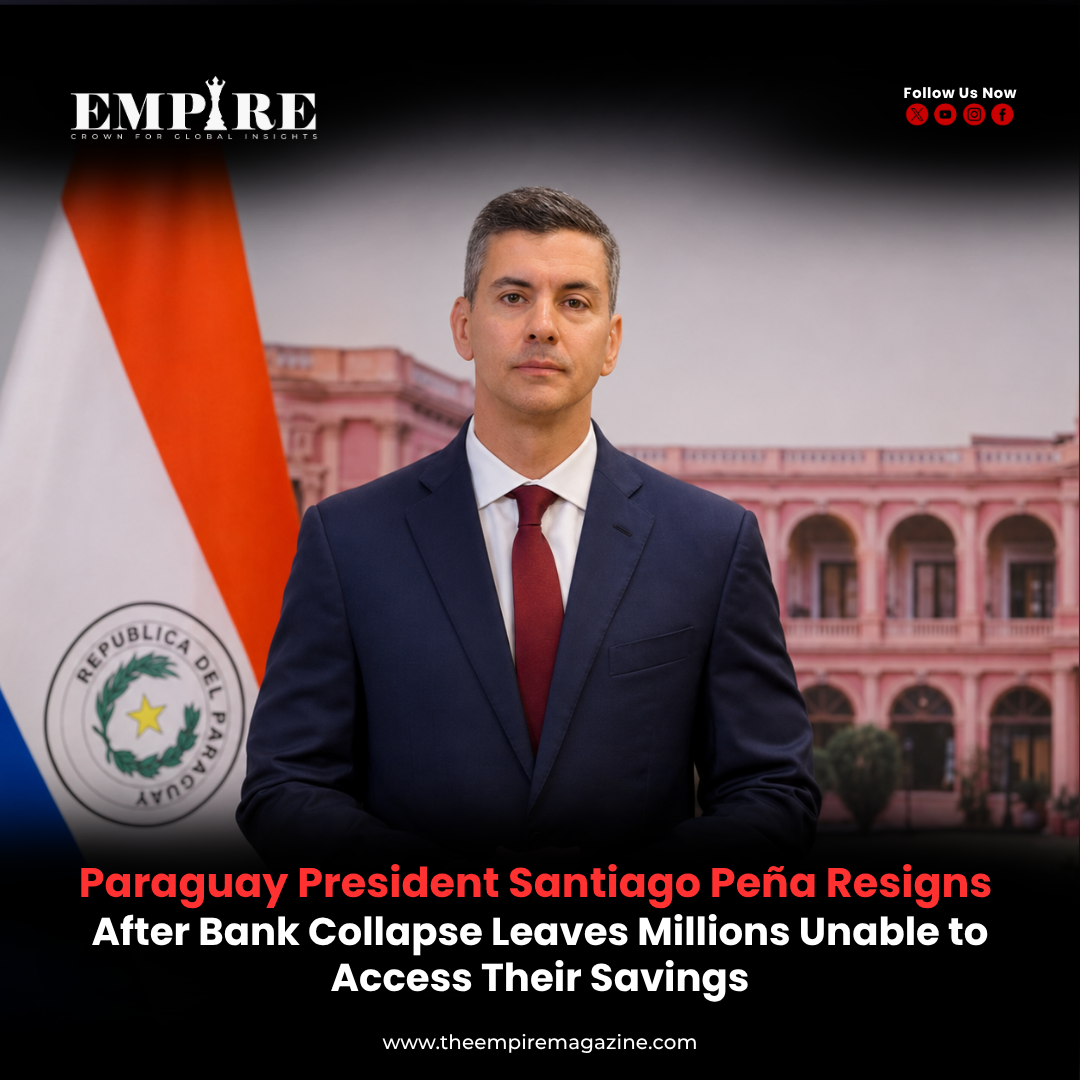
The failure of Ueno Bank has disrupted access to millions of customers’ accounts, triggered protests and placed Paraguay’s political leadership under intense scrutiny.
Reporting checked: 6 November 2026
Santiago Peña has submitted his resignation as Paraguay’s president Santiago Peña following a banking crisis that left millions of Ueno Bank customers unable to access their accounts. Santiago Peña announcement on 5 November came as lawmakers advanced impeachment proceedings and political support for his administration weakened.
However, Santiago Peña departure was not immediately completed. According to the latest reporting reviewed on 6 November, Congress had not accepted his resignation after a joint parliamentary session failed to maintain a quorum. Santiago Peña therefore remained formally in office while the Senate began considering the accusations against him.
The political uncertainty has unfolded alongside an urgent financial problem: restoring access to customers’ money. Initial deposit-guarantee payments have begun for a qualifying group, but the wider recovery process remains ongoing.
What Happened to Ueno Bank?
Paraguay’s central bank announced on 3 November that it was placing Ueno Bank into resolution following a serious capital shortfall.
The Banco Central del Paraguay said adjustments to the lender’s financial statements had pushed its solvency ratio below half the required minimum. Its board had adopted the resolution decision on 2 November.
A solvency requirement concerns the capital a bank must maintain against the risks it carries. Falling substantially below that requirement raises questions about its ability to absorb losses.
The resolution process is intended to manage the failed institution, protect depositors within the applicable framework and limit disruption to the financial system.
Ueno’s importance made the intervention particularly consequential. The lender served approximately 2.94 million customers, giving the crisis a reach far beyond a small group of investors.
Millions Face Disrupted Access to Their Money
Following the intervention, Ueno’s app, card payments and transfers stopped working, while customers encountered closed branches and difficulties withdrawing their savings.
For people who relied on the bank for everyday spending, the disruption created immediate problems. An account balance offers little practical security when its holder cannot use it to buy necessities or make payments.
Public demonstrations followed, with depositors, retirees, students and workers demanding answers and the return of their money.
However, losing access to an account does not establish that the entire balance has been permanently lost. The amount and timing of recovery depend on the repayment arrangements, applicable guarantees and the resolution process.
That distinction is especially relevant now that authorities have started arranging payments for an initial group of customers.
Why Santiago Peña Faces Impeachment
The banking failure became a political crisis because of allegations involving Santiago Peña previous business interests, regulatory appointments and the placement of public funds.
According to the Chamber of Deputies, the impeachment complaint alleges conflicts of interest connected to his participation in Ueno Holding.
Lawmakers also questioned his appointment of Carlos Carvallo, a former head of Financiera Ueno, to lead the central bank. Further allegations concern the concentration of funds from Paraguay’s social security institution, IPS, at Ueno Bank.
On 5 November, all 78 deputies present voted to advance the impeachment accusation. The governing Colorado Party supported proceedings against Santiago Peña.
These allegations remain distinct from a criminal conviction. Santiago Peña has denied wrongdoing and said he would present arguments and evidence in his defence.
The Senate’s role is to consider the impeachment case and determine whether removal from office is warranted under the constitutional process.
Why the Resignation Did Not Immediately End the Crisis
Announcing a resignation and completing a presidential departure are separate institutional steps.
Santiago Peña submitted his resignation while lawmakers were considering impeachment. However, the joint parliamentary session intended to address that resignation failed to maintain the attendance required to proceed.
The Senate subsequently began impeachment proceedings.
Santiago Peña later said he would exercise his right to defend himself and cooperate with the relevant institutions. He also argued that payments to affected savers should continue independently of the debate over his political future.
For readers following the story, this means the announcement should not be confused with a confirmed transfer of presidential authority.
What Repayments Have Authorities Announced?
On 5 November, the central bank announced the start of guarantee payments for a first group of Ueno depositors.
Its published conditions required customers to:
- Have total deposits of no more than 10 million Paraguayan guaraníes.
- Have no debts with Ueno Bank.
- Hold an active account at another bank or financial institution in Paraguay.
The central bank said customers meeting those conditions would receive their full eligible deposit balance.
It also stated that information about subsequent groups would be announced as the process progressed.
These initial payments are a significant development for qualifying customers. They do not mean that every depositor has already recovered their money or that all larger balances have been resolved.
The next practical milestones are the expansion of payment groups, clear instructions for remaining customers and confirmation of when transfers actually reach recipients.
Public Funds Increase the Stakes
The crisis extends beyond individual savings accounts.
Reporting on Ueno’s finances placed its public-sector deposits at approximately US$800 million to US$850 million. Those holdings included money connected to public institutions and pension and healthcare funds.
That exposure helps explain why the bank’s failure quickly became a national accountability issue.
Questions about public money concern more than where funds were deposited. They also involve who authorised those decisions, what risk assessments were conducted and whether institutions responded adequately to warning signs.
Investigations and parliamentary proceedings will need to establish those responsibilities. Allegations about preferential treatment should not be treated as proven findings before that work is completed.
Key Developments in the Paraguay Banking Crisis
| Date | Development |
|---|---|
| 2 November 2026 | The central bank’s board adopted the decision to begin Ueno Bank’s resolution process. |
| 3 November 2026 | Authorities publicly announced the intervention and identified the lender’s capital shortfall. |
| 5 November 2026 | Santiago Peña submitted his resignation, and the Chamber of Deputies approved the impeachment accusation with 78 votes. |
| 5 November 2026 | The central bank announced guarantee payments for an initial qualifying group of depositors. |
| Latest reporting reviewed on 6 November | Santiago Peña remained formally president, with his resignation unresolved and Senate proceedings underway. |
Does This Mean Paraguay’s Entire Banking System Has Failed?
The central bank has described Ueno’s failure as a problem specific to that institution, rather than a general condition across Paraguay’s financial system.
That is the regulator’s assessment. It does not eliminate the need to monitor confidence, payment disruptions and the handling of public deposits.
A major bank failure can affect trust beyond the institution involved. Clear communication and reliable repayments will therefore matter alongside the legal resolution of Ueno itself.
The available evidence does not justify describing every Paraguayan bank as insolvent or every bank account in the country as frozen.
What Happens Next?
The immediate political question is how the Senate resolves the impeachment proceedings and whether Peña’s resignation is formally addressed.
Vice-President Pedro Alliana is the expected constitutional successor if the presidency becomes vacant. A completed handover should be reported only once it has been confirmed.
For depositors, the priority is more direct: recovering usable access to their money.
The authorities’ handling of repayments, investigations and public funds will shape whether confidence can be restored. Resolving the political leadership question alone will not settle the financial claims of affected households and institutions.
Explore more global business, technology and innovation coverage in The Empire Magazine’s article archive.
Read our related coverage: canva-layoffs-exit-package/
Follow The Empire Magazine:
Facebook | Instagram
The Empire Magazine | Crown For Global Insights