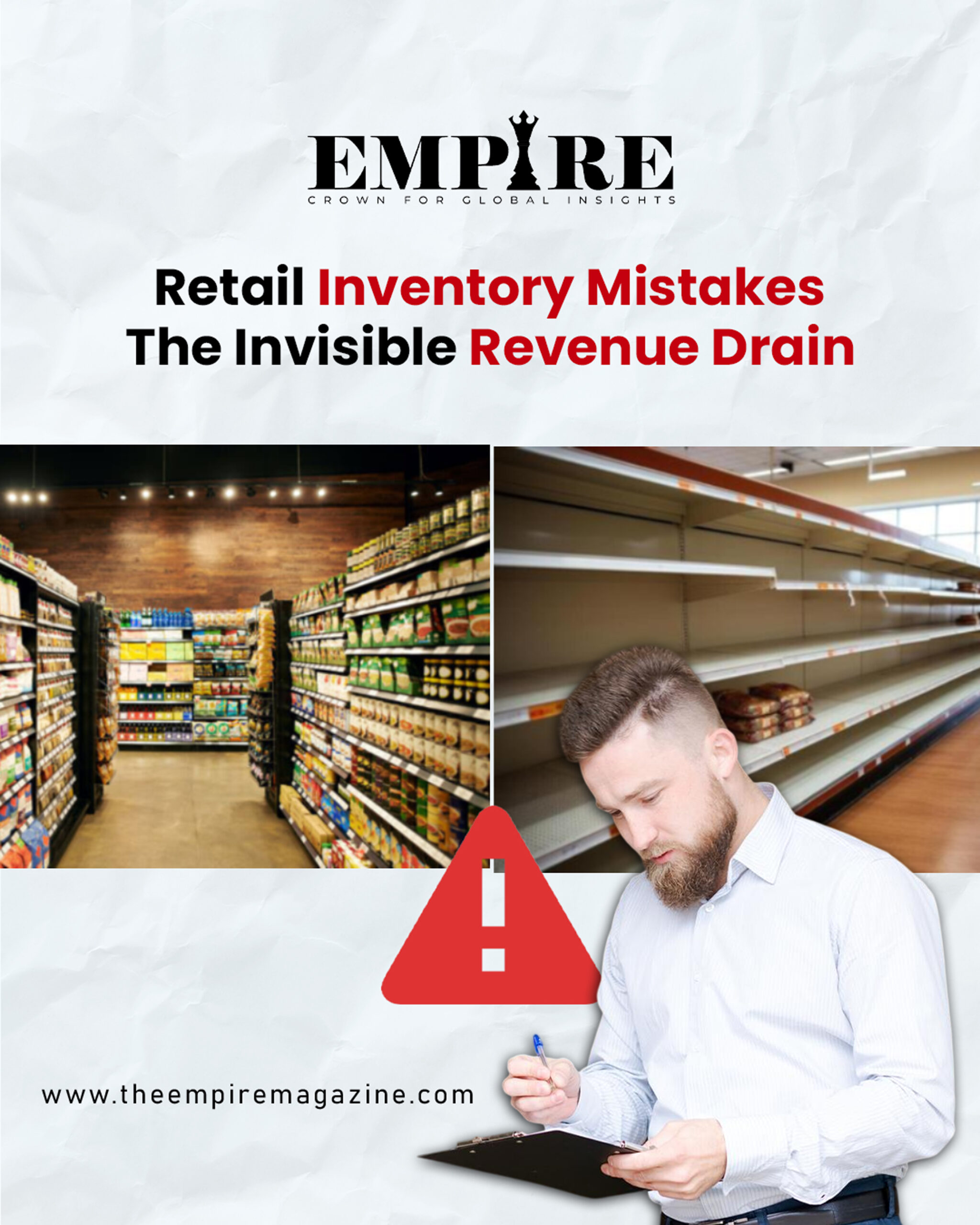
Retail inventory mistakes are the silent killers of your profit margins. You might look at your dashboard and see steady footfall and climbing sales curves, leading you to believe your business is winning. However, in the quiet corners of your warehouse and the blind spots of your store aisles, your hard-earned profit is slowly evaporating.
Today, retail brands do not just lose sales to competitors; they quietly lose between 15% to 25% of their revenue due to internal inefficiencies. This happens not because consumer demand is absent, but because crucial decisions regarding stock allocation and execution go wrong. These hidden barriers operate beneath the surface, gradually eroding your bottom line. To ensure long-term sustainability and maximize your margins, you must understand and eliminate these systemic operational flaws. For deeper insights into optimizing your overarching commercial strategies, be sure to review our comprehensive guide on refining your retail business approach.
Below, we explore the three most damaging retail inventory mistakes and how you can fix them to reclaim your lost revenue.
1. Mismatched Store Assortments
When retailers discuss stock challenges, the conversation often circles back to the planning phase. However, assortment planning is rarely the root cause. Planning teams build highly analytical strategies grounded in historical sales data and demographics. The real problem is assortment accuracy—whether the intended mix of products is actually reflected on the sales floor in the right way.
When an assortment leaves the planning spreadsheet and hits real-world conditions, it often drifts. This merchandising mismatch quietly appears as slower sell-through, unexpected out-of-stocks, and customer frustration. Brick-and-mortar retail used to have a high tolerance for these inefficiencies. If an item was missing, an associate could easily suggest a substitute. Today, that tolerance has vanished due to three factors:
- Less Forgiving Customers: Today’s shoppers know exactly what they want. If they cannot find it, they instantly check their phones and buy it elsewhere. In-store assortments must feel relevant on every single visit.
- Tighter Store Labor: When assortments do not match local demand, associates try to compensate by flexing products to fill empty shelf spaces. These well-intentioned “solutions” disconnect the physical shelf from the original corporate plan.
- Omnichannel Transparency: Customers expect the physical store to mirror what they see online. A missing item feels like a broken promise, heavily punishing your brand’s credibility.
2. The Four Core Inventory Failures
Beyond assortment mismatches, there are core functional retail inventory mistakes that compound daily. They do not look like massive, dramatic failures; rather, they are small, daily inefficiencies that drain your capital.
- Overstocking (The False Sense of Safety): Buying too much product feels safe, but it locks your vital capital into slow-moving items. Eventually, this leads to heavy discounting to clear the stock, resulting in severe margin erosion.
- Understocking (The Invisible Loss): When bestsellers run out mid-season, you lose customers who may never return. You do not see this loss in your daily sales reports, but your competitors are gladly capturing your missed demand.
- Wrong Channel Allocation: Sometimes, the stock exists, but it is in the wrong place. Having inventory sit idle in a warehouse while store shelves go empty—or seeing online demand surge while products are trapped in physical stores—is a catastrophic misallocation of resources.
- Late Reorders: Data comes in late, decisions are delayed, and suppliers miss the delivery window. Timing kills more revenue than bad forecasting ever could.
3. Shrinkage: The Ghost in the Machine
Perhaps the most insidious of all retail inventory mistakes is shrinkage. Shrinkage is any loss of stock that occurs between the point of manufacture and the point of sale. While the average retailer loses roughly 1.5% of their revenue to shrinkage, the mathematical reality is brutal: if your net margin is 10%, a 1.5% loss in inventory means you just lost 15% of your total take-home profit.
Shrinkage is not merely a security problem; it is a manifestation of operational chaos. It occurs in three main ways:
- The External Wound (Shoplifting): This is what we see on security cameras. It is the easiest to blame but hard to stop without ruining the shopping experience.
- The Internal Betrayal (Employee Theft): This is a failure of corporate culture and operational oversight.
- The Papercut (Administrative Errors): This is the ultimate silent killer. A typo at the receiving dock, a miscounted pallet, or a cashier scanning a “Large” shirt instead of a missing “Medium” shirt to keep the line moving.
These administrative errors create “ghost inventory.” Your AI replenishment software thinks you have four units of a high-demand item left, so it decides not to reorder. In reality, the shelf is empty. You are now trapped in a death spiral of out-of-stocks, losing sales on products you think you have while paying storage costs for products that do not exist.
Reclaiming Your Retail Margins
How do you stop these ghosts and correct these massive retail inventory mistakes? You must shift from being reactive to predictive, replacing manual guesswork with automated, data-driven actions.
- Cycle Counts Over Annual Audits: Do not wait for an end-of-year autopsy to discover your losses. Conduct regular, surprise cycle counts. Precision in stock management is a muscle; if it is not exercised daily, it weakens.
- Use AI for Localization: Stop treating all store clusters the same. Use artificial intelligence to localize assortments based on real shopper missions and dynamic purchasing patterns, rather than broad geographic averages.
- Close the Plan-to-Shelf Gap: Real-time visibility is the ultimate fix. Utilize execution platforms that validate shelf reality through photo-based confirmation, ensuring the store matches the original corporate intent.
- Build an Ownership Mentality: Treat your workforce as vital partners. When teams understand that shrinkage negatively affects the survival of the store and their own bonuses, they become a highly effective security and accuracy system.
Stop looking only at your sales numbers. Take a hard look at your missing, misallocated, and mismatched items. Because your store could be highly profitable on paper, and still be dying in the aisles.
Connect with us for more insights:
- Instagram: Follow us on Instagram
- Facebook: Join our Facebook Community
- Website: www.theempiremagazine.com
– The Empire Magazine
Crown For Global Insights