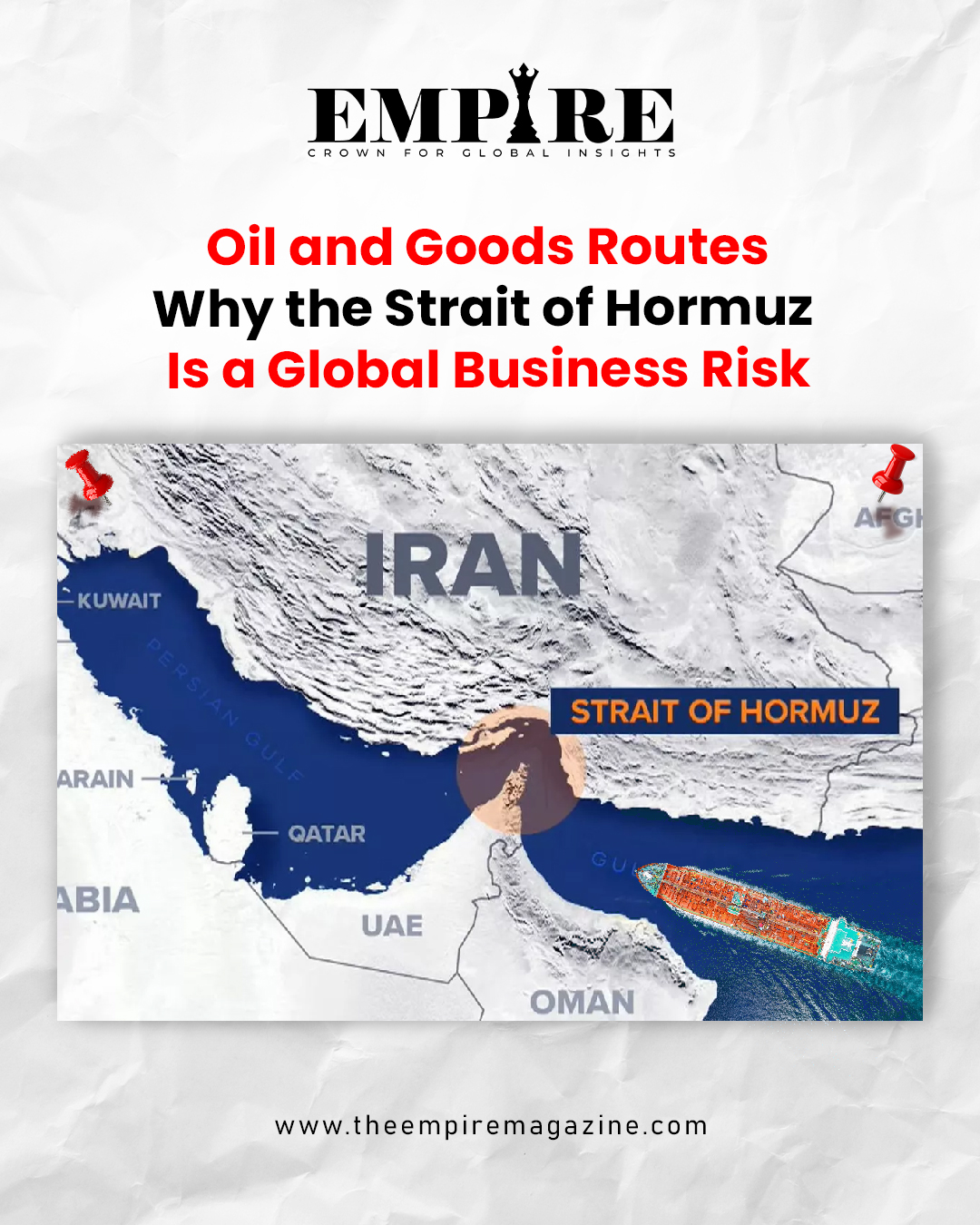
Oil and Goods Routes are central to global trade, and few routes matter more than the Strait of Hormuz. This narrow waterway between Iran and Oman connects the Persian Gulf with the Gulf of Oman and the Arabian Sea. It is one of the world’s most important energy chokepoints because large volumes of oil, liquefied natural gas, chemicals, and other goods move through it every day.
The Strait of Hormuz is not just a regional shipping lane. It is a global business risk because disruption in this route can affect energy prices, shipping costs, insurance premiums, supply chains, inflation, and business planning across the world. Automakers, airlines, retailers, manufacturers, logistics firms, energy companies, and governments all watch the strait closely because it connects Middle East energy producers with major markets in Asia, Europe, and beyond.
In 2024, oil flows through the Strait of Hormuz averaged about 20 million barrels per day, equal to around 20% of global petroleum liquids consumption. That scale explains why even the threat of disruption can move markets quickly.
Oil and Goods Routes and the Importance of the Strait of Hormuz
Oil and Goods Routes are often discussed when global supply chains face pressure, but the Strait of Hormuz stands in a category of its own. It is a chokepoint, meaning a narrow route where large volumes of trade must pass through a limited geographic space. If the route is blocked, delayed, or considered unsafe, businesses cannot easily replace it.
The strait is deep enough and wide enough to handle some of the world’s largest crude oil tankers. It is used by energy exporters including Saudi Arabia, Iraq, Kuwait, Qatar, the United Arab Emirates, and Iran. For many countries, especially in Asia, energy imports from the Gulf are essential for transport, electricity, manufacturing, chemicals, and consumer goods production.
This makes the strait more than a shipping route. It is a foundation of global energy security. When tension rises in the area, companies begin planning for higher costs, delayed cargoes, rerouted shipments, and possible supply shortages.
Why the Strait of Hormuz Matters for Oil Markets
The Strait of Hormuz matters because oil markets are highly sensitive to supply risk. Crude oil is priced globally, so disruption in one major region can affect buyers everywhere. Even countries that do not directly import oil through Hormuz can feel the impact through higher benchmark prices.
Oil passing through the strait supports refineries, petrochemical plants, aviation fuel production, shipping fuel markets, and industrial activity. If fewer tankers move through the route, buyers may need to seek alternative supply from other regions. That can increase competition for available barrels and raise prices.
The problem is that alternatives are limited. Some Gulf producers have pipelines that can move oil outside the strait, but these routes cannot fully replace the massive daily volume that normally travels by sea. That is why the Strait of Hormuz remains one of the most closely watched energy chokepoints in the world.
LNG and Energy Security
Oil is not the only concern. Liquefied natural gas, or LNG, is also exposed to Hormuz risk. Qatar is one of the world’s largest LNG exporters, and almost all of its LNG shipments pass through the Strait of Hormuz. This makes the route important for countries that rely on Qatari gas, especially in Asia and Europe.
LNG is used for electricity generation, heating, industrial production, and energy security. If LNG shipments are delayed or rerouted, buyers may face higher prices or supply uncertainty. For countries with limited storage or high seasonal demand, even temporary disruption can create pressure.
This is why the Strait of Hormuz is not only an oil story. It is also a natural gas, electricity, and industrial-cost story.
Goods, Fertilizers, and Wider Trade Exposure
The Strait of Hormuz also affects goods routes beyond crude oil and LNG. Ships moving through the region carry chemicals, fertilizers, industrial inputs, and consumer goods. Reports have noted that a significant share of global fertilizer materials, including sulphur and ammonia, can be linked to the route.
Fertilizers matter because they support agriculture and food production. If fertilizer shipments face delays or price increases, farmers and food supply chains may feel the impact. Higher fertilizer costs can eventually affect food prices, especially in import-dependent markets.
Consumer goods can also be affected when shipping routes are disrupted. Logistics companies may need to change vessel destinations, move cargo overland, or use alternative ports. These changes can raise costs and create delays for retailers and importers.
Why Importers Face Higher Costs
When the Strait of Hormuz becomes risky, importers face multiple cost pressures at once. Shipping companies may charge more because routes become uncertain. Insurance premiums can rise sharply because vessels entering high-risk waters need war-risk coverage. Ports may become congested as cargo is redirected. Overland transport can become more expensive than ocean freight.
Perishable goods create another problem. Food, pharmaceuticals, flowers, and temperature-sensitive goods cannot wait indefinitely. If shipping schedules become unreliable, companies may need to use faster but more expensive air freight or shift supply from other markets.
This is why Hormuz disruption can affect business margins even when products are not directly related to oil.
Insurance and Shipping Risk
Insurance is one of the fastest ways geopolitical risk becomes a business cost. When tensions rise near the Strait of Hormuz, insurers may increase premiums or restrict war-risk coverage. This makes it more expensive for vessels to enter the region.
Higher insurance costs affect tanker operators, cargo owners, energy companies, and ultimately customers. If a ship owner must pay more to cover risk, that cost can be passed through the supply chain. In some cases, vessels may avoid the route entirely if the risk becomes too high.
Shipping risk also affects scheduling. Companies need reliable arrival times to manage inventory, factory production, and customer delivery. When vessels slow down, reroute, or wait for safer conditions, businesses lose predictability.
Geopolitical Tension and Market Reaction
The Strait of Hormuz has been at the center of geopolitical tension for decades. Iran has previously threatened to block the route during periods of conflict and sanctions pressure. Vessels have also been attacked, seized, or disrupted near the strait in different episodes.
Because of this history, markets react quickly to new threats. Oil prices may rise, shipping rates may increase, and companies may begin emergency planning even before a full closure happens. The risk itself becomes part of the cost.
Recent conflict in the region has shown how quickly shipping flows can be disrupted. Reports in 2026 described tanker traffic falling sharply, vessels going “dark” by switching off tracking systems, and businesses trying to reroute cargo. These developments make it harder for traders and companies to assess real supply conditions.
Why “Dark” Shipping Creates More Uncertainty
When vessels turn off their Automatic Identification System, or AIS, tracking becomes harder. Ships may do this to reduce security risk, avoid detection, or operate under sanctions pressure. However, dark shipping creates uncertainty for energy traders, insurers, governments, and buyers.
If fewer vessels are visible, markets may not know how much oil or LNG is actually moving. This can distort price signals and make planning harder. Companies may overestimate or underestimate available supply, creating more volatility.
For global business leaders, uncertainty is often as damaging as disruption. When companies cannot see where goods are, when they will arrive, or what costs will be, decision-making becomes more difficult.
Business Impact Across Industries
The Strait of Hormuz affects many industries because energy is built into nearly every business cost. Airlines are exposed through jet fuel. Shipping companies are exposed through marine fuel. Manufacturers are exposed through electricity, chemicals, and transport costs. Retailers are exposed through product delivery and consumer inflation.
Automakers may face higher costs for plastics, chemicals, electronics logistics, and fuel-sensitive transport. Food companies may face higher fertilizer and shipping costs. Energy-intensive industries such as metals, cement, chemicals, and glass can be affected by oil and gas price movements.
Financial markets also watch the strait closely. Energy price shocks can affect inflation expectations, central bank decisions, stock markets, and currency movements. That makes Hormuz not only a logistics risk but also a macroeconomic risk.
Why Resilience Planning Is Now Essential
Business leaders are rethinking resilience because the Strait of Hormuz shows how one narrow route can affect the global economy. Companies cannot control geopolitics, but they can prepare for disruption.
Resilience planning may include diversifying suppliers, increasing safety stock, using alternative ports, reviewing transport routes, securing long-term freight contracts, and improving supply chain visibility. Energy buyers may also use hedging strategies to manage price risk.
For companies dependent on Gulf energy or goods, scenario planning is essential. They need to understand what happens if shipping slows for days, weeks, or months. They also need to know which products, suppliers, and customers would be affected first.
The Role of Alternative Routes
Alternative routes can reduce risk, but they cannot fully replace the Strait of Hormuz. Some Gulf countries have pipelines that move oil to ports outside the strait. The United Arab Emirates has export capacity through Fujairah, and Saudi Arabia has pipeline routes toward the Red Sea.
However, these alternatives have limited capacity compared with the full volume normally passing through Hormuz. They also do not solve every problem for LNG, fertilizers, and containerized goods. This means the strait remains difficult to replace.
For global companies, the lesson is clear: alternative routes can help, but they are not a complete solution.
Why the Strait of Hormuz Remains a Global Business Risk
Oil and Goods Routes through the Strait of Hormuz remain a global business risk because the world still depends heavily on Middle East energy and maritime trade. The route connects producers and consumers across continents, and its disruption can affect prices far beyond the Gulf.
The risk is not only about whether the strait fully closes. Even partial disruption, higher insurance costs, dark shipping, port delays, or rerouting can raise business costs. In a world already dealing with inflation, supply chain stress, and geopolitical uncertainty, Hormuz adds another layer of pressure.
For business leaders, the Strait of Hormuz is a reminder that global trade depends on physical routes that can become fragile. Digital systems, financial markets, and modern supply chains still rely on ships moving safely through narrow waterways.
Readers can also explore more climate technology and business insights through this related article: Climeworks: The Climate Tech Startup Capturing Carbon From Air.
For more updates from The Empire Magazine, follow us on Facebook and Instagram.
– The Empire Magazine
Crown For Global Insights