
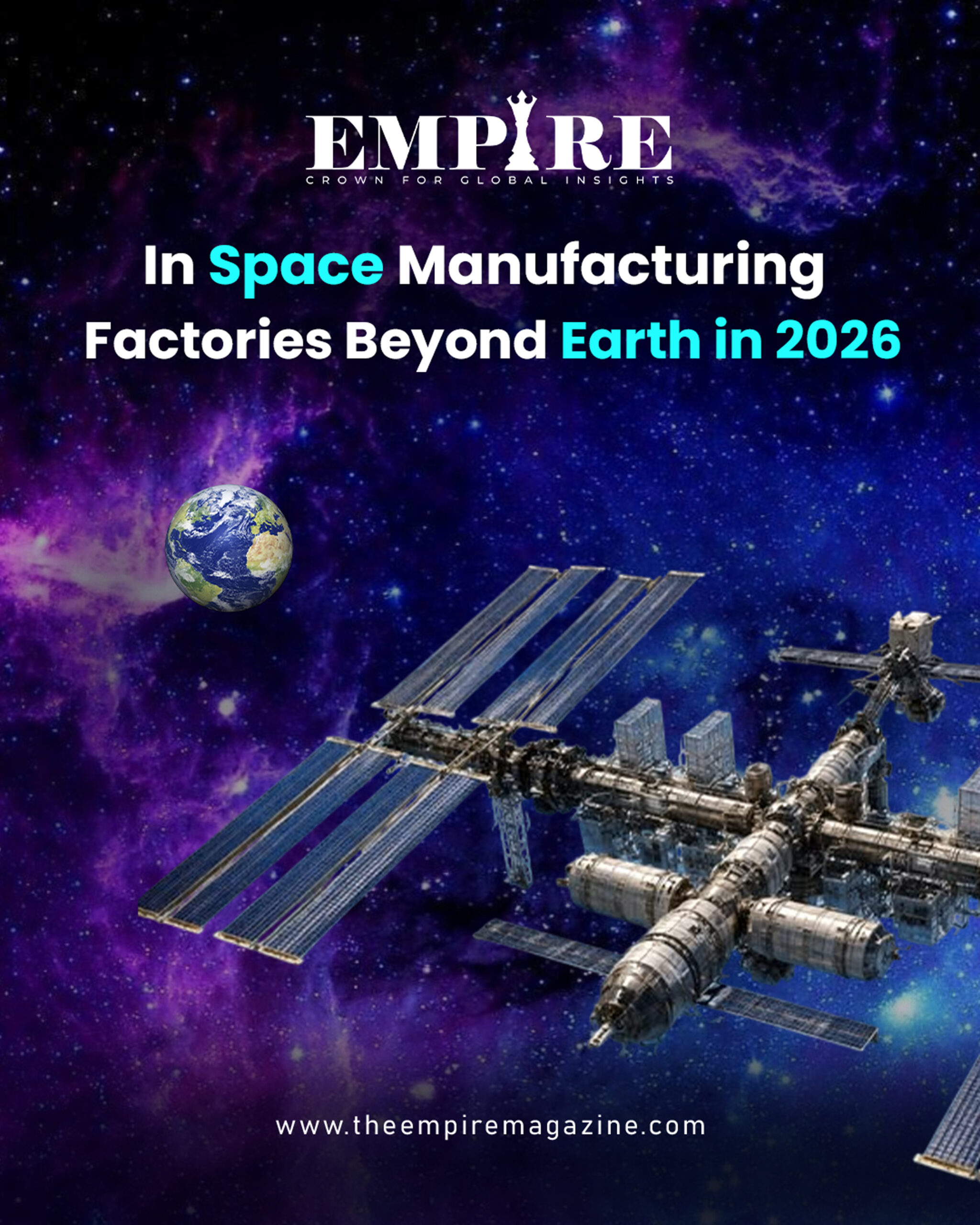
In-Space Manufacturing is rapidly transitioning from concept to reality in 2026. Companies and space agencies are building actual factories in orbit, leveraging the unique conditions of microgravity to produce materials, pharmaceuticals, and components that are difficult or impossible to make on Earth.
What is In-Space Manufacturing?
In-space manufacturing refers to the production of goods in the microgravity environment of space, primarily in Low Earth Orbit (LEO). Unlike terrestrial manufacturing, which is limited by gravity, space offers near-zero gravity, extreme temperatures, and a vacuum environment. These conditions enable the creation of superior crystals, alloys, optical fibers, and biological materials with unprecedented purity and structure.
In 2026, the sector is experiencing accelerated growth as reusable rockets have dramatically reduced launch costs, making orbital production economically viable for the first time.
Key Advantages of Manufacturing in Space
1. Superior Material Quality In microgravity, materials solidify without sedimentation or convection currents. This results in perfectly uniform crystals, flawless optical fibers, and stronger alloys. For example, ZBLAN optical fibers manufactured in space can transmit data with significantly lower signal loss than Earth-made versions.
2. Advanced Pharmaceuticals Space manufacturing allows for the creation of protein crystals with higher quality and uniformity. These crystals are crucial for developing more effective drugs, especially for cancer treatments and complex diseases. Several pharmaceutical companies are now conducting regular experiments on orbital platforms.
3. Innovative Alloys and Composites Without gravity, molten metals mix more evenly, enabling the development of new high-performance alloys for aerospace, electronics, and medical implants.
4. 3D Printing and On-Demand Production Orbital 3D printing facilities can produce spare parts for satellites and space stations directly in space, reducing dependency on expensive resupply missions from Earth.
Major Players and Projects in 2026
Multiple companies are actively developing in-space manufacturing capabilities. Private space stations designed as mixed-use research and production platforms are under construction. Some facilities focus on high-value, low-volume products like semiconductor crystals and specialized optics, while others experiment with larger-scale manufacturing.
Space stations are increasingly being designed with dedicated manufacturing modules equipped with robotic systems, automated labs, and advanced 3D printers. These facilities operate with minimal human intervention, relying heavily on AI and remote control from Earth.
Current Applications and Success Stories
In 2026, several commercial in-space manufacturing projects have moved beyond experimental phases:
- Optical Fibers: Companies are producing kilometers of high-quality ZBLAN fiber for telecommunications and medical lasers.
- Protein Crystallization: Pharmaceutical firms are growing protein crystals for drug development in orbit.
- Metal Alloys: New lightweight, high-strength alloys are being developed for next-generation aircraft and spacecraft.
- Tissue Engineering: Research into growing human tissues and organoids in microgravity shows promising results for regenerative medicine.
The ability to manufacture in space is also proving valuable for on-orbit assembly of large structures, such as solar power arrays and satellite components.
Economic and Strategic Impact
The economics of in-space manufacturing have improved significantly. Reusable launch vehicles have reduced transportation costs, while the high value-per-kilogram of space-manufactured products makes many processes commercially attractive.
This emerging industry is creating new supply chains that extend beyond Earth. Future space economies may rely on in-space manufacturing for everything from satellite maintenance to building habitats on the Moon and Mars.
Governments and private companies view in-space manufacturing as strategically important. It reduces reliance on Earth-based supply chains for critical space operations and opens new frontiers for economic growth in the space sector.
Technological Enablers
Several technologies are making in-space manufacturing possible at scale:
- Advanced robotics and autonomous systems
- AI-powered process control and quality monitoring
- Improved power generation through high-efficiency solar arrays
- Better thermal management systems for industrial processes in vacuum
- Reusable spacecraft for frequent cargo return to Earth
Challenges Facing In-Space Manufacturing
Despite rapid progress, several hurdles remain:
- High initial setup and operational costs
- Limited return capacity to Earth for finished products
- Technical challenges in managing fluids and materials in microgravity
- Regulatory frameworks for commercial space manufacturing are still evolving
- Need for reliable, long-duration power sources
Engineers are actively working on solutions, including larger orbital platforms and improved re-entry vehicles for product return.
Future Outlook for 2026 and Beyond
By the end of 2026 and into 2027, experts expect the first dedicated commercial in-space manufacturing facilities to begin regular operations. The focus will initially remain on high-value, low-mass products, but over time, larger-scale manufacturing could become feasible.
The long-term vision includes using resources from the Moon and asteroids as raw materials, creating a truly self-sustaining space economy. In-space manufacturing will be a foundational pillar of this future, enabling everything from large-scale space infrastructure to new industries we cannot yet imagine.
Conclusion
In-Space Manufacturing: Factories Beyond Earth in 2026 marks the beginning of a new industrial revolution — one that extends humanity’s manufacturing capabilities beyond our planet. What was once pure science fiction is now becoming an emerging business sector with enormous potential.
As technology matures and costs continue to decline, in-space manufacturing could transform multiple Earth-based industries while creating entirely new ones in orbit. The factories of the future may not just be on Earth — they will also float silently above it, producing materials that improve life for people on our home planet.
For more technology and innovation insights, explore related coverage here: Internal Link.
Follow The Empire Magazine on Instagram and Facebook for the latest updates.
– The Empire Magazine
Crown For Global Insights