Genspark.ai Reaches $2.6 B: Why Investors Are Racing Toward the Future of AI
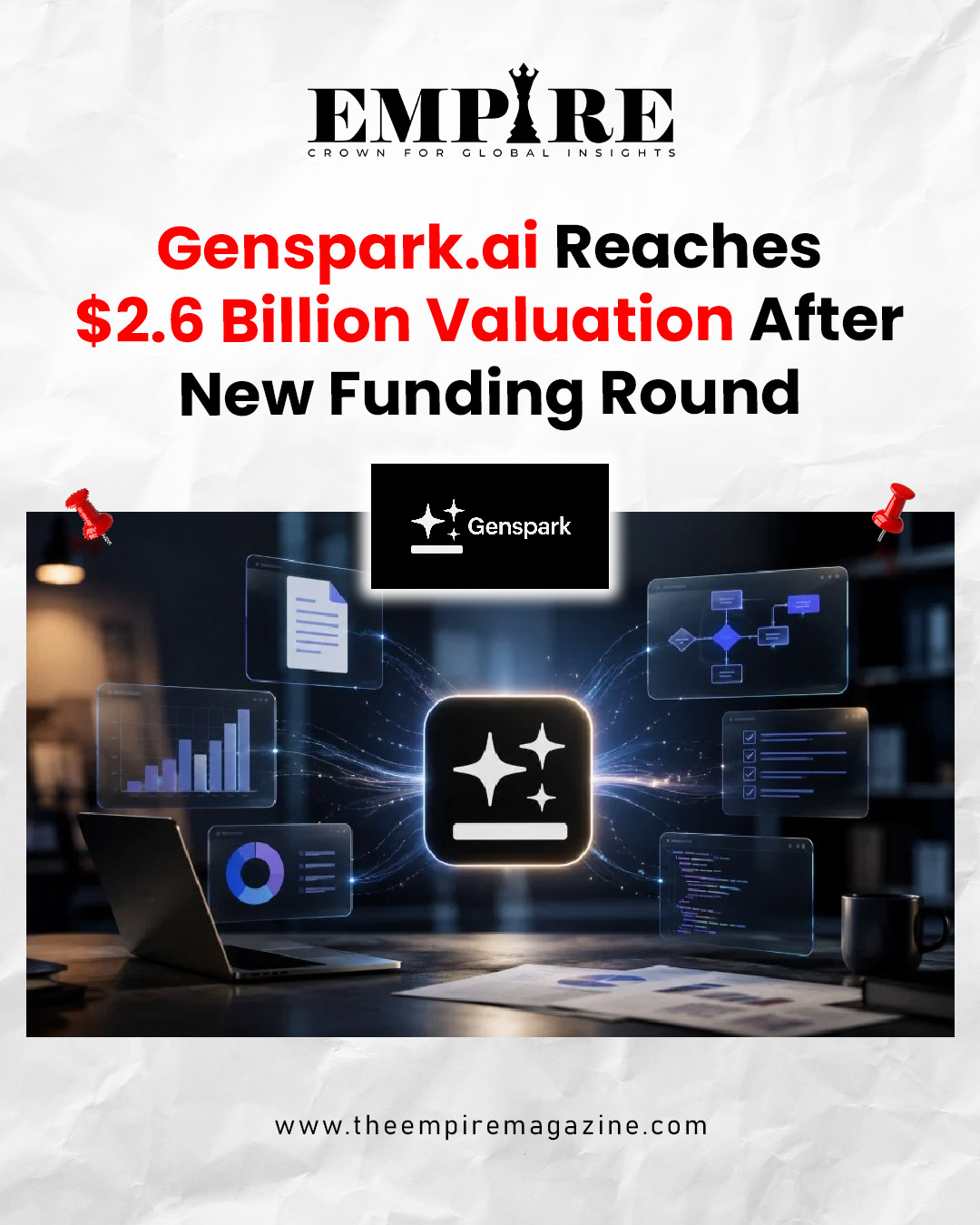
Artificial intelligence has entered a new phase. The race is no longer just about building smarter chatbots, it is about creating AI systems that can actually complete work from start to finish. That shift has turned a relatively young startup, Genspark.ai, into one of Silicon Valley’s fastest-growing companies. The Palo Alto-based AI startup has now reached a remarkable $2.6 billion valuation after raising an additional $100 million in an extended Series B funding round, highlighting how aggressively investors are backing companies that promise to redefine workplace productivity. The latest investment brings Genspark’s total Series B funding to nearly $485 million, with existing investors including Sozo Ventures, Korea Mirae Asset, and UpHonest Capital continuing to increase their bets on the company. Reports suggest the company wasn’t actively seeking more capital; instead, the extension was driven largely by overwhelming investor demand following rapid business growth. That kind of enthusiasm reflects a much broader trend unfolding across the global technology landscape. Venture capital has shifted from simply funding AI models to investing in platforms that combine multiple AI systems into practical business tools. Founded by former engineers from Microsoft, Google, Meta, Pinterest, and YouTube, Genspark has positioned itself at the center of this transformation by building an AI workspace capable of handling presentations, financial models, research reports, coding projects, and numerous enterprise workflows with minimal human intervention. While the valuation itself has attracted headlines, the bigger story lies in what it says about the future of work. Investors increasingly believe that companies enabling AI-powered execution, not just conversation, will define the next generation of enterprise software, making Genspark one of the most closely watched startups in the rapidly expanding AI economy.
Why Investors Are Betting Big on AI Workspaces like Genspark.ai
The excitement surrounding Genspark is not happening in isolation. Over the past year, global venture capital has poured billions into startups building what industry experts call “agentic AI”, systems capable of independently performing complex, multi-step tasks rather than merely responding to prompts. Unlike traditional AI assistants that generate text or answer questions, Genspark orchestrates more than 70 AI models to transform a business objective into a finished product. A simple request like “prepare a quarterly sales presentation” can result in research, spreadsheets, visual slides, financial analysis, and supporting documents without users needing to switch between different applications. This approach significantly reduces repetitive work for knowledge professionals and aligns with what many enterprises now want from AI: tangible productivity gains rather than experimental technology. The company’s rapid growth reportedly added substantial annual recurring revenue within months of launch, convincing investors that businesses are willing to pay for AI systems capable of delivering measurable efficiency improvements. The latest funding also arrives at a time when enterprises worldwide are under pressure to improve productivity while managing rising operational costs. Instead of replacing employees, many organizations are seeking AI that complements existing teams by handling routine tasks, allowing human workers to focus on decision-making, creativity, and customer relationships. This practical positioning has made Genspark especially attractive to investors looking beyond today’s AI hype toward long-term enterprise adoption. Its success also signals growing confidence that AI-native workplaces could eventually become as fundamental to businesses as cloud computing became over the past decade.
How Genspark Is Challenging the Biggest AI Companies
The rise of Genspark illustrates how quickly the competitive landscape of artificial intelligence is evolving. While companies like OpenAI, Google, Microsoft, Anthropic, and Meta continue competing to build the world’s most capable AI models, a new category of startups is emerging with a different objective: making those models actually useful inside everyday business operations. Rather than relying on a single large language model, Genspark combines multiple AI systems, choosing the most appropriate model for each task. This “mixture of agents” strategy enables the platform to balance speed, cost, and performance while reducing dependence on any one AI provider. It also allows businesses to complete entire workflows inside one integrated environment instead of juggling separate AI tools for writing, coding, designing, and research. That distinction has become one of Genspark’s biggest competitive advantages. Investors increasingly view application-layer AI companies as potentially more valuable than model developers because they build lasting customer relationships and generate recurring enterprise revenue. The company has also strengthened its leadership team as it prepares for broader enterprise expansion, reflecting ambitions that stretch well beyond startup status. Nevertheless, competition remains intense. Tech giants continue embedding AI into products used by billions of people, while countless startups are introducing their own AI workspaces, autonomous agents, and productivity platforms. Success for Genspark will therefore depend not only on technological innovation but also on execution, reliability, security, and its ability to convince enterprises that adopting an entirely AI-native workflow is worth the transition. In an industry moving at extraordinary speed, maintaining momentum may prove even more challenging than achieving it in the first place.
Genspark.ai: What This Means for Businesses, Workers, and the AI Industry
For business leaders, Genspark’s latest funding round represents much more than another billion-dollar startup announcement, it signals how enterprise software itself is beginning to change. Traditional workplace applications have largely required employees to manually coordinate multiple tools for writing documents, building presentations, analyzing spreadsheets, communicating with teams, and conducting research. AI-native workspaces promise to consolidate those activities into a single intelligent platform capable of executing complete workflows. If these systems continue improving, organizations may dramatically reduce the time spent on repetitive administrative tasks while accelerating project delivery across departments. Employees, meanwhile, are likely to experience a workplace where AI functions less like a search engine and more like a digital colleague capable of independently completing assignments. That shift will inevitably reshape job roles, emphasizing strategic thinking, creativity, oversight, and human judgment over repetitive execution. At the same time, it raises important questions about workforce adaptation, responsible AI governance, cybersecurity, and the skills future professionals will require. Regulators and enterprises alike are paying increasing attention to issues surrounding data privacy, AI transparency, and operational accountability as more decision-making becomes automated. For investors, Genspark’s soaring valuation reinforces a growing belief that the next wave of AI winners will be companies capable of turning cutting-edge models into practical business outcomes. Rather than rewarding AI for its novelty alone, the market increasingly values platforms that solve everyday problems and generate measurable returns for enterprise customers.
The Road Ahead for Genspark.ai
Reaching a $2.6 billion valuation is undoubtedly a significant milestone, but it also raises expectations that few startups can comfortably ignore. The fresh capital provides Genspark with resources to accelerate product development, expand global operations, strengthen enterprise sales, and invest in infrastructure capable of supporting increasingly sophisticated AI workloads. Yet maintaining such rapid growth will require more than attracting investors, it will require consistently delivering value to customers in an increasingly crowded AI marketplace. Large technology companies possess enormous financial resources, global customer networks, and integrated software ecosystems that make competition exceptionally challenging. At the same time, enterprises adopting AI are becoming more selective, demanding stronger security, regulatory compliance, reliability, and measurable return on investment before deploying AI across mission-critical operations. Genspark therefore enters its next phase carrying both remarkable opportunity and significant responsibility. Its journey reflects the broader transformation taking place across the technology sector, where AI is evolving from a fascinating experiment into an essential layer of modern business infrastructure. Whether Genspark ultimately becomes one of the defining enterprise software companies of the AI era remains to be seen, but its extraordinary rise already offers a clear message about where innovation, investment, and the future of work are headed. As organizations worldwide search for smarter ways to operate, startups capable of turning artificial intelligence into real-world productivity may become some of the most valuable companies of the coming decade. Genspark’s latest funding round suggests many investors believe that future has already begun.
For more business and retail insights, read more on The Empire Magazine
Previous article: AI Boom vs Oil Shocks: Global Markets
Magazine Feautures | Podcasts: Empire Global Talks
Follow The Empire Magazine on Facebook | Instagram | LinkedIn
The Empire Magazine | Crown for Global Insights