EU–India Relations and the Free Trade Deal
A Strategic Partnership Shaping the Future of Global Trade
The relationship between the European Union and India has entered a decisive phase, marked by renewed momentum toward a long-awaited Free Trade Agreement (FTA). As global supply chains realign and geopolitical priorities evolve, EU–India cooperation is increasingly seen as a cornerstone of economic stability, innovation, and sustainable growth in the 21st century.
With negotiations revived after years of stagnation, the proposed EU–India Free Trade Deal represents more than a trade pact—it reflects a broader strategic convergence between two of the world’s largest democratic economies.
Evolution of EU–India Relations
EU–India relations date back to the early 1960s, but cooperation deepened significantly after the establishment of the EU–India Strategic Partnership in 2004. Since then, collaboration has expanded across trade, climate action, digital transformation, education, research, and security.
The European Union is one of India’s largest trading partners, while India is a key market for European companies seeking growth beyond traditional economies. Annual bilateral trade in goods and services exceeds hundreds of billions of euros, yet both sides believe the relationship remains under-leveraged given their combined economic potential.
The EU–India Free Trade Agreement: An Overview
Negotiations for the EU–India Free Trade Agreement were initially launched in 2007 but stalled in 2013 due to differences over market access, tariffs, intellectual property rights, labor standards, and environmental regulations.
In response to shifting global dynamics—including supply chain disruptions, rising protectionism, and strategic competition—the talks were officially relaunched in 2022 with a renewed sense of urgency and pragmatism.
The negotiations are structured around three parallel tracks:
- A Free Trade Agreement (FTA)
- An Investment Protection Agreement
- A Geographical Indications (GI) Agreement
Key Objectives of the Free Trade Deal
1. Tariff Reduction and Market Access
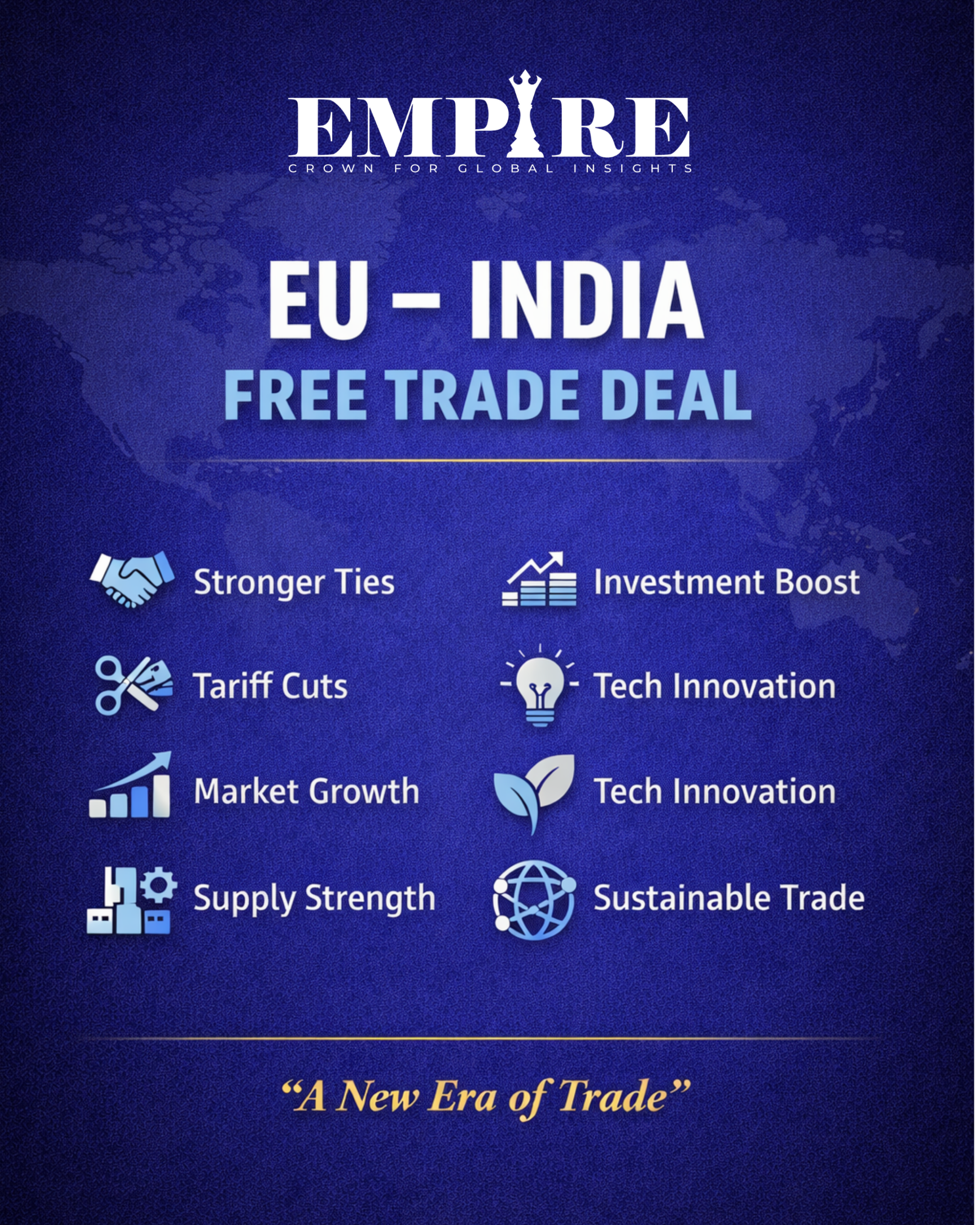
The agreement aims to significantly reduce or eliminate tariffs on a wide range of goods. Indian exports such as textiles, pharmaceuticals, engineering goods, and agricultural products stand to gain improved access to European markets. In return, EU companies seek lower tariffs on automobiles, machinery, wines, spirits, and high-value manufactured goods entering India.
2. Services and Digital Trade
Both sides are focused on expanding trade in services, including IT, financial services, professional services, and digital commerce. India’s strength in technology and skilled labor aligns with Europe’s demand for digital transformation and innovation.
3. Investment and Supply Chain Resilience
The deal is expected to boost foreign direct investment by providing regulatory certainty and investment protection. European firms are increasingly looking at India as a manufacturing and sourcing hub, supporting the EU’s strategy to diversify supply chains away from over-dependence on single regions.
Strategic and Geopolitical Importance
Beyond economics, the EU–India Free Trade Deal carries significant geopolitical weight. Both partners share a commitment to democratic values, rule-based international order, and multilateralism.
As global power balances shift, closer EU–India ties serve as a counterweight to economic coercion and fragmented trade systems. Cooperation in areas such as clean energy, critical minerals, green hydrogen, and sustainable infrastructure aligns with shared climate goals and long-term resilience.
Sustainability, Labor, and Regulatory Challenges
One of the most complex aspects of the negotiations lies in aligning regulatory frameworks. The European Union places strong emphasis on labor rights, environmental protection, and sustainability standards, while India prioritizes development flexibility and domestic industry protection.
Balancing these concerns remains a challenge, particularly in areas like carbon regulations, data protection, and public procurement. However, ongoing dialogue suggests a growing willingness on both sides to seek pragmatic, phased solutions rather than rigid positions.
Opportunities for India and the European Union
For India, the agreement could:
- Enhance export competitiveness
- Attract high-quality European investment
- Support manufacturing, employment, and technology transfer
For the European Union, it offers:
- Access to one of the world’s fastest-growing major economies
- New opportunities for businesses amid slowing growth elsewhere
- Stronger strategic presence in the Indo-Pacific region
The Road Ahead
While negotiations are complex and timelines remain fluid, political commitment at the highest levels signals optimism. A successful EU–India Free Trade Deal would rank among the most ambitious trade agreements globally, reshaping economic engagement between Europe and South Asia for decades to come.
As both partners navigate global uncertainty, the EU–India relationship stands poised to evolve from a promising partnership into a defining alliance of the modern global economy.
The Empire Magazine
Crown for Global Insights