Energy companies are signing long-term electricity contracts to power AI data centers, reshaping global energy markets, infrastructure investments, and the future of artificial intelligence.
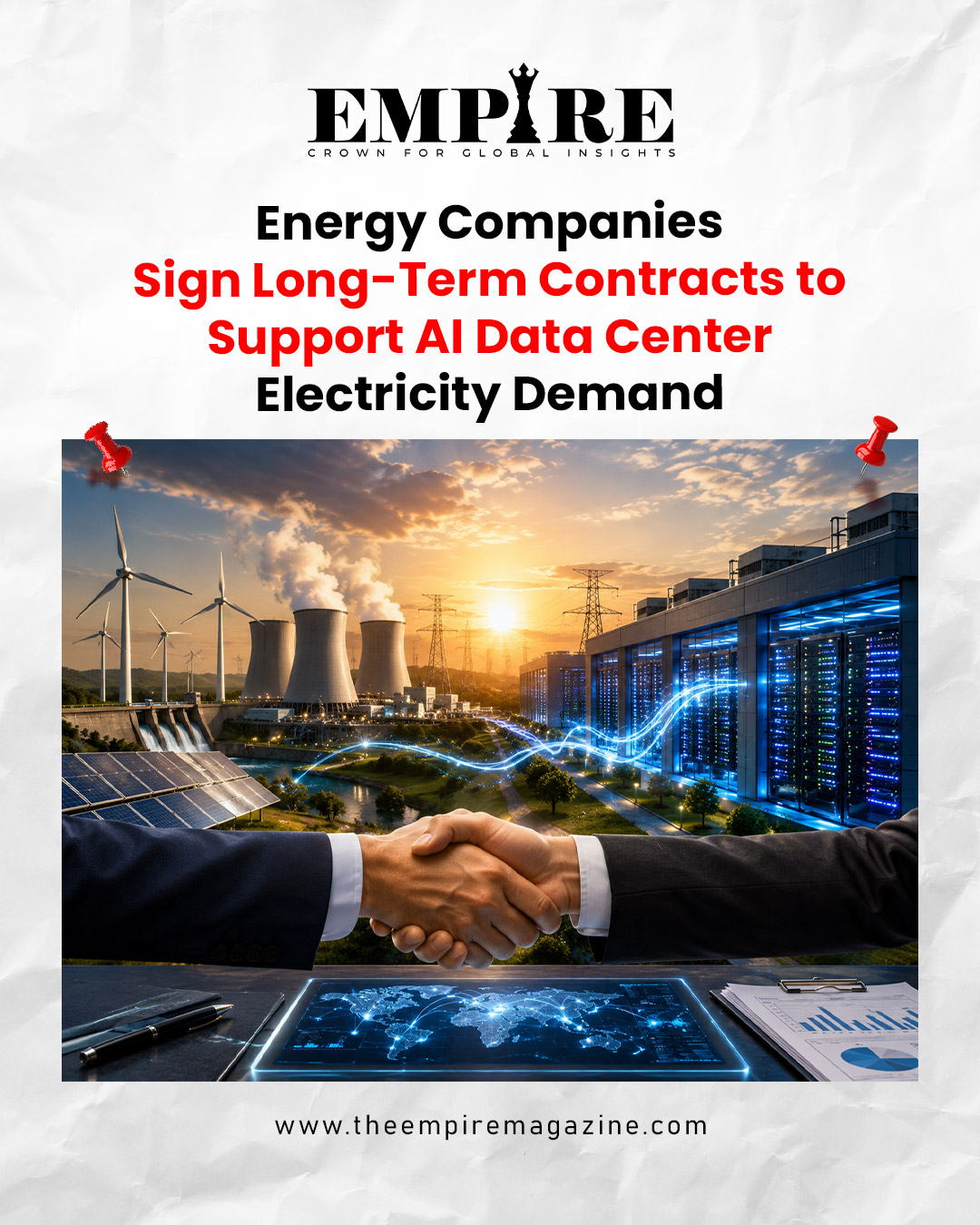
Energy Companies Sign Long-Term Contracts to Support AI Data Center Electricity Demand
Artificial intelligence is transforming industries at an unprecedented pace, but behind every AI breakthrough lies a challenge that receives far less attention, electricity. As companies race to develop larger AI models, expand cloud computing infrastructure, and deploy generative AI applications worldwide, the demand for reliable power has become one of the defining business stories of the decade. Today, energy companies are signing long-term electricity agreements with technology giants to ensure that AI data centers continue operating without interruption. These partnerships are not merely commercial contracts; they represent a fundamental shift in how the global energy and technology sectors will evolve together over the coming years.
From Microsoft and Google to Amazon Web Services, Meta, Oracle, and emerging AI infrastructure providers, technology companies are investing billions of dollars into hyperscale data centers capable of training increasingly sophisticated AI systems. These facilities consume enormous quantities of electricity around the clock, forcing utilities and energy producers to rethink capacity planning, renewable investments, nuclear generation, and transmission infrastructure. At the same time, governments are encouraging public-private collaboration to modernize aging power grids while maintaining energy security and meeting sustainability commitments.
The Growing Energy Companies AI Data Center Electricity Demand
The explosive growth of artificial intelligence has dramatically increased electricity consumption across the digital economy. Unlike traditional enterprise computing, AI model training requires thousands of high-performance graphics processing units (GPUs) operating continuously for weeks or even months. Every prompt entered into an AI chatbot, every automated business process, and every machine learning model deployed in healthcare, finance, manufacturing, or logistics depends on data centers that require uninterrupted electrical power. Industry analysts estimate that global data center electricity demand could more than double during the next decade, making AI one of the fastest-growing consumers of energy worldwide. As a result, energy companies are proactively securing multi-year supply agreements that provide predictable revenue while allowing technology firms to expand operations without concerns over power shortages. These contracts are becoming increasingly important because AI infrastructure investments often extend over ten to twenty years, requiring equally long-term commitments from electricity providers that can guarantee stable generation capacity and future grid availability.
Why Long-Term Energy Contracts Are Becoming Essential
Long-term electricity contracts are rapidly becoming the preferred strategy for both energy producers and technology companies because they reduce uncertainty for every stakeholder involved. Technology firms receive guaranteed access to power at negotiated prices, helping them manage operating costs despite volatile energy markets. Energy companies, meanwhile, secure dependable revenue streams that justify investments in new power plants, renewable energy facilities, transmission networks, and storage technologies. These agreements also simplify financing, as investors are more willing to support billion-dollar infrastructure projects backed by long-duration purchase commitments from financially strong customers. In recent years, several major technology companies have announced partnerships with utilities, renewable developers, and even nuclear operators to secure future electricity supplies. Such collaborations demonstrate that electricity is no longer viewed simply as an operational expense but as a strategic asset that directly influences AI competitiveness, cloud expansion, and digital transformation initiatives across industries worldwide.
Renewable Energy Powers the AI Revolution
Sustainability has become an equally important factor in the rapidly growing relationship between energy companies and AI infrastructure providers. Most leading technology firms have committed to ambitious carbon reduction targets, making renewable energy procurement central to every new data center project. Solar farms, wind parks, hydroelectric stations, battery storage systems, geothermal facilities, and next-generation nuclear technologies are increasingly being integrated into long-term power agreements to support cleaner AI operations. Energy companies are responding by accelerating investments in renewable generation while developing hybrid energy portfolios capable of supplying reliable electricity throughout varying weather conditions. Rather than depending on a single source, many providers are combining renewable energy with battery storage and flexible backup generation to maintain continuous operations. This diversified approach not only supports sustainability goals but also strengthens grid resilience as AI data centers continue expanding into new geographic regions where electricity demand is growing faster than traditional infrastructure can accommodate.
AI Data Center Electricity Demand Reshapes Global Infrastructure
The rapid expansion of AI data centers is influencing infrastructure planning far beyond the technology sector. Governments, regulators, utility companies, construction firms, semiconductor manufacturers, and equipment suppliers are increasingly coordinating investments to meet future electricity requirements. New transmission lines, substations, high-voltage distribution systems, and smart grid technologies are being developed to connect energy generation facilities with hyperscale data centers located across North America, Europe, Asia-Pacific, and the Middle East. Regions offering abundant renewable resources, supportive regulatory environments, and reliable power infrastructure are becoming attractive destinations for new AI investments. This trend is also creating significant employment opportunities across engineering, construction, electrical maintenance, renewable energy development, and digital infrastructure management. For many countries, attracting AI infrastructure has become part of broader economic development strategies aimed at strengthening technological leadership while encouraging private investment in national energy systems.
Challenges Behind AI Data Center Electricity Demand by Energy Companies
Despite enormous investment opportunities, the growing electricity requirements of AI infrastructure also present complex challenges. Existing power grids in many countries were designed decades ago and now face increasing pressure as electricity demand rises across transportation, manufacturing, residential electrification, and artificial intelligence simultaneously. Utilities must balance the needs of industrial customers with those of households while ensuring affordability and maintaining system reliability. Environmental concerns also remain significant, particularly in regions where fossil fuel generation still represents a substantial share of electricity production. Although renewable energy capacity continues expanding rapidly, intermittent generation requires complementary storage technologies and modern transmission infrastructure capable of delivering electricity where it is needed most. In addition, permitting processes for new power plants and transmission projects often take several years, potentially slowing the pace of AI infrastructure expansion. These realities highlight why long-term planning between governments, utilities, investors, and technology companies is becoming increasingly important for ensuring sustainable growth.
What Energy Companies AI Data Center Electricity Demand Means for the Future
Looking ahead, the relationship between energy companies and AI developers is expected to deepen considerably as artificial intelligence becomes integrated into virtually every sector of the global economy. Future data centers are likely to become more energy-efficient through advanced cooling systems, AI-driven power management, and next-generation semiconductor technologies that deliver higher computational performance with lower electricity consumption. Nevertheless, overall electricity demand will continue rising because the scale of AI deployment is expanding even faster than efficiency improvements. Long-term contracts will therefore remain a cornerstone of digital infrastructure development, encouraging investments in renewable generation, advanced nuclear energy, carbon capture technologies, battery storage, and intelligent grid management. Energy companies that successfully adapt to these evolving market requirements are likely to become strategic partners in the AI economy rather than traditional utility providers. Likewise, technology firms capable of securing reliable, affordable, and sustainable electricity will gain a significant competitive advantage in delivering AI services to businesses and consumers worldwide.
Relationship between the energy and technology industries
The rise of artificial intelligence has fundamentally altered the relationship between the energy and technology industries. What was once considered a routine utility service has become one of the most strategic resources driving digital innovation. Long-term electricity contracts between energy companies and technology providers are enabling the construction of the next generation of AI data centers while supporting investments in renewable energy, modern power infrastructure, and grid resilience. Although challenges surrounding electricity availability, sustainability, and infrastructure expansion remain, these partnerships are creating a roadmap for balancing rapid technological advancement with responsible energy development. As AI continues reshaping economies and industries across the globe, reliable electricity will become just as critical as computing power itself. The companies capable of aligning innovation with sustainable energy strategies will be best positioned to lead the next era of global technological transformation.
How Energy Contracts Reduce AI Data Center Electricity Risk
As AI data center electricity demand continues to surge, long-term energy contracts are becoming critical tools for managing operational and financial risk. These agreements, often spanning 10 to 25 years, allow technology companies to lock in electricity prices while ensuring uninterrupted access to power for mission-critical AI workloads. For energy providers, these contracts guarantee predictable revenue streams that support investments in new generation capacity, including solar farms, wind parks, nuclear facilities, natural gas plants, and battery storage systems. The growing dependence on long-term power purchase agreements (PPAs) demonstrates that reliable electricity has become just as valuable as computing infrastructure in sustaining the AI economy, making energy contracts a strategic foundation for digital transformation worldwide.
Energy Contracts Accelerate AI Infrastructure Growth
The expansion of AI data center electricity demand is also reshaping how energy companies plan future infrastructure investments. Instead of responding to electricity consumption after demand increases, utilities are now developing generation projects alongside AI data center construction through long-term energy contracts. This coordinated approach enables faster grid expansion, reduces supply uncertainty, and attracts billions of dollars in private investment into renewable energy, transmission networks, and smart grid technologies. As artificial intelligence becomes central to cloud computing, healthcare, finance, manufacturing, and government services, long-term electricity agreements are emerging as one of the most important drivers of sustainable AI infrastructure growth, ensuring that innovation is supported by secure, reliable, and scalable energy supplies.
For more business and retail insights, read more on The Empire Magazine
Previous article: https://theempiremagazine.com/healthcare-ai/
Magazine Feautures | Podcasts: Empire Global Talks
Follow The Empire Magazine on Facebook | Instagram | LinkedIn | YouTube
The Empire Magazine | Crown for Global Insights