The global economic landscape is undergoing a profound shift. The BRICS vs G7 rivalry has evolved from a simple comparison of economic blocs into a symbol of the broader transition toward a multipolar world. While the G7 represents established Western industrial powers, BRICS embodies the rising influence of emerging economies. As of 2026, this divide is widening in terms of growth rates, population, and long-term potential, even as the G7 maintains advantages in nominal wealth and technology.
Understanding the Two Blocs
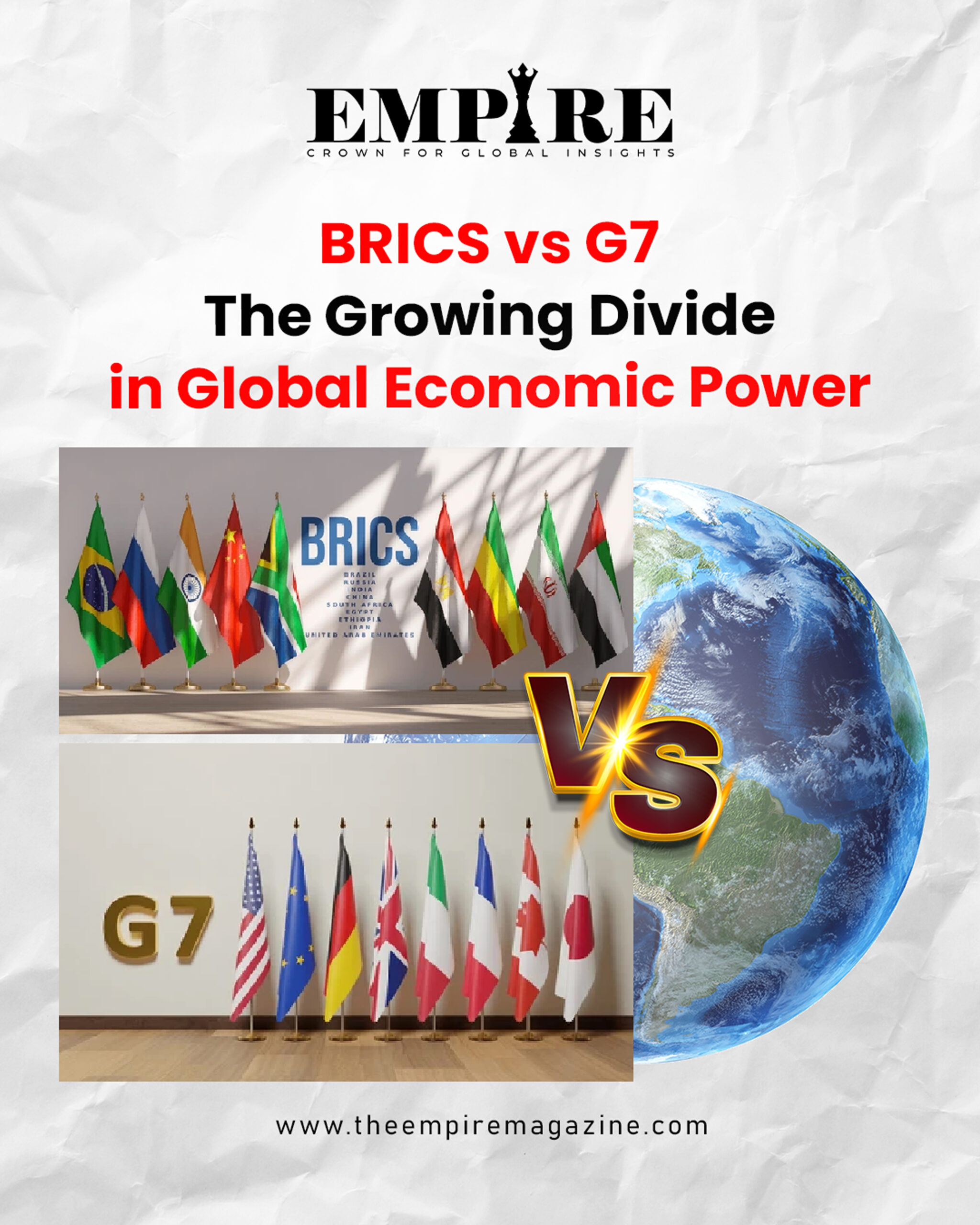
The G7 consists of seven advanced economies: the United States, Canada, United Kingdom, France, Germany, Italy, and Japan. Formed in the 1970s, it has traditionally dominated global economic governance through institutions like the IMF and World Bank.
BRICS, originally comprising Brazil, Russia, India, China, and South Africa, has expanded significantly. By 2026, it includes Egypt, Ethiopia, Iran, UAE, and Indonesia as full members. The bloc now represents a powerful alliance of emerging markets challenging the established order.
Economic Size and GDP Comparison
In nominal GDP terms, the G7 still holds a lead with approximately $54.5 trillion compared to BRICS’ roughly $33–35 trillion in 2026. The United States alone accounts for a massive portion of G7 output.
However, when measured by Purchasing Power Parity (PPP) — which better reflects actual economic output and living standards — BRICS has overtaken the G7. BRICS now accounts for around 40–41% of global GDP (PPP), while the G7 represents about 28–30%. This marks a historic reversal from two decades ago when G7 nations dominated global output.
China and India are the primary drivers of BRICS’ rise. China remains the world’s second-largest economy, while India continues its strong momentum as one of the fastest-growing major economies.
Growth Rates: BRICS Pulling Ahead
One of the clearest aspects of the BRICS vs G7 divide is the difference in growth trajectories. In 2026, BRICS nations are projected to achieve an average GDP growth of around 3.7%, more than three times higher than the G7’s projected 1.1–1.2%.
Key growth highlights for 2026 include:
- Ethiopia: ~7.1%
- India: ~6.2%
- UAE and Indonesia: ~5%
- China: ~4.2%
In contrast, most G7 economies are expected to grow below 2%, with the United States performing relatively better at around 2.1%, while European members and Japan face slower expansion due to aging populations and structural challenges.
Population and Market Potential
BRICS holds a massive demographic advantage, representing nearly 45–46% of the world’s population. This translates into a vast consumer market and labor force. The G7, by comparison, accounts for only about 10% of global population.
This demographic edge gives BRICS significant long-term advantages in consumption, innovation, and economic resilience, though it also brings challenges related to poverty alleviation and infrastructure development.
Trade, Resources, and Global Influence
BRICS countries dominate global production of critical commodities, including oil, rare earth minerals, and agricultural goods. The bloc is also expanding intra-BRICS trade and exploring alternatives to the US dollar, such as local currency settlements and the New Development Bank.
The G7 maintains superiority in:
- Advanced technology and innovation
- Financial systems and capital markets
- Soft power and established global institutions
However, BRICS is actively challenging this dominance through initiatives like de-dollarization efforts, alternative payment systems, and greater influence in the Global South.
Key Drivers of the Growing Divide
- Economic Momentum — Emerging markets in BRICS benefit from urbanization, digital transformation, and a rising middle class.
- Expansion Strategy — BRICS’ inclusive approach has attracted new members seeking alternatives to Western-led institutions.
- Policy Focus — BRICS emphasizes infrastructure, South-South cooperation, and multipolarity, while G7 focuses on sustainability, technology standards, and coordinated sanctions.
- Geopolitical Tensions — Events like the Russia-Ukraine conflict and US-China strategic competition have accelerated the bloc’s push for greater independence.
Challenges for Both Blocs
For BRICS: Internal differences in political systems, economic models, and priorities can slow decision-making. Managing rapid growth while addressing inequality and climate goals remains complex.
For G7: Aging populations, high debt levels, and slower productivity growth pose structural risks. The bloc must adapt to a world where its relative economic weight is declining.
The Road Ahead for BRICS vs G7
The growing divide does not necessarily mean outright confrontation. Many analysts see opportunities for cooperation on global issues like climate change, pandemic preparedness, and artificial intelligence regulation.
By 2030, projections suggest BRICS’ share of global GDP (PPP) will continue expanding, potentially reshaping international financial architecture, trade rules, and governance forums.
The BRICS vs G7 dynamic reflects a fundamental rebalancing of global economic power. While the G7 remains a powerhouse of innovation and stability, BRICS represents the energy, scale, and ambition of the Global South.
This evolving competition — and occasional collaboration — will significantly influence the global economy, investment flows, and geopolitical alignments in the coming decades.
For more inspiring stories of leadership, technology, and global affairs, read our detailed coverage here.
Follow The Empire Magazine for more updates on business, startups, technology, and global insights: Instagram | Facebook
– The Empire Magazine
Crown For Global Insights