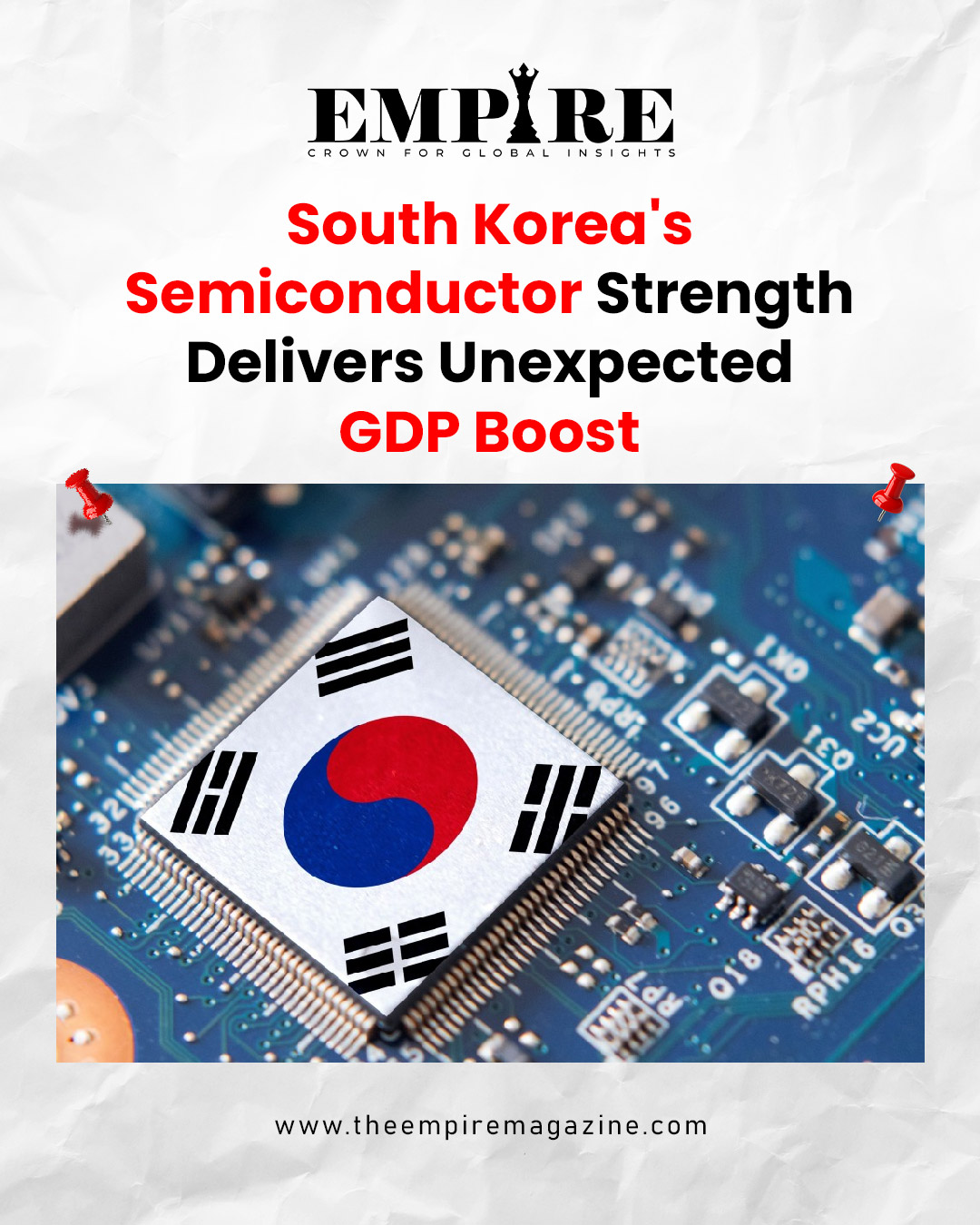
South Korea’s semiconductor industry powers stronger-than-expected GDP growth, highlighting the global importance of AI chips, exports, and innovation. South Korea’s semiconductor strength has become the biggest driver behind the country’s stronger-than-expected GDP growth. Rising global demand for AI chips, high-bandwidth memory, and advanced semiconductors has revived exports, boosted industrial production, and reinforced South Korea’s position as one of the world’s leading technology economies.
South Korea Semiconductor Strength Lifts Economic Growth
South Korea’s semiconductor strength has once again demonstrated why the country remains one of the world’s most influential technology powerhouses. At a time when economists expected modest economic expansion amid slowing global demand and geopolitical uncertainty, the nation’s latest GDP figures surprised financial markets by posting stronger-than-anticipated growth. Behind this unexpected economic resilience lies a familiar but increasingly important engine—the semiconductor industry. As artificial intelligence transforms industries across the globe, demand for advanced memory chips, AI processors, and data centre infrastructure has accelerated sharply, creating fresh opportunities for South Korean manufacturers. Companies such as Samsung Electronics and SK hynix have benefited from rising orders for high-bandwidth memory (HBM), DRAM, and NAND flash products that are essential for AI servers and cloud computing. The resulting export momentum has strengthened industrial output, improved business confidence, and contributed significantly to national economic performance. More importantly, this growth comes after a challenging period marked by declining chip prices and weakening electronics demand. The turnaround highlights how quickly the semiconductor cycle can influence the broader economy. Investors, policymakers, and businesses are now watching South Korea closely because the country’s economic performance increasingly reflects global technology investment trends. As AI adoption continues to accelerate worldwide, South Korea’s semiconductor ecosystem is emerging not only as a pillar of domestic prosperity but also as a critical foundation supporting the next generation of digital transformation.
South Korea Semiconductor Strength Revives Exports
South Korea semiconductor strength has historically been closely linked with the country’s export performance, and the latest economic data once again confirms this relationship. Semiconductor exports account for a substantial share of South Korea’s overseas shipments, making the industry one of the largest contributors to national income and foreign exchange earnings. During the recent quarter, exports of memory chips and advanced semiconductor products recorded significant year-on-year growth as technology companies worldwide accelerated investments in AI infrastructure. Cloud computing providers, hyperscale data centres, and AI developers have continued purchasing advanced chips capable of supporting increasingly complex machine learning models. This renewed demand has reversed the downturn experienced during the global electronics slowdown and has restored confidence across South Korea’s manufacturing sector. Rising exports have also benefited logistics companies, component suppliers, chemical manufacturers, equipment providers, and thousands of small and medium-sized enterprises that support the semiconductor value chain. The ripple effect has extended beyond factories, improving employment prospects and strengthening regional economies where semiconductor manufacturing facilities operate. Government officials have welcomed the improvement, viewing semiconductor exports as a stabilising force amid ongoing uncertainty in global trade. While consumer spending remains relatively subdued, export-driven growth has compensated for domestic weaknesses, demonstrating how deeply integrated South Korea’s economy is with international technology markets. This export resurgence has therefore become one of the most important reasons behind the country’s stronger GDP performance.
South Korea Semiconductor Strength Benefits from AI Boom
The rapid expansion of artificial intelligence has fundamentally reshaped the semiconductor industry, creating unprecedented demand for high-performance memory and computing solutions. South Korea semiconductor strength has positioned the country at the centre of this technological transformation because its manufacturers dominate several critical segments of the global memory chip market. High-bandwidth memory, widely regarded as an essential component for AI accelerators, has become one of the fastest-growing semiconductor categories in the world. Companies building AI models require enormous processing power, and that processing power depends on advanced memory technologies where South Korean firms maintain global leadership. This competitive advantage has allowed manufacturers to secure premium pricing, improve profit margins, and increase investment in next-generation fabrication facilities. Beyond direct financial gains, AI-driven semiconductor demand has encouraged greater research and development spending, fostering innovation throughout the domestic technology ecosystem. Universities, research institutions, and technology startups are also benefiting from stronger collaboration with major chipmakers, creating an environment that supports long-term competitiveness. International investors increasingly view South Korea as one of the primary beneficiaries of the AI revolution, reinforcing foreign investment flows into technology-related sectors. Although competition from other semiconductor-producing nations continues to intensify, South Korea’s decades of manufacturing expertise, skilled workforce, and technological capabilities provide a strong foundation for sustaining growth in an AI-driven global economy.
South Korea Semiconductor Strength Supports Global Supply Chains
South Korea semiconductor strength extends well beyond its national borders because the country’s chip manufacturers play an indispensable role in global technology supply chains. Modern smartphones, electric vehicles, cloud computing systems, industrial automation platforms, medical equipment, and defence technologies all depend on advanced semiconductor components produced by companies headquartered in South Korea. As governments and multinational corporations seek to diversify semiconductor supply chains following disruptions experienced during the pandemic, South Korea has become an increasingly strategic partner for countries seeking reliable access to advanced chip manufacturing. Major investments in fabrication facilities, advanced packaging technologies, and semiconductor research continue to reinforce the country’s position in the international market. Governments including the United States, European nations, and regional partners have expanded collaboration with South Korean semiconductor firms through investment agreements, research partnerships, and manufacturing incentives. This growing international cooperation not only strengthens supply chain resilience but also creates additional opportunities for South Korean exports and technology leadership. The semiconductor industry’s influence now reaches diplomacy, trade negotiations, and national security discussions, demonstrating how critical advanced chips have become for economic competitiveness. Consequently, South Korea’s semiconductor success increasingly represents more than industrial performance, it reflects the country’s broader strategic importance in an interconnected global economy where technological leadership shapes geopolitical influence.
South Korea Semiconductor Strength Faces Emerging Challenges
Despite the encouraging outlook, South Korea semiconductor strength continues to face several challenges that could influence future growth. Semiconductor markets remain cyclical, with periods of strong demand often followed by corrections in pricing and inventory levels. Rising geopolitical tensions between major economies have introduced uncertainty regarding export controls, technology transfers, and international investment. At the same time, governments around the world are investing heavily in domestic semiconductor production, increasing competitive pressure on established industry leaders. Countries including the United States, China, Japan, and members of the European Union have introduced substantial incentives aimed at expanding local chip manufacturing capabilities. South Korean companies must therefore continue investing aggressively in research, production efficiency, and next-generation technologies to preserve their competitive edge. Labour shortages in highly specialised engineering fields and increasing capital expenditure requirements also present long-term challenges. Environmental sustainability has become another important consideration as semiconductor fabrication requires significant energy and water resources. Meeting ambitious climate goals while maintaining manufacturing competitiveness will require continued investment in cleaner technologies and renewable energy integration. Nevertheless, industry analysts believe South Korea’s extensive experience, strong innovation ecosystem, and established customer relationships position it favourably to navigate these evolving risks while maintaining leadership in advanced semiconductor production.
South Korea Semiconductor Strength Signals Long-Term Growth
The latest GDP figures provide more than short-term economic optimism, they reinforce the long-term importance of South Korea semiconductor strength in shaping the country’s future prosperity. As digital transformation accelerates across healthcare, finance, manufacturing, transportation, education, and entertainment, demand for increasingly sophisticated semiconductor technologies is expected to continue rising. Artificial intelligence, autonomous vehicles, robotics, quantum computing, and next-generation telecommunications will all require advanced memory and processing solutions where South Korean manufacturers possess globally recognised expertise. Continued government support through tax incentives, research funding, and infrastructure investment further strengthens the industry’s long-term outlook. Businesses across multiple sectors are also investing in digital innovation, creating sustained demand for semiconductors beyond traditional consumer electronics. This broader diversification reduces dependence on individual market cycles while opening new revenue opportunities for manufacturers. Investors view the semiconductor sector as one of South Korea’s most valuable strategic assets because it combines technological leadership with global export competitiveness. Although short-term volatility remains inevitable, the structural drivers supporting semiconductor demand appear stronger than ever before. The latest economic performance therefore illustrates how technological leadership can translate directly into national economic resilience. South Korea’s experience offers an important lesson for economies worldwide: sustained investment in innovation, advanced manufacturing, and research can create long-term competitive advantages that extend well beyond individual industries.
South Korea’s stronger-than-expected GDP growth
South Korea’s stronger-than-expected GDP growth is more than a positive economic surprise—it is clear evidence of how semiconductor leadership can transform national economic performance. The renewed strength of memory chip exports, supported by the rapid expansion of artificial intelligence and digital infrastructure, has reaffirmed the country’s position as one of the world’s indispensable technology hubs. While geopolitical risks, rising competition, and market cycles remain important considerations, South Korea’s deep expertise, world-class manufacturers, and continued commitment to innovation provide a strong platform for future growth. As AI reshapes industries across the globe, South Korea semiconductor strength is likely to remain one of the defining forces behind both the nation’s economic success and the evolution of the global technology landscape.
For more business and retail insights, read more on The Empire Magazine
Previous article: https://theempiremagazine.com/cipla-fy27-profit/
Magazine Feautures | Podcasts: Empire Global Talks
Follow The Empire Magazine on Facebook | Instagram | LinkedIn | YouTube
The Empire Magazine | Crown for Global Insights