How Andrey Rogachev is redefining financial leadership through cross-cultural intelligence, transparency, strategic risk management and artificial intelligence
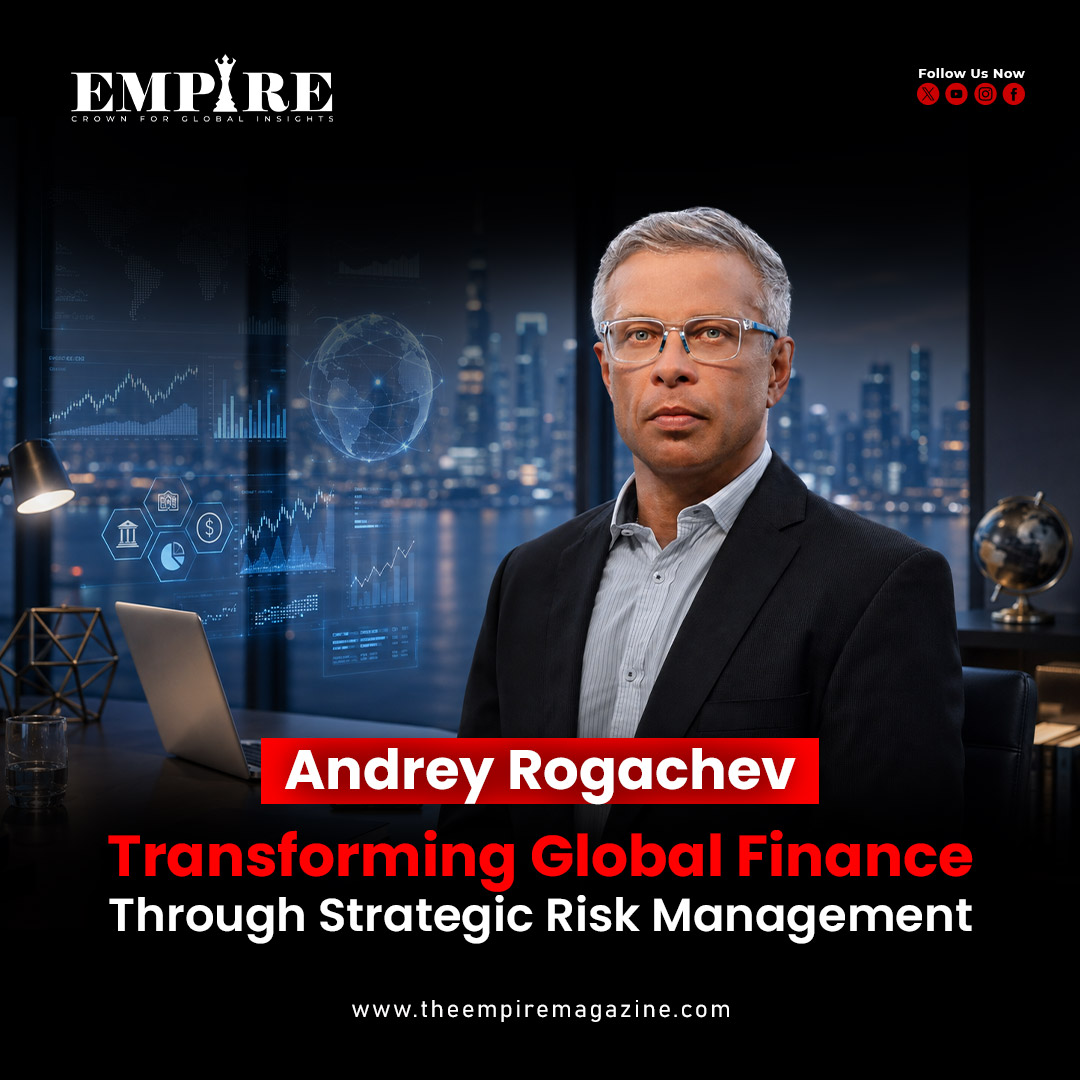
Andrey Rogachev is a global finance and risk management leader with three decades of international experience across the USA, EU, Russia, South Africa and the Middle East. His leadership philosophy combines financial transparency, strategic risk management, cross-cultural intelligence, decisive decision-making and responsible adoption of AI.
Financial leadership has changed dramatically in a world defined by geopolitical uncertainty, regulatory pressure, technological disruption and rapidly shifting markets. For Andrey Rogachev, navigating this environment requires more than financial expertise. It demands the ability to understand risk across cultures, challenge assumptions, act decisively and remain transparent when the numbers are uncomfortable.
With around three decades of experience across global finance and risk management, Prof. Dr. Andrey Rogachev has worked across the USA, European Union, Russia, South Africa and the Middle East. His professional background combines finance, risk management, corporate decision-making, international business and academia. He is qualified in CIMA and Lean Six Sigma Black Belt and is certified as an Independent Director. Today, Andrey Rogachev also teaches and conducts research at universities across four countries, bringing together practical financial experience and academic insight.
His perspective is shaped by a simple understanding: financial risk is never completely universal. It is influenced by markets, regulations, cultures, business models and human decisions.
That philosophy has become central to his approach to modern financial leadership.
Andrey Rogachev on the Future of Global Finance and Risk Management
For Andrey Rogachev, the modern finance function is no longer limited to reporting financial results. Finance has become a strategic navigator for organizations operating in complex markets.
Financial data tells leaders where a business stands. Margins, liquidity, profitability, costs and cash flows provide an objective picture of organizational performance. But the real value of finance comes when leaders use that information to make better decisions. This is where strategic risk management becomes critical.
Businesses today operate under constantly changing conditions. Regulations can shift. Geopolitical developments can disrupt markets. Customer behavior can change. Technology can transform entire industries.
A successful finance leader therefore needs to understand not only what happened yesterday but also what could happen tomorrow. Andrey Rogachev’s international career has reinforced this perspective. Working across multiple regions taught him that financial stability can look very different depending on the market in which it is measured.
Andrey Rogachev Explains Why Risk Is Different Across Markets
One of the strongest insights from Andrey Rogachev is that risk must always be understood in context. A financial model that works effectively in one country may not produce the same results in another.
Different markets operate under different regulatory systems, economic conditions, political environments and cultural expectations. Even the way businesses perceive uncertainty can vary significantly. According to Andrey Rogachev, some markets may demonstrate a more cautious approach to uncertainty, while others may have a higher appetite for risk.
This means international finance leaders cannot simply copy a strategy from one market and apply it unchanged somewhere else.
Cross-border financial leadership requires observation, adaptability and continuous learning. Geopolitical and regulatory risks are also highly regional. A risk framework developed for one jurisdiction may overlook important vulnerabilities in another.
For Andrey Rogachev, this is why experience alone is not enough. Leaders must remain curious. They need to keep learning about new markets, new regulations, new business cultures and new forms of risk.
Andrey Rogachev Challenges the Myth of Low-Risk Business Models
One of the more distinctive perspectives in Andrey Rogachev’s approach to risk management is his warning against assuming that asset-light businesses are automatically safer.
At first glance, an asset-light company may appear less exposed to risk because it owns fewer physical assets and requires less infrastructure.
But the absence of physical assets does not eliminate financial risk. Instead, risk can move into less visible areas. Businesses may become dependent on third parties, platforms, liquidity conditions, technology providers, intermediaries, regulatory permissions or specific market structures. These dependencies may remain hidden until market conditions change.
That is why Andrey Rogachev believes financial leaders need to look beyond the obvious structure of a business. A company that appears simple on a balance sheet can have a highly complex underlying risk profile.
For strategic risk management, understanding these hidden dependencies can be more valuable than simply identifying traditional balance-sheet risks.
Cross-Cultural Finance Requires More Than Financial Expertise
Global finance is also about people. Andrey Rogachev’s experience across different regions has shown him that cultural intelligence can directly influence financial and business outcomes.
The way relationships are built, trust is established and negotiations are conducted can vary dramatically between markets.
His experience in the Middle East, for example, highlighted cultural differences in relationship-building. In some Arab business environments, personal conversation and relationship development can be an important foundation for professional cooperation. In Nordic European environments, professional and personal boundaries may be more clearly separated.
Neither approach is inherently better. The lesson for international leaders is to understand the environment before assuming that a familiar approach will work. For Andrey Rogachev, cultural awareness therefore becomes another component of risk management.
A leader who misunderstands the culture surrounding a business relationship may overlook a critical variable in the decision-making process.
Andrey Rogachev Believes Financial Transparency Builds Stronger Businesses
Financial transparency is another major theme in Andrey Rogachev’s leadership philosophy.
He views finance as a navigator because numbers provide an objective representation of an organization’s condition. A financial statement does not need to be persuasive. It simply reflects what the business has achieved. The difficulty arises when the numbers reveal uncomfortable realities.
Poor performance, declining margins, weak decisions or operational inefficiencies can create pressure for leaders who would rather present a more positive picture. Andrey Rogachev argues that avoiding uncomfortable financial information creates greater risk. Organizations cannot correct problems they refuse to acknowledge.
Strong financial leadership therefore requires the courage to confront difficult numbers, accept responsibility and turn financial information into action.
The strongest leaders are not necessarily those who always have good news. They are the leaders willing to face bad news early enough to do something about it.
Strategic Risk Management Is Moving From Static to Dynamic
The traditional approach to risk management often involved identifying risks, documenting them and monitoring them through structured checklists. But Andrey Rogachev believes modern risk management has evolved significantly.
Today, strategic risk management is increasingly dynamic, data-driven and scenario-based. Instead of asking only, “What could go wrong?”, organizations need to consider multiple possible futures. What happens under a worst-case scenario?
What happens if conditions are significantly better than expected? What happens somewhere between those extremes? Scenario analysis allows organizations to understand how much risk they can realistically absorb while still pursuing their strategic objectives.
For Andrey Rogachev, risk tolerance should therefore be connected directly to business ambition. A company pursuing aggressive growth cannot necessarily operate with the same risk framework as an organization prioritizing preservation and stability.
The objective is not to eliminate risk. The objective is to understand it well enough to manage it.
Andrey Rogachev Reveals the Hidden Risks in Simple Businesses
Another important lesson from Andrey Rogachev’s career is that apparently simple businesses can contain highly complicated risk structures. Trading and intermediary models, for example, may look straightforward from the outside.
But underneath the surface can exist dependency risks, liquidity risks and structural vulnerabilities. These risks are not always obvious. That creates a dangerous temptation for leaders to demand simple answers to complex questions. But financial reality rarely operates in simple categories.
As Andrey Rogachev’s approach demonstrates, effective financial leadership requires comfort with ambiguity. Leaders must be willing to recognize that some decisions involve competing objectives and incomplete information. The goal is not to manufacture certainty. The goal is to make the best decision possible while understanding the uncertainty surrounding it.
Andrey Rogachev on the Changing Role of Finance Leaders
The finance function is undergoing a major transformation.
Traditionally, finance teams were often viewed as organizations responsible for reporting, dashboards, budgeting and financial control.
Andrey Rogachev sees the role evolving into something much more strategic. Modern finance leaders are increasingly becoming co-pilots for CEOs and executive teams.
They are expected to explain what financial data means, connect financial performance with strategic objectives and help organizations make forward-looking decisions. This evolution reflects the growing importance of data in business.
Numbers have always told a story. The difference today is that finance leaders are increasingly expected to help organizations act on that story.
Andrey Rogachev’s own career sits at this intersection between financial knowledge and strategic decision-making.
His academic work further strengthens that perspective by allowing him to compare theoretical frameworks with the realities of business.
Andrey Rogachev Bridges Finance, Academia and Real-World Leadership
One distinctive element of Andrey Rogachev’s career is the combination of professional finance experience and academic engagement.
He continues to teach and conduct research while remaining connected to practical business challenges.
For him, students offer a valuable form of intellectual challenge. They question assumptions that experienced professionals may stop questioning. That interaction can force practitioners to reconsider established ideas.
At the same time, practical experience gives students a perspective that textbooks cannot always provide: real businesses operate under uncertainty, incomplete information, changing regulations and human pressures.
Andrey Rogachev is also preparing a book on cross-cultural management, expected in autumn 2026, designed around real cases that connect academic theory with practical management experience.
This continuing bridge between academia and business reflects his broader belief in lifelong learning.
Andrey Rogachev Says Growth and Financial Stability Must Work Together
Growth and stability are often presented as opposing objectives. Andrey Rogachev takes a different view.
A business that becomes overly focused on stability can stop growing. But aggressive growth without a sufficiently strong financial foundation can create equally serious risks.
The objective is balance. Organizations need enough financial stability to support their ambitions while remaining willing to invest, innovate and pursue opportunities.
This balance also applies to organizational culture. Financial leaders need employees to communicate problems early.
If people are afraid to report bad news, small problems can become major ones before senior management becomes aware of them.
For Andrey Rogachev, transparency should therefore exist not only in financial statements but also inside organizational communication.
Andrey Rogachev Promotes a Culture Where Employees Can Admit Mistakes
Leadership becomes especially visible when something goes wrong.
Andrey Rogachev’s approach is to distinguish between an honest mistake and deliberate misconduct.
When employees identify mistakes early and communicate openly, the focus should be on learning, correcting the issue and strengthening capabilities.
Training, coaching and professional development can help address genuine gaps in knowledge or experience. Deliberate misconduct or intentional non-compliance, however, requires a different response.
The distinction matters because organizations need both accountability and psychological safety. If honest mistakes are punished in the same way as deliberate misconduct, employees may become afraid to report problems.
That can make organizational risk significantly worse.
Andrey Rogachev instead promotes a culture in which information travels quickly, problems are identified early and teams are encouraged to challenge assumptions.
Andrey Rogachev Believes Decisive Financial Leadership Matters
One of the strongest leadership lessons from Andrey Rogachev concerns decision-making.
In finance, waiting for perfect information can itself create risk.
Markets move.
Costs change.
Opportunities disappear.
Regulations evolve.
By the time a leader has complete information, the decision may already have become more expensive.
Andrey Rogachev therefore emphasizes informed action rather than endless hesitation. He illustrates this through a simple financial comparison: losing 100,000 Dirhams today through a well-considered decision may be preferable to delaying until the potential loss reaches 1 million Dirhams. His point is not that leaders should act recklessly. It is that decision-making requires accepting uncertainty. Even when a decision turns out to be wrong, a well-reasoned mistake can generate valuable learning.
As he puts it, “Even if you take the wrong decision, you shouldn’t be afraid, because from this decision, from this mistake, you learn, you improve yourself.”
Andrey Rogachev on Artificial Intelligence in Finance
Artificial intelligence is emerging as one of the most significant forces shaping the future of financial management. Andrey Rogachev sees clear opportunities for AI in finance. AI can accelerate analysis, process large quantities of data and help professionals identify information faster than traditional processes.
But speed also creates new risks. Algorithms can interpret data incorrectly. Inputs can be weighted incorrectly. Automated systems can amplify errors at a scale that humans may struggle to detect immediately.
This makes AI governance increasingly important for financial institutions and businesses. For Andrey Rogachev, adopting AI should not mean abandoning professional judgment.
Finance leaders still need to understand how systems work, question outputs and remain accountable for important decisions.
The future of financial leadership will therefore require both technological literacy and human judgment.
Andrey Rogachev Says Finance Leaders Must Adapt to a Faster World
The pace of technological change has transformed the finance profession. Andrey Rogachev compares today’s working environment with the early stages of his career, when starting a computer system could take considerably longer and technology itself imposed natural pauses in the working day.
Today, financial professionals operate in an environment where information is available almost instantly. That speed creates opportunity, but it also creates pressure. Leaders must process information faster, respond to market developments sooner and continuously update their knowledge.
For Andrey Rogachev, standing still is therefore not a neutral choice. Finance professionals need to keep learning about new regulations, analytical tools, technologies, business models and risk-management techniques.
The Global Finance Leadership Lessons of Andrey Rogachev
The career of Andrey Rogachev offers a broader lesson about modern financial leadership. Global finance cannot be managed effectively through formulas alone.
Leaders must understand numbers, but they must also understand people, markets, cultures, regulations and uncertainty. They must know when to challenge assumptions. They must recognize hidden risks. They must communicate uncomfortable truths. They must make decisions without waiting for perfect information. And they must remain willing to learn when those decisions produce unexpected outcomes. His experience across multiple regions has reinforced this approach.
As Andrey Rogachev explains, “Moving across regions teaches you humility faster than anything else. What worked in one market is never a template for the next. You listen, you adapt and you earn the room.”
That philosophy captures the essence of cross-cultural financial leadership.
Andrey Rogachev Is Shaping the Next Generation of Global Finance
The future of finance will be shaped by volatility, regulatory complexity, technological change and artificial intelligence.
For Andrey Rogachev, these developments do not represent reasons to retreat from risk. They represent reasons to understand risk more intelligently.
His approach combines financial transparency with strategic thinking, international experience with cultural intelligence, and technological innovation with human judgment. The finance leader of the future will not simply report what happened. That leader will help organizations understand what could happen next.
They will translate data into decisions, risk into strategy and uncertainty into informed action. Andrey Rogachev’s career reflects this evolution.
From investment banking and risk management to corporate finance, cross-border leadership, academia and emerging AI-driven financial practices, his professional journey demonstrates how finance continues to expand beyond numbers.
The central lesson is clear: strong financial leadership is not about eliminating uncertainty. It is about developing the knowledge, courage and strategic discipline to make better decisions within it. For Andrey Rogachev, that means staying curious, remaining adaptable, confronting uncomfortable truths and continuing to learn. In an increasingly interconnected global economy, those qualities may become as important as financial expertise itself.
Read the complete feature here: https://theempiremagazine.com/magazine/dr-andrey-rogachev-the-most-influential-leader-driving-innovation-in-global-finance-and-risk-management-in-2026/
Read the previous feature here: https://theempiremagazine.com/magazine/alexander-berler-the-most-influential-strategic-leader-driving-innovation-across-global-health-and-tech-in-2026/
Magazine Feautures | Podcasts: Empire Global Talks
Follow The Empire Magazine on Facebook | Instagram | LinkedIn | YouTube
The Empire Magazine | Crown for Global Insights